


How to Choose an AI Development Company in 2026: A CTO's Evaluation Framework
Most enterprises can now point to at least one AI pilot. Far fewer can point to an AI system that is in production, secure, measurable, and affordable to run at scale. The development partner you choose has an outsized influence on which side of that gap you land.
Choosing well is harder than it was two years ago. Generative AI is now core architecture, and agentic systems take actions inside business workflows. The distance between a convincing demo and a dependable production system has widened. This guide gives CTOs and technology leaders a structured way to evaluate an AI development company: what has changed in 2026, a weighted scorecard, the questions that separate credible vendors from polished ones, and a process for reaching a defensible shortlist.
What Has Changed in 2026
Five shifts should shape your evaluation criteria:
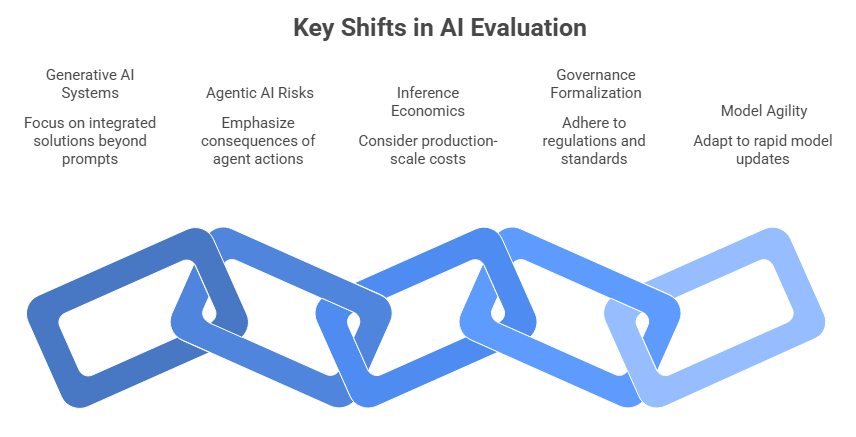
- Generative AI is a systems problem: Useful LLM applications depend on retrieval (RAG), evaluation harnesses, guardrails, and integration with existing data, not just prompts against a model API.
- Agentic AI raises the cost of error: When an agent calls tools, updates records, or triggers payments, a failure is a wrong action rather than a wrong sentence. Permissions, approval thresholds, and audit trails become design requirements.
- Inference economics matter: Usage-based model costs that look trivial in a pilot can become a material line item at production volume.
- Governance expectations are formalizing: The EU AI Act is phasing in, and frameworks such as the NIST AI Risk Management Framework and ISO/IEC 42001 are increasingly referenced in procurement and audits.
- Models change quickly: Providers update and retire models, so an architecture locked to a single model creates future rework.
Before You Talk to Vendors: Define What “Good” Looks Like
You cannot evaluate a vendor against an undefined problem. Before issuing an RFI, document the target use case, the business metric it should move (cost per resolved support ticket, claims cycle time), the data sources and their quality, integration points, regulatory constraints, and who will own the system internally.
This step also tells you what kind of partner you need. If your roadmap is still forming, an AI strategy and consulting engagement may need to come before a build partner. Leaders who need to frame the decision for their board can start with this overview of an enterprise AI consulting framework. If the use case is already clear, you can move straight to scoping.
The CTO’s AI Vendor Scorecard
Score each vendor from 1 to 5 on every criterion, multiply by the weight, and total out of 100. Adjust the weights to your context. A regulated healthcare buyer will weight security and governance more heavily than a team building an internal productivity tool.
| Criterion | Weight | What to verify | Red flag |
|---|---|---|---|
| AI/ML and technical depth | 15 | Experience across ML, LLMs, RAG, and agents; architecture choices explained with trade-offs | Every problem gets the same tool or model |
| Production readiness and scalability | 15 | MLOps, observability, load testing, cost per transaction at volume | Only prototypes and demos to show |
| Data security and privacy | 15 | Data handling, retention, regional hosting, access controls, certifications backed by evidence | Vague answers on whether client data trains third-party models |
| AI governance and responsible AI | 10 | Evaluation, bias and safety testing, human oversight, alignment with NIST AI RMF or ISO/IEC 42001 | Governance treated as a post-launch task |
| Industry and domain experience | 10 | Delivered work in your sector and regulatory context | Generic case studies with no measurable outcomes |
| Delivery methodology | 10 | Stage gates from discovery to production; pilot success criteria defined upfront | Fixed timelines promised before reviewing your data |
| Pricing and total cost | 10 | Build, inference, infrastructure, and maintenance estimates; IP ownership | Low build price with no run-cost model |
| Team and communication | 5 | Named senior engineers, escalation paths, reporting cadence | Team unnamed or swapped after signing |
| Post-launch support | 5 | Monitoring, retraining, SLAs, regression testing on model updates | Support ends at handover |
| Proof of past work | 5 | Referenceable production clients with before-and-after metrics | References unavailable or limited to pilots |
Proof of past work carries a low weight here because it also validates every other row. Ask for evidence behind each score.
Where Vendors Actually Differ
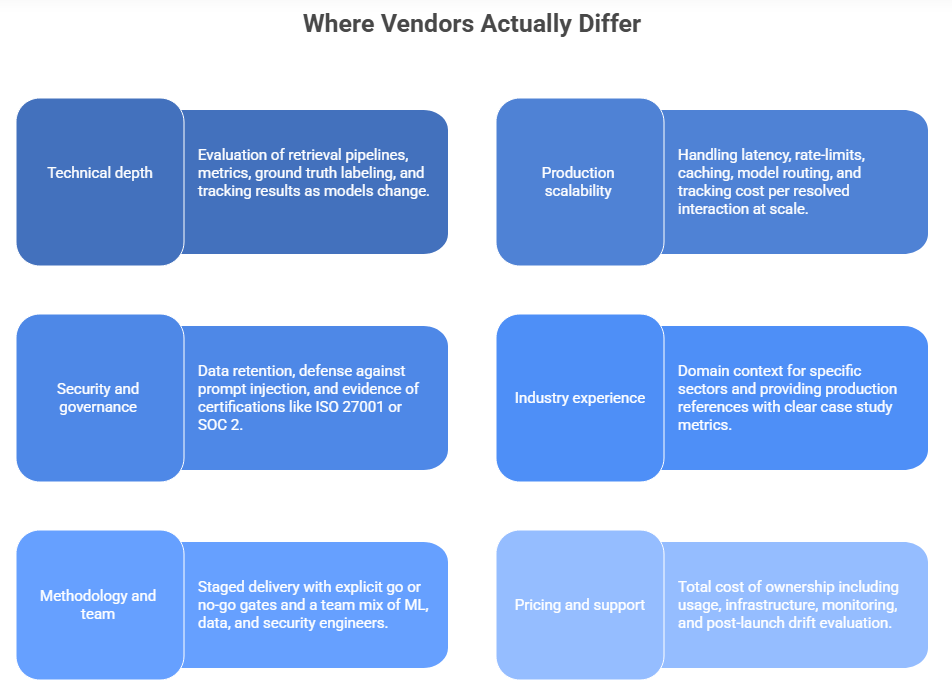
Technical depth beyond the model API
Anyone can wrap an API call. Ask how the vendor would evaluate a retrieval pipeline for a contract-review assistant: which test set, which metrics, who labels the ground truth, and how results are tracked as prompts and models change. Credible teams doing generative AI development talk about measurement, not just outputs. They can also explain when classical machine learning or a smaller model is a better fit than a large LLM.
Production scalability and cost
A support copilot handling a few hundred conversations in a pilot behaves differently at tens of thousands a month. Ask about latency targets, rate-limit handling, caching, model routing, and how the vendor tracks cost per resolved interaction. Request an inference cost projection at ten times your pilot volume. A vendor who cannot produce one has probably not run these systems in production. For background on the stack decisions involved, see this guide to AI app development tools and technologies.
Security, privacy, and governance
Treat this as an architecture question, not a compliance checkbox:
- Where does your data go, how long is it retained, and is it ever used to train third-party models?
- How does the vendor defend against prompt injection and data leakage, risks catalogued in the OWASP Top 10 for LLM Applications?
- Can they show evidence of certifications such as ISO 27001 or SOC 2, rather than a logo on a slide?
For agentic AI development, ask how agent permissions are scoped. A refund agent, for example, might auto-approve small amounts, route larger ones to a human, and log every action. Public-sector buyers should also confirm experience with frameworks such as FedRAMP and FISMA, as covered in App Maisters AI services for government agencies.
Responsible AI should appear in the delivery plan itself: documented model behavior, bias and safety testing, human-in-the-loop checkpoints, and an incident response process.
Industry experience and proof of work
Domain context reduces rework. A team that has handled protected health information understands why a clinical assistant needs different retention and logging rules than a retail recommender. Ask for two or three production references, and ask what went wrong and how it was resolved. Good case studies state the baseline, the metric, and the timeframe. This piece on industry-specific AI applications explains why sector context affects both accuracy and compliance.
Methodology, team, and communication
Prefer staged delivery: discovery and data assessment, a proof of concept with predefined success criteria, an MVP, then production hardening. Each gate should end in an explicit go or no-go decision. Ask who will actually do the work, review their profiles, and confirm the mix of ML engineers, data engineers, and security expertise. Slow, unclear communication during sales and discovery is a reliable predictor of delivery friction.
Pricing and post-launch support
Compare total cost of ownership, not build price. Estimates should include model usage, infrastructure, monitoring, and ongoing evaluation and retraining. Confirm IP ownership, code and data portability, and exit terms. Time-and-materials suits exploratory work, while milestone-based pricing suits well-scoped builds.
After launch, ask who monitors drift, who reruns evaluations when a model provider ships an update, and what the SLA covers. Define ROI metrics before launch; this guide to generative AI strategy and enterprise ROI explains how.
Red Flags to Screen Out Early
- Guaranteed accuracy or ROI before reviewing your data
- No evaluation methodology beyond “we test it manually”
- Demos built on public data with no path to your environment
- Reluctance to discuss failed projects or system limitations
- Lock-in to a single model or platform presented as a benefit
Turning the Scorecard Into a Shortlist
- Issue a short RFI to six to eight vendors, built from the scorecard questions.
- Score the written responses and cut the list to three.
- Run a working session on your real use case, with your architects and security team in the room.
- Fund a paid discovery or pilot with two finalists, with success criteria agreed in advance.
Where App Maisters Fits
App Maisters delivers AI/ML development across strategy, custom models, generative AI, and agentic systems, with consulting and engineering under one roof. The company holds ISO 27001 and ISO 9001 certifications. It expects to be evaluated against a scorecard like this one, including references and production evidence.
Final Thoughts
Choosing an AI development company in 2026 comes down to evidence. Define the problem first, then score vendors on ten weighted criteria. Probe the areas where credible teams differ from polished ones: evaluation, production cost, security, and governance. Validate the finalists with a paid pilot rather than a demo.
A practical next step is to pick one high-value use case, send the scorecard questions to three vendors, and compare their written answers within two weeks. If you want a second opinion on scoping or readiness, the team behind App Maisters AI development services can help you pressure-test the plan.
FAQs
How do I choose an AI development company for my business?
Score shortlisted vendors on weighted criteria (technical depth, production readiness, security, governance, and proof of past work), then validate the top two with a paid pilot. App Maisters begins with AI/ML strategy consulting to align the project with your business goals before any build starts, so you can judge its approach on your real use case.
What questions should I ask an AI development company before signing?
Ask how they measure model accuracy, where your data is stored and whether it trains third-party models, what inference costs look like at production volume, and which live deployments you can reference. App Maisters is open to this kind of scrutiny and holds ISO 27001 and ISO 9001 certifications you can verify.
How much does enterprise AI development cost?
Cost depends on scope, data readiness, and integration needs, so treat any fixed quote issued before discovery with caution. App Maisters scopes each engagement around your highest-value use case first, which keeps the initial budget contained and lets you see results before expanding.
What is the difference between AI consulting and AI development?
AI consulting covers readiness assessment, use case prioritization, and roadmap design, while AI development builds, integrates, and maintains the solution. App Maisters delivers both, so the team that defines your AI strategy is the one that engineers and supports it.
Can an AI development company integrate generative AI, LLMs, and AI agents with our existing systems?
Yes, provided the vendor designs for integration from the start rather than bolting it on. App Maisters builds generative AI and agentic AI solutions to connect with existing CRMs, ERPs, cloud services, and internal APIs, whether your environment is cloud-based or on-premises.
How do AI development companies handle data security and responsible AI?
A credible partner documents data handling, access controls, and retention, and builds governance into delivery instead of adding it after launch. App Maisters works under ISO 27001-certified processes, and for public-sector clients it aligns AI solutions with frameworks such as the NIST AI Risk Management Framework, FedRAMP, and FISMA.
How long does it take to move an AI project from proof of concept to production?
Timelines depend on data quality, integration depth, and compliance requirements, so a serious vendor will not commit to dates before reviewing your data. App Maisters uses agile, staged delivery, moving from proof of concept to a production system in phases with defined success criteria, and continues with monitoring and optimization after launch.