


How Implementing a Generative AI Strategy Can Improve Enterprise ROI
Generative AI has crossed the line from boardroom buzzword to business baseline. By 2026, 88% of organizations report regular AI use in at least one business function, up from 78% a year earlier, according to McKinsey’s State of AI research. U.S. enterprises are now projecting average AI spending of around $207 million over the next 12 months nearly double the prior year, per KPMG’s Q1 2026 AI Pulse. Yet here’s the uncomfortable truth most vendors won’t tell you: a widely cited MIT study found that roughly 95% of enterprise generative AI pilots delivered zero measurable P&L return.
So what separates the companies multiplying their money from the ones quietly writing it off? It isn’t a bigger model or a fatter budget. It’s strategy. This guide breaks down how a deliberate approach to generative AI development can turn experimental spend into durable, measurable enterprise ROI in 2026.
The ROI Gap Is Real and It’s Strategic, Not Technical
Let’s start with the numbers, because they tell a story of two very different outcomes.
On the optimistic side, McKinsey now reports an average 5.8x ROI on AI investment within 14 months of production deployment. The enterprises seeing 171%+ returns share a consistent operating model built around governance and clear ownership. Organizations using centralized or hub-and-spoke AI operating models report around 36% higher AI ROI than those running decentralized, scattered efforts.
On the cautionary side, more than 80% of organizations still report no measurable EBIT impact from generative AI, and Gartner warns that over 40% of agentic AI projects are at risk of cancellation by 2027 due to unclear value and runaway costs. The gap between these two groups is striking and almost never about the technology itself.
Research consistently points to the same culprits: unclear ownership, weak data foundations, and pilots launched with no defined success metrics. Tellingly, 52% of enterprises cite data quality as the single biggest blocker to deployment. In short, AI transformation is a strategy problem wearing a technology costume.
App Maisters specializes in AI Transformation for mid-market and enterprise organizations. Our experienced consultants help you close the data, governance, and ownership gaps that quietly sink most AI pilots so your investment lands on the right side of the ROI divide.
Why a Generative AI Strategy Beats Scattered Experiments
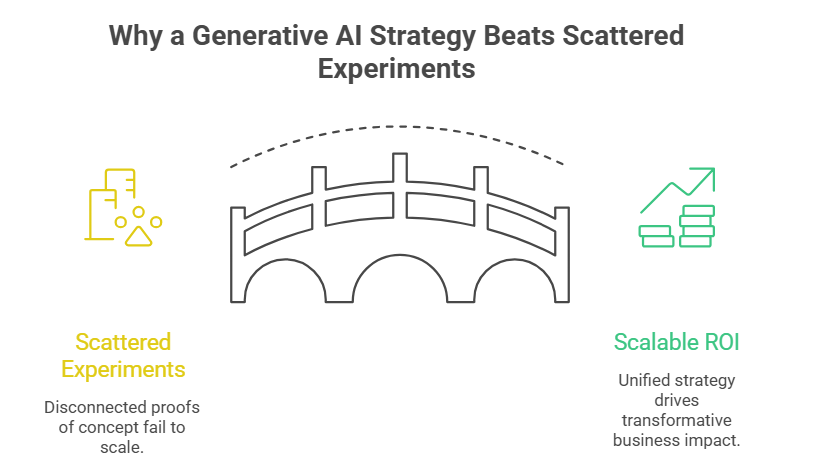
The instinct for many companies is to “try AI” spin up a chatbot here, a content generator there, a coding assistant for the dev team. These disconnected proofs of concept feel productive, but they rarely scale. They produce demos, not dollars. In fact, while 62% of organizations are experimenting with AI agents, fewer than 10% are actually scaling them.
A coherent AI business strategy changes the math in three ways:
It prioritizes high-value use cases
Instead of chasing novelty, strategic enterprises map AI to functions where it compounds customer intelligence, contact center automation, marketing, and knowledge management. Deloitte’s 2026 research (surveying 3,235 leaders) found that organizations redesigning core processes around AI capture transformative impact, while the third applying AI only at the surface level see little change.
It assigns business ownership
The most successful programs put outcome metrics in the hands of business owners not just IT. CFO-ready initiatives track token costs, inference spend, automation yield, and hard financial KPIs from day one. Notably, by 2026, 70% of large-company CEOs will focus AI ROI on growth, not just cost savings a sign the conversation has matured from efficiency to value creation.
It builds on a solid data foundation
A robust, AI-ready data layer is repeatedly cited as the cornerstone of successful enterprise AI implementation. With 72% of CEOs identifying integrated enterprise data architecture as their top infrastructure need, the prepared minority pulls decisively ahead.
App Maisters helps mid-market and enterprise organizations move from scattered experiments to a unified AI business strategy prioritizing high-value use cases, assigning clear ownership, and building the data foundation that turns pilots into production wins.
Where Generative AI Actually Moves the ROI Needle
When AI for enterprises is deployed with intent, the value shows up across four concrete levers:
- Labor cost reduction: Automating repetitive, unstructured workflows can cut process costs by 40–70%, according to 2025–2026 enterprise deployment data.
- Knowledge worker productivity: AI efficiency tools boost output 30–60% for tasks like drafting, research, summarization, and analysis and tools like AI coding assistants are already reshaping how software gets built. (See our deep dive on generative AI for automated software development.)
- Quality improvements: AI-assisted review and error detection can reduce defects by 20–40%, lowering rework and compliance risk.
- Revenue acceleration: Sales and marketing use cases personalized outreach, lead scoring, content generation drive 10–30% revenue lift in well-executed programs.
App Maisters experienced consultants implement predictive analytics tools and machine learning solutions across these value levers from cost-cutting automation to revenue-accelerating personalization so growth is measurable and risk stays minimized.
The Agentic Shift: Why Strategy Matters More Than Ever in 2026
If 2024 was about generative AI and 2025 about scaling it, 2026 is the year of agentic AI systems that don’t just generate content but reason through tasks, call enterprise APIs, and execute supervised workflows across CRM, ERP, and data platforms.
The trajectory is steep. Gartner forecasts that 40% of enterprise applications will embed task-specific AI agents by the end of 2026, up from less than 5% in 2025. Around 51% of enterprises already run AI agents in production, and Microsoft projects 1.3 billion AI agents operating across the global economy by 2028. The enterprise agentic AI market alone is projected to grow from $2.58 billion in 2024 to $24.5 billion by 2030.
But here’s the governance gap that should sober every executive: only about 21% of organizations have a mature model for overseeing autonomous AI agents, even as 73% of leaders flag security and data privacy as top concerns and 1 in 8 enterprise data breaches are now linked to AI agent activity. This is exactly why agentic AI development must be strategy-led. As autonomy increases, the cost of ungoverned deployment rises with it. A strategy that builds in oversight, model routing for cost control, and clear human-in-the-loop checkpoints isn’t bureaucratic friction it’s the thing that keeps AI-powered innovation from becoming a liability.
App Maisters builds scalable, governed agentic AI systems for mid-market and enterprise organizations pairing autonomous workflows with the oversight, security, and human-in-the-loop controls that let you scale without the risk.
A Practical Blueprint for AI-Driven ROI
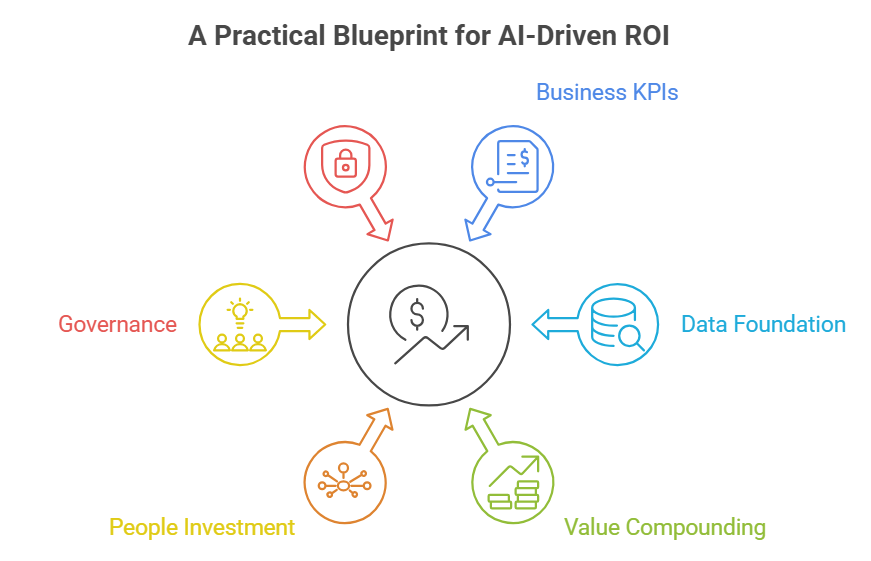
Drawing on the patterns that separate winners from the 95%, a high-ROI generative AI strategy follows a clear sequence:
- Tie every initiative to a business KPI: Define success metrics and secure executive sponsorship before a single line of code is written. Initiatives linked to measurable outcomes are far more likely to win sustained funding.
- Fix your data foundation first: Clean, accessible, governed data is the multiplier behind every successful deployment and the top blocker when neglected.
- Start where value compounds: Pick a focused set of high-impact use cases rather than spreading thin across novelty projects.
- Choose a centralized operating model: Hub-and-spoke structures deliver roughly 36% higher ROI than decentralized free-for-alls.
- Invest in people: The AI skills gap remains the single biggest barrier to integration — upskilling and workflow redesign are not optional.
- Govern from the start: Build in monitoring, cost controls, and accountability so AI scales safely instead of stalling.
App Maisters turns this blueprint into a concrete roadmap from initial AI-readiness assessment and use-case prioritization through deployment, governance, and ongoing optimization tailored to your organization’s AI maturity level.
The Bottom Line
The data is unambiguous: generative AI delivers real, measurable enterprise ROI — but only for organizations that treat it as a strategic discipline rather than a technology experiment. The winners aren’t the ones with the biggest budgets; they’re the ones with clear objectives, AI-ready data, defined ownership, and the right implementation partner.
That last factor is often the difference-maker. Building an effective AI business strategy and executing it through scalable, governed, production-grade systems demands experience most teams are still acquiring. This is where App Maisters comes in. As an ISO-certified technology partner specializing in AI and machine learning consulting, agentic AI development, and enterprise AI implementation, App Maisters helps organizations move from scattered pilots to measurable impact aligning AI-powered innovation with the KPIs that actually drive your bottom line.
The companies that win the next phase of AI transformation won’t be the ones that adopted fastest. They’ll be the ones that adopted smartest. The strategy you build today is the ROI you report tomorrow.
FAQs
How do you measure ROI from generative AI?
Measure both hard ROI (labor cost savings, reduced cycle times, incremental revenue) and soft ROI (faster innovation, better decision quality, improved customer experience) against defined KPIs set before launch. App Maisters helps enterprises map each AI use case to a measurable business metric, so you can prove value to the board instead of relying on hype.
What is a generative AI strategy and why does my business need one?
A generative AI strategy is a deliberate plan that aligns AI initiatives with business goals, assigns ownership, prioritizes high-value use cases, and builds in governance rather than launching scattered pilots. Since fewer than 10% of companies successfully scale their AI experiments, App Maisters’ consultants help mid-market and enterprise organizations build a strategy that actually reaches production.
Why do most enterprise AI projects fail?
Most fail because of unclear ownership, poor data quality, and missing success metrics not because of the technology. With 52% of enterprises citing data quality as their biggest blocker, App Maisters focuses on closing these foundational gaps first to keep your project off the wrong side of the 95% failure rate.
How long does it take to see ROI from AI implementation?
McKinsey reports an average 5.8x return within roughly 14 months of production deployment, though timelines vary by use case and data readiness. App Maisters accelerates time-to-value by prioritizing quick-win use cases while building toward larger transformation goals.
What is the difference between generative AI and agentic AI?
Generative AI creates content and augments human work, while agentic AI autonomously executes multi-step workflows across enterprise systems. As agents move into production, App Maisters builds scalable, governed agentic AI systems with the oversight and human-in-the-loop controls enterprises need to scale safely.
How can enterprises improve AI adoption across teams?
Adoption improves when employees see tangible benefits, leadership defines clear metrics, and workflows are redesigned around AI rather than bolted on. App Maisters supports AI adoption in companies through change management, upskilling, and establishing AI Centers of Excellence tailored to your organization’s maturity level.
Which industries benefit most from AI transformation?
Technology and financial services lead adoption, while manufacturing, healthcare, and government are accelerating fastest. As an ISO-certified and SBA 8(a)-certified partner, App Maisters delivers AI transformation across both commercial and public-sector organizations, with solutions tailored to each industry’s compliance and ROI requirements.