


Enterprise AI Consulting Framework: A Guide for Board-Level Leaders
Artificial intelligence is no longer a technology initiative. It is a boardroom imperative.
According to McKinsey’s Global AI Survey, 72% of organizations have adopted AI in at least one business function up from 55% just two years prior. Yet despite the pace of adoption, a striking gap remains: the majority of enterprises deploying AI have yet to realize sustainable, connecting AI investments to measurable ROI. Pilots succeed. Enterprise transformation stalls.
The reason is rarely the technology. It is the absence of a structured, governance-grade enterprise AI consulting framework one that connects AI investments directly to strategic business outcomes, manages organizational risk, and drives measurable performance at scale.
This guide outlines what that framework looks like.
What Is an Enterprise AI Consulting Framework?
An enterprise AI consulting framework is a structured methodology that guides organizations through the end-to-end lifecycle of AI adoption from strategic alignment and readiness assessment through to implementation, governance, and continuous optimization.
Unlike point solutions or departmental AI tools, a board-grade framework operates across three dimensions simultaneously:
- Strategic: aligning AI investments with corporate objectives and shareholder value
- Operational: embedding AI capabilities into core business processes
- Governance: establishing accountability, risk controls, ethical standards, and compliance guardrails
For board-level leaders, the framework serves as both a decision-making tool and a performance management system enabling them to evaluate AI investments with the same rigor applied to capital expenditure, M&A, or market expansion.
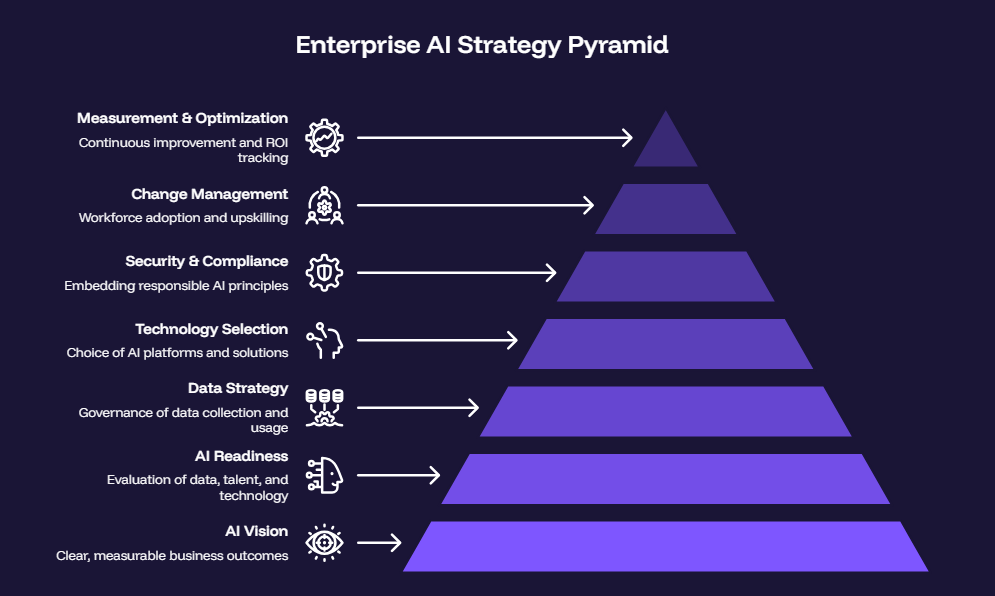
The 7 Core Pillars of a Successful Enterprise AI Strategy
1. AI Vision & Business Alignment
Every successful enterprise AI initiative begins with a clearly articulated vision that is tied to measurable business outcomes. This means moving beyond aspirational language (“we want to be AI-driven”) to specific, time-bound strategic objectives: reducing operational costs by 20% within 18 months, improving customer retention by 15 points, or cutting time-to-decision by half.
Board members should ensure AI initiatives are anchored to the enterprise’s core value drivers not adopted in isolation as technology experiments.
2. AI Readiness Assessment
Before committing capital, organizations must conduct a rigorous AI readiness assessment that evaluates data infrastructure maturity, talent capabilities, technology stack compatibility, and organizational change capacity. Gartner research indicates that over 85% of AI projects fail to move from pilot to production and inadequate readiness assessment is among the primary contributing factors.
3. Data Strategy & Governance
AI is only as strong as the data that powers it. Enterprises that attempt to implement AI without first addressing data quality, data architecture, and data governance consistently underperform. A robust enterprise AI and analytics services defines how data is collected, stored, labeled, accessed, and governed ensuring AI systems are trained on accurate, representative, and compliant datasets.
4. AI Technology Selection
The proliferation of AI platforms, foundation models, and vendor solutions has made technology selection increasingly complex. Board leaders must understand the trade-offs between build vs. buy, open-source vs. proprietary, and cloud-native vs. on-premise deployments. Technology decisions should be driven by business requirements, integration complexity, scalability, and total cost of ownership not vendor marketing.
5. Security, Compliance & Responsible AI
Enterprise AI introduces a new class of organizational risk: model bias, data privacy exposure, adversarial vulnerabilities, regulatory non-compliance, and reputational damage from AI-driven decisions. With the EU AI Act now in effect and regulatory frameworks evolving rapidly across the US, UK, and Asia-Pacific, compliance is no longer optional. Responsible AI principles transparency, fairness, accountability, and explain ability must be embedded into AI systems from the outset.
6. Change Management & Workforce Adoption
Technology accounts for only a fraction of AI transformation success. The human dimension how employees adapt, adopt, and augment their work with AI determines whether enterprise value is actually realized. Leaders must invest in structured change management programs that address workforce upskilling, role redefinition, cultural readiness, and trust-building around AI-assisted decision-making.
7. Measurement, ROI & Continuous Optimization
AI deployments must be treated as ongoing investments, not one-time implementations. Establishing clear KPIs, model performance benchmarks, and business impact metrics from day one enables boards to make evidence-based decisions about where to scale, where to pivot, and where to exit. Continuous optimization through retraining, model monitoring, and process refinement ensures AI systems remain accurate and effective as business conditions evolve.
A Step-by-Step Enterprise AI Consulting Framework for Board-Level Leaders
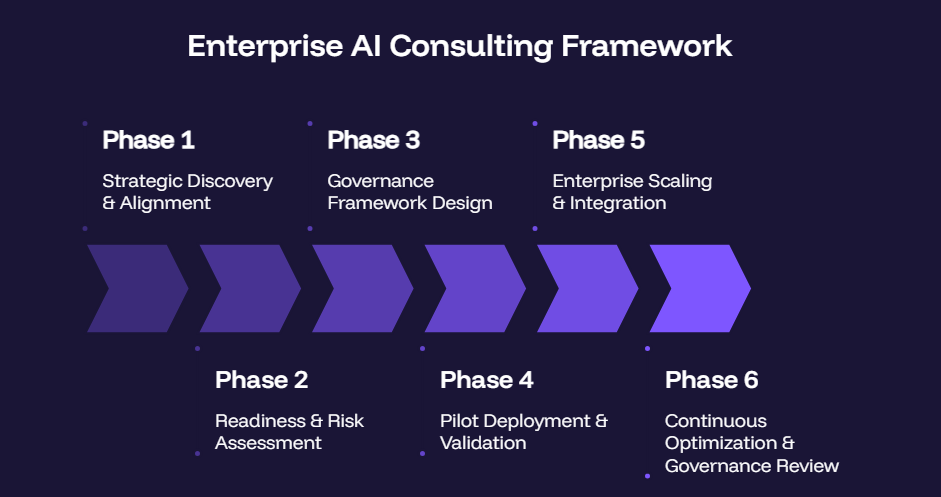
- Phase 1: Strategic Discovery & Alignment Define the enterprise AI vision, identify high-value use cases, and secure board-level sponsorship. Map AI opportunities to P&L drivers and prioritize initiatives by impact and feasibility.
- Phase 2: Readiness & Risk Assessment Conduct comprehensive audits of data infrastructure, technology architecture, talent capabilities, and regulatory exposure. Identify critical gaps and prioritize remediation pathways.
- Phase 3: Governance Framework Design Establish an AI governance structure including roles, accountability frameworks, ethical guidelines, compliance protocols, and risk management processes. Define escalation paths for AI-related incidents.
- Phase 4: Pilot Deployment & Validation Design and deploy controlled AI pilots within high-impact business domains. Establish baseline metrics, capture performance data, and validate ROI assumptions before scaling.
- Phase 5: Enterprise Scaling & Integration Scale validated AI capabilities across business units, integrate with enterprise systems, and operationalize change management programs to drive workforce adoption.
- Phase 6: Continuous Optimization & Governance Review Monitor AI performance, conduct regular model audits, respond to regulatory changes, and refine strategies based on evolving business intelligence.
Common AI Adoption Mistakes That Cost Enterprises Millions
The path to enterprise AI transformation is littered with avoidable failures. The most costly mistakes board leaders should guard against include:
- Investing in AI before addressing data quality: AI models trained on incomplete, inconsistent, or biased data deliver unreliable outputs and often introduce liability.
- Running pilots without scale-readiness planning. A successful proof of concept does not automatically translate to enterprise deployment. Organizations that fail to plan for integration complexity, change management, and infrastructure scaling regularly abandon investments after pilot stage.
- Underinvesting in AI governance: AI systems operating without oversight frameworks expose organizations to regulatory penalties, reputational damage, and erosion of stakeholder trust. The average cost of an AI-related compliance failure now exceeds $5 million per incident.
- Measuring AI by activity, not outcomes: Tracking model accuracy rather than business impact leads to AI investments that perform well in testing but deliver negligible enterprise value.
- Treating AI as an IT project: AI transformation requires C-suite and board ownership. Organizations that delegate AI strategy entirely to IT functions consistently fail to achieve strategic integration.
How Board Members Can Evaluate AI Investments Effectively
Board members need a sharper lens for evaluating AI proposals than traditional capital investment frameworks provide. Key questions to bring to every AI investment discussion:
- What specific business outcome is this AI initiative designed to improve, and by how much?
- What is the total cost of ownership over a three-to-five-year horizon, including data infrastructure, talent, and ongoing model maintenance?
- How will we measure success at 90 days, 12 months, and 36 months?
- What are the primary risk vectors technical, regulatory, operational, and reputational — and how are they being mitigated?
- Is our organization’s data infrastructure capable of supporting this initiative at the required scale?
- What governance structures will oversee this system’s decisions?
Boards that apply this evaluative rigor consistently report higher AI ROI and lower implementation failure rates than those that approve AI investments based on market trends or competitive pressure alone.
Enterprise AI Governance Model: Roles and Responsibilities
Effective AI governance requires clear ownership across the organization:
Role | Responsibility |
Board AI Committee | Oversee AI strategy, ethics, and enterprise risk |
Chief AI Officer / CTO | Lead AI strategy, architecture, and technology decisions |
Chief Data Officer | Govern data quality, access, privacy, and compliance |
Chief Risk Officer | Manage AI-related regulatory and operational risk |
Business Unit Leaders | Champion AI adoption and own functional outcomes |
AI Ethics Council | Review model decisions for bias, fairness, and explain ability |
Organizations without a defined AI governance structure are not merely underprepared they are exposed. As regulatory scrutiny of AI intensifies globally, the absence of a governance model is itself a material business risk.
Measuring ROI from Enterprise AI Initiatives
Board leaders must demand quantifiable ROI frameworks before approving AI investments. A rigorous enterprise AI ROI model captures value across four dimensions:
- Cost Reduction: Direct savings from automation, process optimization, and resource efficiency. Quantifiable in labor hours, operational spend, and error rate reduction.
- Revenue Growth: AI-driven improvements in customer acquisition, conversion, retention, and lifetime value. Measurable through revenue attribution modeling.
- Risk Mitigation: Reduction in compliance penalties, fraud losses, cybersecurity incidents, and supply chain disruptions. Quantified through loss avoidance modeling.
- Strategic Optionality: Long-term competitive positioning, speed-to-market, and data asset value creation. Evaluated through scenario modeling and market share analysis.
Why Partnering with an Enterprise AI Consulting Firm Accelerates Success
The complexity of enterprise AI transformation spanning strategy, data, technology, governance, change management, and compliance is beyond the bandwidth of most internal teams working in isolation.
Enterprise AI consulting firms bring three critical accelerators that internal teams alone cannot replicate:
- Institutional knowledge across industries: Experienced AI consulting partners have implemented solutions across dozens of enterprise environments, giving them pattern recognition that shortens the path from strategy to scaled deployment.
- Pre-built frameworks and governance methodologies: Rather than building assessment, architecture, and governance frameworks from scratch, enterprises benefit from battle-tested methodologies refined through hundreds of real-world implementations.
- Vendor neutrality and technology objectivity: Independent AI consultants evaluate technology options based on client fit rather than vendor relationships ensuring technology decisions serve the enterprise’s long-term interests.
The ROI of effective AI consulting is not simply the value of the AI itself it is the acceleration of time-to-value, the avoidance of costly mistakes, and the establishment of governance structures that make AI outcomes durable.
Why App Maisters Is the Strategic Enterprise AI Consulting Partner for Modern Enterprises
App Maisters brings together enterprise AI strategy, technology implementation, and governance expertise under a single, integrated consulting framework purpose-built for board-level accountability.
Our enterprise AI consulting practice is defined by four foundational commitments:
- Outcome-First Methodology: Every engagement begins with a clear definition of business outcomes and a measurable ROI framework. We hold ourselves accountable to results, not deliverables.
- End-to-End Capability: From AI readiness assessment and data strategy through to implementation, change management, and ongoing optimization, App Maisters provides continuity across the entire AI transformation lifecycle eliminating the coordination risk that undermines multi-vendor engagements.
- Governance-Grade Rigor: Our AI governance frameworks are designed to satisfy the oversight requirements of boards, audit committees, and regulators not simply to satisfy a project checklist. We embed responsible AI principles, bias auditing, and compliance controls into every solution we build.
- Enterprise-Scale Experience: App Maisters has delivered AI transformation across financial services, healthcare, retail, manufacturing, and logistics with a proven track record of scaling pilots into enterprise-wide programs that generate sustained business value.
For board members and C-suite leaders seeking a consulting partner who speaks the language of business outcomes, shareholder value, and enterprise risk App Maisters is that partnera.
Final Thoughts and Executive Takeaways
Enterprise AI transformation is the defining strategic challenge of this decade and the boardrooms that treat it with the gravity it deserves will be the ones that pull ahead. The technology itself is no longer the differentiator. Strategy, governance, and disciplined execution are.
The organizations that will win are not necessarily those with the largest AI budgets. They are the ones that align AI investments to business outcomes from day one, build governance structures that earn regulatory and stakeholder trust, and measure performance with the same rigor they apply to any major capital program. AI adoption without that foundation is not a competitive advantage it is a liability in motion.
The path from AI ambition to enterprise value is neither short nor simple. But it is navigable for organizations willing to invest in the right framework, the right governance, and the right partners. The enterprises doing this well today are not reacting to the AI moment. They are defining it.
Ready to Build an Enterprise AI Strategy That Performs at the Board Level?
Whether you are evaluating your organization’s AI readiness, designing a governance framework, scaling an existing AI program, or seeking an independent strategic review of your current AI investments our team is ready to engage at the level your enterprise demands.
FAQs
What does an enterprise AI consulting framework actually include?
It is a structured methodology covering AI strategy, data governance, technology selection, security, change management, and ROI measurement. App Maisters designs these frameworks specifically for board-level accountability not just technical delivery.
How do board members evaluate whether an AI investment is worth approving?
App Maisters recommends evaluating AI investments across four dimensions: cost reduction, revenue growth, risk mitigation, and strategic optionality with clearly defined success metrics at 90 days, 12 months, and 36 months before any approval is granted.
Why do most enterprise AI pilots fail to scale into production?
The failure is rarely the technology it is the absence of governance, data readiness, and change management. App Maisters embeds scalability planning and stakeholder alignment from day one, not as afterthoughts at the end of a pilot.
What is responsible AI, and why does it matter at the board level?
Responsible AI ensures systems operate transparently, fairly, and in regulatory compliance. For boards, it is a risk management imperative. App Maisters builds transparency, fairness, and explainability directly into every solution not as a policy layer added after deployment.
How long does enterprise AI implementation typically take?
App Maisters follows a phased approach: readiness assessment in weeks one through eight, pilot deployment in months two through six, and enterprise-wide scaling from month six through eighteen. Organizations with stronger data foundations and executive sponsorship consistently move faster.
What should enterprises look for when selecting an AI consulting partner?
Prioritize delivery methodology, governance expertise, and proven outcomes in live enterprise environments not brand size. App Maisters offers outcome-first engagements with end-to-end continuity across strategy, implementation, and ongoing optimization.
How is AI governance different from general IT governance?
IT governance manages system reliability and security. AI governance adds accountability for how systems learn, decide, and impact people. App Maisters designs governance models that address bias auditing, explainability, and regulatory compliance built to scale as AI regulations continue to evolve.