


AI-Powered Predictive Maintenance Apps for Oil & Gas
Oil and gas companies manage highly complex assets operating under extreme pressure, temperature, vibration, and environmental conditions. Pumps, compressors, drilling systems, pipelines, turbines, storage facilities, and refinery equipment must perform reliably because a single critical failure can interrupt production, increase safety risks, and trigger substantial repair costs.
Traditional maintenance models are often insufficient. Reactive maintenance addresses equipment only after failure, while schedule-based preventive maintenance may replace components prematurely or miss faults developing between inspections.
AI predictive maintenance provides a more precise alternative. By combining artificial intelligence, machine learning, IoT sensors, operational data, and mobile applications, companies can monitor asset health continuously, detect early signs of deterioration, and schedule maintenance before failures disrupt operations.
McKinsey estimates that condition-based maintenance programs for offshore and surface equipment can reduce unplanned downtime by 20% to 30%. This makes predictive maintenance in oil and gas a strategic investment in asset reliability, safety, and operational efficiency.
What Is AI Predictive Maintenance?
AI predictive maintenance uses real-time and historical equipment data to identify abnormal behavior, estimate failure probability, and determine when maintenance should be performed.
Basic monitoring systems generate alerts when a measurement exceeds a fixed threshold. AI systems go further by examining relationships between multiple variables. For example, a compressor’s temperature and pressure may remain within acceptable limits, but rising vibration, changing discharge pressure, and increasing energy consumption together may indicate bearing or lubrication degradation.
Predictive maintenance apps convert these analytical findings into practical information for engineers and field teams, including:
- Real-time asset-health scores
- Anomaly and failure-risk alerts
- Remaining useful life estimates
- Recommended inspections or maintenance actions
- Digital work orders and technician checklists
- Maintenance histories and engineering records
- Downtime, reliability, and cost dashboards
The application acts as the operational connection between equipment, AI models, maintenance planners, and field technicians.
Why Oil and Gas Companies Need Predictive Maintenance
Expensive Unplanned Downtime
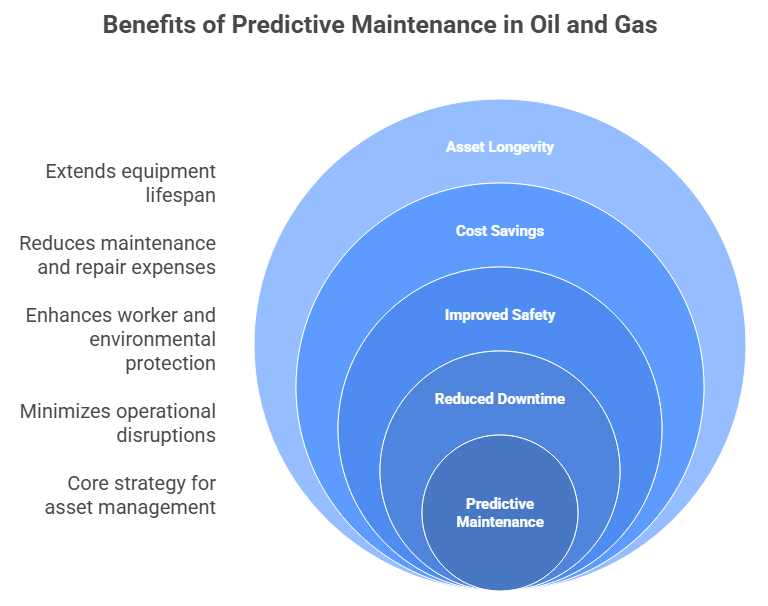
Failure of an offshore compressor, drilling component, or refinery asset can affect an entire production process. McKinsey documented an offshore oil producer whose compressor failures stopped platform operations and cost approximately $1 million to $2 million per day.
Emergency transportation, specialist labor, expedited parts, inspections, and restart procedures increase the total financial impact.
Aging and Distributed Assets
Oil and gas operators frequently manage assets of different ages and manufacturers across offshore platforms, remote fields, pipelines, terminals, and refineries. Operational data may be distributed across SCADA systems, historians, computerized maintenance management systems, spreadsheets, and paper documentation.
An integrated oil and gas asset management solution can bring these sources together and provide a consistent view of equipment condition.
Harsh Operating Environments
Corrosion, sand intrusion, thermal cycling, saltwater exposure, contamination, pressure fluctuations, and constant vibration accelerate equipment degradation. AI models can evaluate how actual operating conditions affect individual assets rather than relying solely on manufacturer-recommended service intervals.
Safety and Environmental Exposure
Failures involving pipelines, valves, pressure vessels, or rotating equipment may cause worker injuries, emissions, leaks, or regulatory violations. Predictive analytics can help identify deterioration earlier, although it must complement not replace required inspection and process-safety programs.
Predictive Maintenance Use Cases Across Oil and Gas
Upstream operators can apply predictive maintenance to equipment used in drilling, well production, and offshore operations.
Important use cases include:
- Electric submersible pumps: Analyze motor current, temperature, pressure, and vibration to detect abnormal loading or pump degradation.
- Drilling equipment: Monitor mud pumps, top drives, draw works, and rotary systems to identify wear before breakdowns delay drilling.
- Compressors and turbines: Detect bearing, rotor, lubrication, and performance problems that could interrupt production.
- Artificial-lift systems: Separate equipment degradation from normal changes in reservoir and production conditions.
- Well integrity: Evaluate pressure, temperature, flow, and intervention history to identify unusual well behavior.
Offline-capable mobile apps for remote oil-field operations can deliver alerts, asset histories, and inspection forms to technicians working in areas with limited connectivity.
Midstream Operations
Pipeline, transportation, and storage companies can use AI predictive maintenance to:
- Monitor pipeline pump and compressor stations
- Detect abnormal pressure and flow patterns
- Assess valves, actuators, meters, and control systems
- Prioritize pipeline segments for corrosion inspection
- Identify possible leakage or equipment degradation
- Predict maintenance needs for terminals and storage assets
Predictive insights should be integrated with existing pipeline integrity, leak detection, and emergency response systems rather than treated as a standalone safety mechanism.
Downstream Operations
Refineries and petrochemical facilities contain interconnected assets where one failure can affect multiple production units. Relevant use cases include:
- Rotating-equipment failure prediction
- Heat-exchanger fouling detection
- Furnace and boiler condition monitoring
- Valve and steam-trap analysis
- Distillation-column anomaly detection
- Corrosion-risk prioritization
- Instrument and sensor fault detection
McKinsey estimates that reliability-related lost-profit opportunities can range from $20 million to $50 million annually for a midsize refinery.
How AI-Powered Predictive Maintenance Apps Work
A predictive maintenance system typically includes six connected stages.
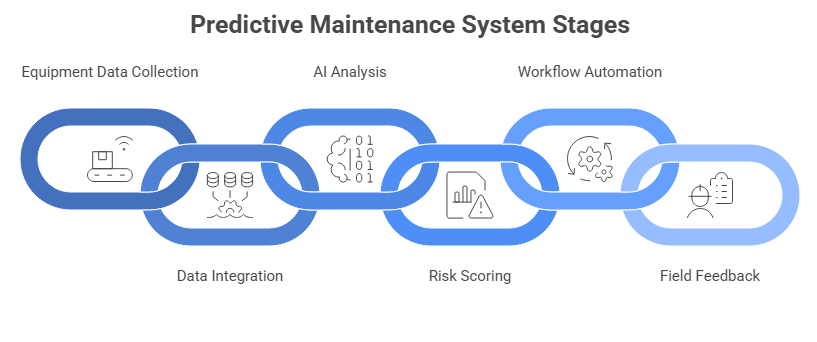
1. Equipment Data Collection
IoT sensors, PLCs, SCADA platforms, distributed control systems, historians, and inspection devices collect information such as vibration, temperature, pressure, flow, acoustic signals, electrical current, and lubricant condition.
2. Data Integration
Sensor readings are connected with asset hierarchies, operating modes, work orders, failure records, production schedules, spare-parts information, and engineering documents. Integration with CMMS, EAM, and ERP systems gives the data operational context.
3. AI and Machine Learning Analysis
Different models support different maintenance objectives:
- Anomaly detection identifies unusual equipment behavior.
- Classification models recognize known failure modes.
- Time-series models forecast changes in performance.
- Remaining useful life models estimate how long an asset can operate.
- Computer vision identifies visible corrosion, cracks, or leaks.
- Natural language processing analyzes technician notes and work orders.
4. Risk Scoring and Explainable Alerts
The system ranks issues using failure probability, asset criticality, operational impact, and model confidence. Alerts should show which readings influenced the prediction so engineers can validate the recommendation.
5. Maintenance Workflow Automation
Once an alert is reviewed, the application can generate a work order, recommend an inspection, identify required skills, check spare-parts availability, and suggest an appropriate maintenance window.
6. Field Feedback
Technicians use the mobile app to review asset history, complete checklists, record measurements, attach photographs, and document confirmed failure causes. This information improves the quality of future predictions.
Essential Features of Predictive Maintenance Apps
An enterprise-grade application should provide:
- Real-time asset monitoring
- Configurable anomaly alerts
- Failure probability and remaining-life estimates
- Role-based access controls
- Offline data collection and synchronization
- GIS-based asset visualization
- Digital inspections and photographic records
- CMMS, EAM, ERP, SCADA, and historian integration
- Automated work-order routing
- Spare-parts visibility
- Model explainability and confidence scores
- Model drift and performance monitoring
- Audit trails and electronic approvals
- Secure APIs for third-party systems
Organizations building connected maintenance platforms can combine custom IoT development services with scalable enterprise application development.
Key Implementation Challenges
Predictive maintenance initiatives often struggle because of incomplete records, inconsistent asset names, poor sensor quality, limited examples of actual failures, legacy-system constraints, and resistance from maintenance personnel.
A practical implementation should begin with a limited number of high-value assets. The company should establish baseline downtime and maintenance costs, evaluate available data, develop and validate the model, integrate alerts into existing workflows, and measure results before expanding.
Human validation remains important. Excessive false alerts can quickly reduce technician confidence, while missed failures can create operational risk. Successful systems combine machine learning with engineering rules and feedback from experienced reliability teams.
ROI and Cost Considerations
The cost of predictive maintenance apps depends on the number of connected assets, sensor readiness, data volume, AI complexity, system integrations, deployment environment, mobile requirements, and cybersecurity controls.
The business case should consider:
- Avoided production losses
- Reduced emergency repairs and overtime
- Lower preventive maintenance costs
- Longer equipment life
- Better spare-parts planning
- Fewer unnecessary inspections
- Improved energy efficiency
- Reduced safety and environmental exposure
ROI should not be measured only by prediction accuracy. Management must determine whether alerts resulted in timely interventions and whether those actions produced measurable operational or financial benefits.
Security and Data Considerations
Connecting industrial assets to cloud and mobile platforms increases the cybersecurity surface. Predictive maintenance architecture should preserve separation between operational technology and enterprise systems through controlled gateways and secure interfaces.
Important controls include encryption, multifactor authentication, role-based permissions, segmented IT and OT networks, secure IoT device provisioning, API security, audit logs, data-retention policies, backups, and incident-response procedures.
Implementations should also align with relevant guidance such as IEC 62443, NIST cybersecurity frameworks, API standards, and company-specific process-safety requirements.
Future of Predictive Maintenance in Oil and Gas
Predictive maintenance is moving toward prescriptive and increasingly autonomous decision support. Edge AI will enable faster analysis at remote sites, while digital twins will provide more accurate simulations of asset behavior.
Drones, robots, thermal cameras, and computer vision will expand automated inspection. Generative AI copilots will help technicians retrieve procedures, summarize maintenance histories, and interpret complex alerts. Prescriptive systems will recommend not only when maintenance is required, but also which technicians, parts, and operating windows are most appropriate.
Building a Scalable Predictive Maintenance Capability
AI-powered predictive maintenance can help oil and gas companies move from reactive and calendar-based maintenance toward continuous, condition-based asset management. Its value depends on combining reliable data, engineering knowledge, AI models, enterprise integration, secure architecture, and practical field applications.
App Maisters supports this transformation through AI development services, IoT integration, enterprise software engineering, and custom mobile app development. The focus is on connecting predictive insights with real maintenance workflows and measurable business outcomes.
The most effective strategy is to begin with a high-impact asset class, demonstrate value through a controlled pilot, and scale only after technical accuracy, user adoption, and operational ROI have been established.
FAQs
What is AI predictive maintenance in oil and gas?
AI predictive maintenance analyzes equipment and IoT sensor data to identify anomalies and predict failures before they occur. App Maisters develops predictive maintenance apps that support proactive oil and gas asset management.
How does predictive maintenance reduce downtime?
Predictive maintenance detects early signs of equipment deterioration, allowing maintenance teams to act before breakdowns interrupt production. App Maisters integrates AI-powered alerts with maintenance workflows and mobile field applications.
Which oil and gas assets can AI monitor?
AI can monitor pumps, compressors, turbines, pipelines, drilling equipment, valves, heat exchangers, and storage assets. App Maisters creates oil and gas asset management software tailored to specific equipment and operating environments.
How is IoT used in predictive maintenance?
IoT sensors continuously capture vibration, temperature, pressure, flow, and equipment-performance data. App Maisters combines IoT predictive maintenance technology with AI analytics, dashboards, and real-time mobile alerts.
What are the benefits of AI predictive maintenance?
Key benefits include reduced downtime, lower maintenance costs, longer asset life, improved safety, and better spare-parts planning. App Maisters helps oil and gas companies translate predictive insights into measurable operational improvements.
How much does a predictive maintenance app cost?
The cost depends on connected assets, IoT sensors, AI model complexity, integrations, security, and mobile requirements. App Maisters evaluates these factors before recommending a scalable predictive maintenance solution and implementation roadmap.
Can predictive maintenance software integrate with existing systems?
Yes. Predictive maintenance software can integrate with SCADA, CMMS, EAM, ERP, historians, and IoT platforms through secure APIs. App Maisters builds enterprise integrations that connect AI insights with existing oil and gas maintenance workflows.