


Top 10 Mobile App Development Trends to Implement in 2026
Do you remember when it was enough to simply launch your app on the Play Store and hope for downloads? Those days are long gone. With over 5 million apps competing today, standing out is no longer about visibility it’s about creating smart, engaging, and memorable experiences.
Most apps fail to retain users. In fact, 90% of mobile apps are used just once and then forgotten. That’s why staying ahead of the latest mobile app development trends for 2026 is essential not just to launch your app but to make it thrive.
Here’s a guide to the top 10 mobile app trends in 2026, complete with actionable steps on how to implement them effectively.
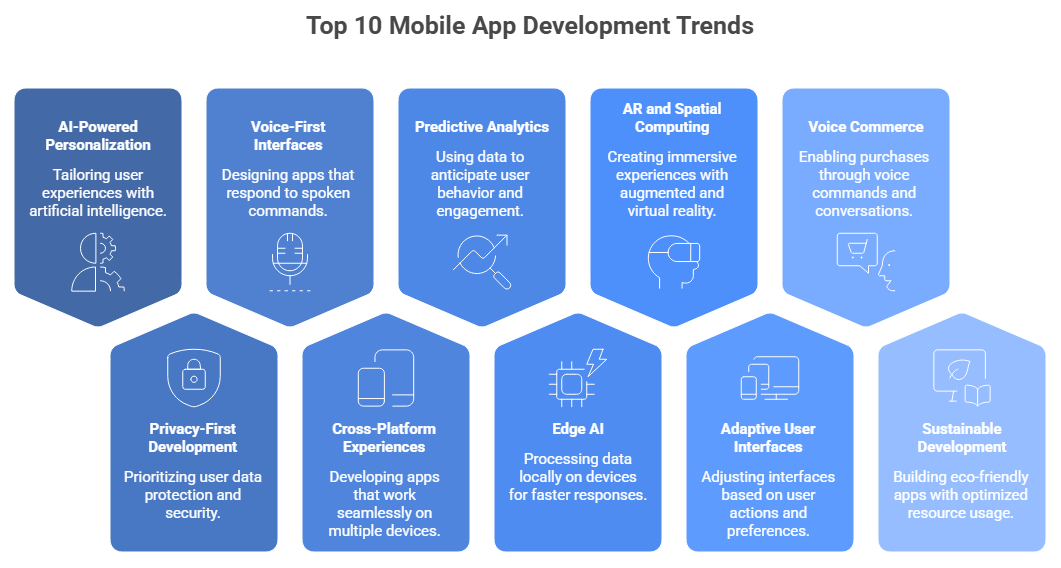
1. AI-Powered Personalization
Generic experiences are dead. AI-driven personalization is no longer optional it’s a requirement. Mobile apps in 2026 are expected to anticipate user behavior, dynamically adjust content, and deliver predictive interactions.
Implementation:
- Integrate AI to tailor home screens, notifications, and recommendations based on user behavior.
- Use machine learning to adjust feature placement or content feeds dynamically.
- Predict churn and re-engage users automatically through smart notifications.
Practical Example: A shopping app recommends products and discounts in real-time, anticipating a user’s preferences before they even browse.
2. Privacy-First Development
Users are more privacy-conscious than ever. Privacy breaches cost trust and in 2026, trust drives retention. Apps that respect user data gain loyalty, while invasive apps get deleted.
Implementation:
- Enable full user control over personal data with clear permissions.
- Collect first-party data only and provide real value in return.
- Include transparent privacy messaging in onboarding, app store listings, and updates.
Practical Example: A fitness app asks permission to use health data solely for workout personalization, not marketing.
3. Voice-First and Conversational Interfaces
Voice interactions and chat-based interfaces are becoming mainstream. Users expect to interact with apps naturally, without navigating endless menus.
Implementation:
- Incorporate voice commands for essential app functions.
- Use natural language processing (NLP) to enable fluid, contextual conversations.
- Combine voice with gestures or AR to enhance accessibility.
Practical Example: A cooking app lets users ask questions and skip steps hands-free while preparing meals.
4. Cross-Platform Experiences
Users move across devices phones, tablets, desktops, wearables. Apps that provide a continuous experience across platforms will dominate in 2026.
Implementation:
- Enable cloud syncing of preferences, data, and app progress.
- Standardize messaging and notifications across devices.
- Develop web versions or lightweight PWAs for universal accessibility.
Practical Example: A note-taking app allows writing on a tablet, editing on a phone, and reviewing on a desktop with no data loss.
5. Predictive Analytics for Engagement
Predictive analytics helps apps understand user intent and intervene proactively to increase engagement and retention.
Implementation:
- Identify users likely to churn and trigger automated retention campaigns.
- Prioritize content or features based on predicted user preferences.
- Track behavioral patterns and adjust user journeys dynamically.
Practical Example: A fitness app suggests workout reminders before a user’s usual exercise time based on past activity.
6. Edge AI for Real-Time Processing
In 2026, Edge AI for Real-Time, meaning apps can process data locally on the device rather than sending everything to the cloud. This improves speed, reduces latency, and enhances privacy.
Implementation:
- Deploy lightweight AI models on devices to analyze user behavior in real-time.
- Use edge AI for instant recommendations, predictive typing, or on-device personalization.
- Reduce dependence on cloud servers for sensitive data, improving privacy and app responsiveness.
Practical Example: A language learning app provides real-time speech analysis and pronunciation feedback without internet delays.
7. Immersive AR and Spatial Computing
Augmented Reality (AR) is evolving into spatial computing, where digital objects interact naturally with the physical world. This creates next-level engagement in gaming, education, retail, and navigation apps.
Implementation:
- Integrate AR for interactive tutorials, product visualization, and immersive storytelling.
- Use spatial anchors and environment mapping for persistent, location-based experiences.
- Combine AR with AI to customize interactions based on user behavior and environment.
Practical Example: A furniture app allows users to place virtual furniture in their room and adjust it using hand gestures detected by the device.
8. Adaptive User Interfaces with Behavioral Intelligence
Static interfaces are no longer enough. In 2026, apps are expected to adapt dynamically to each user’s behavior, context, and accessibility needs.
Implementation:
- Use AI to rearrange features and content based on user habits.
- Adjust layouts for light/dark mode, screen size, and accessibility preferences automatically.
- Apply predictive UX to surface the most-used functions when the user needs them most.
Practical Example: A productivity app hides less-used features and highlights quick-action buttons for tasks users perform most often.
9. Voice Commerce and Conversational Transactions
Voice is not only for navigation it’s becoming a key interface for transactions. Voice-enabled apps reduce friction in shopping, booking, and service apps.
Implementation:
- Integrate secure voice-based authentication for payments and transactions.
- Use conversational AI to guide users through purchases or bookings.
- Combine voice with contextual AI to suggest products or actions based on previous behavior.
Practical Example: A food delivery app lets users place orders, customize meals, and track delivery all through voice commands.
10. Sustainable App Development and Eco-Optimized Apps
Sustainability is becoming a trend in technology, and mobile apps are no exception. Users in 2026 expect apps to consume less energy, reduce data usage, and promote eco-conscious behaviors.
Implementation:
- Optimize background processes to reduce CPU and battery usage.
- Minimize unnecessary animations and heavy media assets to reduce energy consumption.
- Encourage eco-friendly user behaviors, such as route optimization in navigation apps or energy-efficient settings in smart home apps.
Practical Example: A navigation app recommends routes for electric vehicles that minimize energy usage while still being efficient, and tracks carbon savings over time.
Wrapping Up
Mobile app success in 2026 is not about launching and hoping for the best—it’s about smart personalization, immersive experiences, and user-centric design. From AI-driven personalization to community engagement and generative AI, apps must evolve beyond features to anticipate, delight, and retain users.
Partnering with a trusted mobile app development company like App Maisters ensures your app leverages these cutting-edge trends effectively. With expertise in mobile app innovation, cross-platform development, and AI integration, App Maisters transforms ideas into apps that don’t just launch they thrive.
FAQs
What are the top mobile app development trends to implement in 2026 with App Maisters?
App Maisters identifies the latest mobile app development trends for 2026, including AI-powered personalization, cross-platform development, immersive AR experiences, voice-first interfaces, predictive analytics, edge AI, adaptive UI, voice commerce, and sustainable app practices. Implementing these trends ensures apps deliver personalized, engaging, and high-performance user experiences.
How can App Maisters help with AI integration in mobile apps?
App Maisters specializes in integrating AI into mobile apps for predictive personalization, user behavior analysis, and automated decision-making. Their team helps businesses implement AI-driven features that enhance engagement, retention, and overall app performance while keeping user experience seamless.
What is cross-platform app development, and how does App Maisters implement it?
Cross-platform app development allows a single codebase to run seamlessly on iOS, Android, and web platforms. App Maisters leverages frameworks like Flutter and React Native to deliver efficient, cost-effective apps with native-like performance and consistent UI/UX across all devices.
How does App Maisters use AR and immersive technology in mobile apps?
App Maisters implements immersive AR and spatial computing features in mobile apps to enhance engagement and interactivity. From virtual product placement to interactive learning and gamified experiences, they create apps that blend digital and physical worlds for next-level user experiences.
Why is AI personalization important for mobile apps, and how does App Maisters implement it?
AI personalization enables apps to anticipate user needs and dynamically deliver tailored content, notifications, and features. App Maisters implements machine learning and AI algorithms to personalize user journeys, increase engagement, and boost retention by providing relevant, predictive experiences.
How can App Maisters ensure mobile apps are sustainable and eco-friendly?
App Maisters focuses on eco-optimized app development by minimizing energy consumption, optimizing background processes, and reducing data usage. They design apps that are efficient, lightweight, and environmentally conscious, meeting the growing user demand for sustainable digital solutions.
What makes App Maisters the best mobile app development company for implementing 2026 trends?
App Maisters combines expertise in AI, AR/VR, predictive analytics, cross-platform development, and sustainable app design. By following the latest 2026 trends, they help businesses create innovative, high-performing mobile apps that attract users, retain them, and generate measurable ROI.