


How Context-Aware Apps Are Transforming Enterprise Mobility
Enterprise mobility used to be a question of access. Could a field technician pull up a work order on a phone? Could a regional manager approve an invoice from an airport lounge? Those questions have been answered for the better part of a decade. The more interesting question now is a different one: can the application understand the situation the user is in, and adjust itself accordingly?
That shift, from applications that respond to input to applications that respond to circumstance, is what context awareness means in practice. It is one of the quieter but more consequential changes taking place in enterprise software, and it is beginning to separate organizations that have digitized their operations from those that have genuinely improved them.
What Makes an Application Context-Aware
A context-aware application draws on signals about the user’s environment and intent, then uses those signals to shape what it shows, what it recommends, and what it does automatically.
Four categories of input do most of the work:
- Location intelligence: Not just coordinates, but meaning derived from coordinates. Is the user on a client site, in a warehouse aisle, approaching a scheduled stop, or outside an approved geographic boundary? Indoor positioning, geofencing, and route data turn raw location into operational context.
- Sensor and device data: Accelerometers, gyroscopes, cameras, NFC and Bluetooth beacons, barcode and RFID readers, and increasingly the connected equipment around the user, which is where IoT development and mobile application design begin to overlap. A tablet that knows it is mounted in a moving vehicle should not present the same interface it presents at a desk.
- Behavioral and historical data: What this user does at this time of day, in this role, in this part of the workflow. Patterns across a workforce reveal what the next likely action is, and that prediction can be surfaced rather than searched for.
- Real-time analytics and AI: The layer that fuses the rest. Streaming data pipelines and AI models running at the edge or in the cloud interpret combined signals fast enough to matter, which for most field operations means within seconds.
None of these components is new in isolation. What has changed is cost and maturity. Edge inference on commodity devices, cheap sensor hardware, and mature streaming architectures have made continuous context processing economically viable for mid-market organizations, not only for large enterprises with dedicated data engineering teams.
Enterprise Use Cases Where Context Delivers Measurable Value
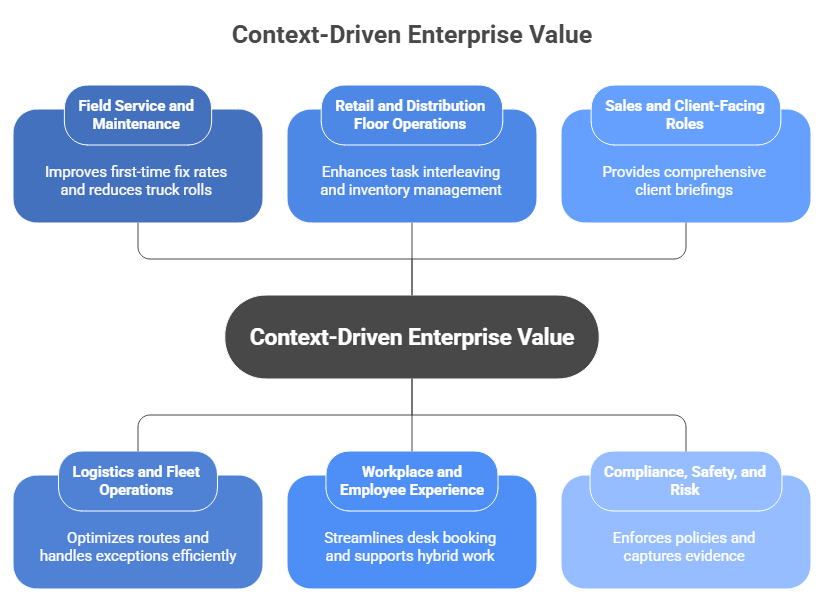
Field Service and Maintenance
Field service is the clearest case because the gap between the office and the job site is where information usually gets lost. A context-aware enterprise mobile application built for field teams can recognize arrival on site, pull the correct asset history without a search, surface the specific safety procedure for that equipment class, and pre-populate the parts list based on the fault code transmitted by the machine itself.
The measurable outcomes are familiar service metrics: first-time fix rate, mean time to repair, and truck rolls avoided. Research from Gartner and other industry analysts has consistently identified first-time fix rate as the single metric most closely tied to field service profitability, because a repeat visit consumes travel, labor, and customer patience simultaneously.
Compression Built Into the Build Pipeline
A model sized for a data center will not fit a mid-range Android phone. Compression is a first-class part of delivery, not a cleanup step. Four techniques carry most of the weight: quantization from FP32 to INT8 or INT4, which commonly yields two to four times faster inference at modest accuracy cost; pruning of low-contribution weights and channels; knowledge distillation of a compact student model from a larger teacher; and selecting mobile-native architectures rather than shrinking an oversized model after the fact. Mature teams track accuracy loss as a documented budget with a hard ceiling, validated on device before release.
Logistics and Fleet Operations
Route guidance that accounts for live traffic, weather, dock availability, and driver hours-of-service constraints produces different decisions than static dispatch. Asset-heavy sectors face the same pattern at larger scale, which is why oil and gas operators increasingly connect field mobility to SCADA and monitoring platforms rather than treating them as separate systems. Context also supports exception handling: an application that detects a delivery running late can notify the recipient, reschedule downstream stops, and flag the pattern for planners without anyone filing a report.
Retail and Distribution Floor Operations
Indoor positioning combined with inventory data allows a store associate’s device to guide them to a specific bay rather than a general aisle. In distribution centers, the same combination supports task interleaving, where the system assigns the next pick based on where the worker already is.
Workplace and Employee Experience
Occupancy sensors, badge data, and calendar context together enable desk and room booking that reflects reality rather than intention. Applications can adjust to hybrid patterns, surface who is on site today, and reduce the low-grade friction that makes returning to an office feel administratively expensive.
Sales and Client-Facing Roles
A representative arriving for a meeting benefits from a briefing assembled from CRM history, recent support tickets, contract renewal dates, and relevant product updates. The value is not the data, which already existed. The value is that no one had to remember to assemble it.
Compliance, Safety, and Risk
Context awareness supports controls that are difficult to enforce through policy alone: restricting access to sensitive records outside approved locations, requiring lone-worker check-ins in high-risk zones, and capturing time-stamped, location-verified evidence of inspection.
The Business Case, Stated Honestly
Context awareness produces value through five mechanisms, and it is worth being specific about each because they are measured differently.
- Productivity improves by removing search, navigation, and data entry from the task. Time studies in operational settings consistently show that a meaningful share of a frontline worker’s shift goes to finding information rather than acting on it, and context-aware design targets precisely that overhead.
- Personalization at enterprise scale means role-appropriate and situation-appropriate interfaces rather than a single application that serves everyone adequately and no one well.
- Operational efficiency shows up in asset utilization, fuel and mileage, inventory accuracy, and reduced rework.
- Employee experience is harder to quantify but visible in adoption rates and turnover, particularly in frontline roles where poor tooling is a recognized contributor to attrition.
- Decision-making improves because context-rich data flows back into planning, particularly where mobile telemetry is connected to business intelligence and analytics rather than stored in an operational silo. Operations leaders gain a clearer picture of how work actually happens, not how it was designed to happen.
Challenges Worth Anticipating
- Privacy and employee trust: Continuous location and behavioral data collection sits close to surveillance, and employees notice. The practical safeguards are purpose limitation, transparency about what is collected, collection during working hours only, aggregation for analytics, and genuine consent processes.
- Battery and device performance: Continuous sensing is expensive. Adaptive sampling, event-driven rather than polling architectures, and on-device filtering are the standard mitigations.
- Data quality and integration: Context is only as good as the systems it draws from, which makes data analytics groundwork a prerequisite rather than a follow-on phase. If the asset register is wrong, location awareness will confidently deliver the wrong maintenance history.
- Connectivity: Field environments include basements, tunnels, rural routes, and industrial sites with poor coverage. Offline-first architecture with conflict-aware synchronization is not an optimization here, it is a requirement.
- Security surface: More sensors and more integrations mean more exposure. Device attestation, certificate pinning, encryption in transit and at rest, and clear key management practices belong in the initial design rather than a later hardening phase.
- Change management: An application that acts on its own initiative changes how people work. Adoption depends on users trusting the system’s inferences, which means the system needs to explain itself and accept correction.
Implementation Considerations
Organizations that get this right tend to follow a similar sequence.
Start with a single high-friction workflow rather than a platform initiative. Pick something with a measurable baseline, a defined user group, and a clear owner.
Define the signals before selecting technology. Ask what the application needs to know to make a better decision, then work backward to the data sources that supply it. Platform choices, including whether a cross-platform build can access the sensor APIs the workflow depends on, follow from that analysis rather than preceding it.
Design for graceful degradation. When a signal is unavailable or ambiguous, the application should fall back to a usable manual path rather than guess.
Keep humans in the loop for consequential actions. Automation is appropriate for retrieval, sequencing, and pre-population. It is less appropriate for decisions with safety, financial, or contractual consequences, at least until the system has earned confidence.
Instrument from day one. Context-aware systems generate the telemetry needed to evaluate themselves. Baseline the metrics you intend to improve before deployment.
Where This Is Heading
Several developments will shape the next phase.
On-device AI will handle more inference locally, which improves latency and reduces the volume of sensitive data leaving the device. That is a privacy improvement as much as a performance one.
Agentic behavior will extend context awareness from adapting interfaces to completing multi-step tasks. The governance question becomes central: what is the application permitted to do without asking?
Convergence with IoT and digital twin models will let applications reason about equipment state rather than only equipment identity.
Ambient and hands-free interaction, driven by wearables, voice, and heads-up displays, suits environments where a phone screen was always an awkward fit.
Regulatory attention to workplace monitoring and AI-assisted decision-making will tighten. Organizations that build purpose limitation and auditability into their architecture now will adapt more cheaply than those retrofitting later.
Closing Thought
The strategic point is straightforward. For years, enterprise mobility asked employees to adapt to software. Context awareness inverts that relationship, and the organizations that benefit most will be the ones that treat it as an operational redesign supported by technology rather than a technology project with operational side effects.
App Maisters works with businesses of all sizes to design and build custom mobile and enterprise applications, and our engagements typically begin with the same question posed here: what would the application need to know to make this work better? For teams evaluating a first build, our mobile app development practices are a reasonable place to start.
FAQs
What is a context-aware application?
A context-aware application uses signals such as location, sensor readings, device state, time, user role, and past behavior to adjust what it displays and what it does automatically. App Maisters designs context-aware enterprise apps so that the software adapts to the working situation instead of requiring the user to search, filter, and re-enter data.
How is context-aware computing different from location-based services?
Location-based services react to where a device is. Context-aware computing combines location with sensor data, behavioral history, and real-time analytics to infer what the user is trying to accomplish. App Maisters treats location intelligence as one input among several rather than the whole system.
What are examples of context-aware apps in enterprise mobility?
Common examples include field service apps that load asset history on arrival at a site, warehouse apps that assign the nearest pick, fleet apps that reroute around live conditions, and workplace apps that adjust to hybrid occupancy patterns. App Maisters has built mobile and IoT solutions across field operations, logistics, healthcare, energy, and public sector workflows.
What technologies are used to build context-aware mobile apps?
Typical components include GPS and indoor positioning, Bluetooth and NFC beacons, device sensors, IoT and telemetry feeds, streaming data pipelines, machine learning models running on device or in the cloud, and offline-first synchronization. App Maisters combines mobile development with AI, IoT, and analytics engineering so these layers work as one system.
What are the benefits of context-aware apps for businesses?
The main benefits are reduced time spent searching for information, higher first-time fix and task completion rates, better asset and route utilization, stronger frontline adoption, and richer operational data for planning. App Maisters baselines these metrics before deployment so the improvement can be measured rather than assumed.
What are the privacy risks of context-aware and location-tracking apps?
Continuous location and behavioral collection can resemble employee surveillance and is treated as sensitive under regulations including GDPR. Practical safeguards include purpose limitation, collection restricted to working hours, aggregation for reporting, on-device processing, transparency, and clear consent. App Maisters builds these controls into the architecture, supported by ISO 27001 and ISO 9001 certified processes.
How much does it cost to build a context-aware enterprise app?
Cost depends on the number of data sources to integrate, whether offline operation is required, the complexity of the AI or rules layer, and compliance scope. App Maisters typically scopes a single high-friction workflow first, which keeps the initial investment contained and produces a measurable result before wider rollout.