


Cloud & AI Solutions for Energy Sector Digital Transformation
The energy sector is being asked to do something it has never done before: modernize aging infrastructure, integrate volatile renewables, meet aggressive decarbonization targets, and hold down costs, all at the same time. Spreadsheets, siloed control systems, and calendar-based maintenance were built for a slower, more predictable world. That world is gone.
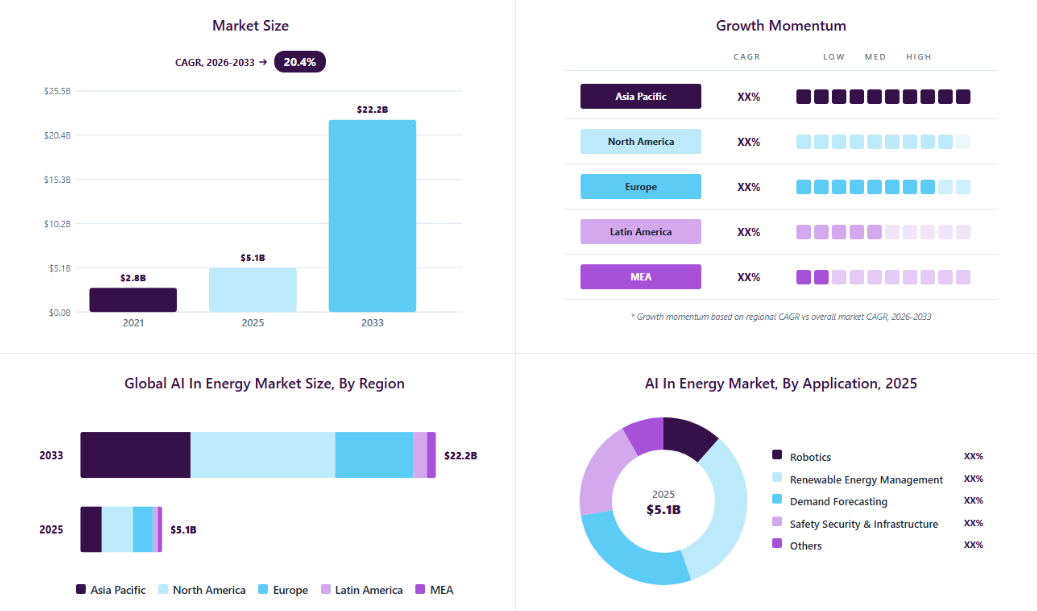
Cloud and AI have moved from pilot projects to boardroom priorities because they address these pressures directly. The AI in energy market alone is expected to grow from roughly USD 5.1 billion in 2025 to over USD 22.2 billion by 2033, a signal of just how quickly operators are shifting from experimentation to scaled deployment.
This guide walks energy leaders through where cloud and AI create measurable value, the challenges they solve, a practical implementation approach, and the trends worth watching. The goal is not more technology for its own sake. It is a grid, a plant, or a field operation that runs safer, leaner, and smarter.
Why energy sector digital transformation is no longer optional
Energy companies face a convergence of pressures that legacy systems simply cannot absorb.
- Aging assets meeting rising demand: Transformers, pipelines, and turbines are being pushed harder while surging electrification and data center growth add load faster than grids were designed to handle.
- Renewable volatility: Solar and wind introduce intermittency that traditional forecasting tools were never built to manage.
- Data overload: Smart meters, SCADA systems, and IoT sensors generate enormous volumes of operational data that mostly sits unused.
- Regulatory and sustainability mandates: Emissions reporting, reliability standards, and decarbonization commitments demand traceable, data-backed decisions.
- Margin and workforce pressure: An aging technical workforce and tighter budgets leave little room for reactive firefighting.
Notably, energy and utilities adopt AI at a rate of only around 33 percent, below the cross-industry average, largely because critical infrastructure and overlapping regulations raise the bar for safety and governance. That gap is the opportunity. Operators who close it responsibly gain a durable advantage through enterprise digital transformation built for regulated, mission-critical environments.
How cloud and AI work together in energy
Cloud and AI are often discussed separately, but their value compounds when combined.
The cloud provides the elastic compute, storage, and connectivity to consolidate data from generation, transmission, distribution, and field operations into a single accessible foundation. It replaces brittle on-premise systems with scalable platforms that support real-time monitoring and remote collaboration.
AI turns that consolidated data into foresight. Machine learning models detect anomalies, forecast demand, and recommend actions faster than any human team reviewing dashboards. Without the cloud, AI lacks the data and horsepower to scale. Without AI, the cloud is just a bigger, more accessible data store. Together, they form the backbone of energy sector digital transformation.
High-impact cloud and AI use cases in energy
Predictive maintenance
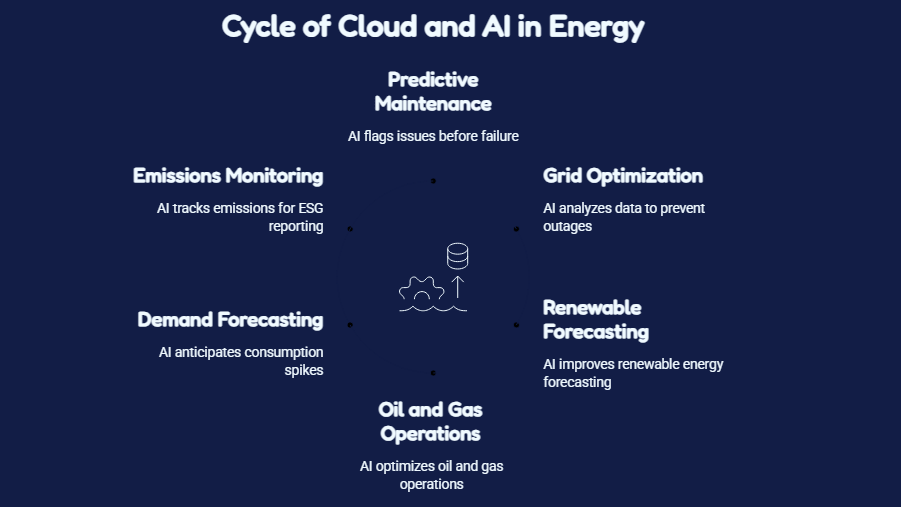
This is the clearest early win for most operators. Instead of servicing equipment on a fixed schedule or waiting for failure, condition-based models flag issues weeks in advance. It is one of the highest-return applications in remote oil field and asset operations, where a single avoided failure can outweigh the cost of the deployment. Vattenfall reported reducing unplanned downtime across its Nordic wind fleet by 34 percent, cutting roughly 12 million euros in annual maintenance costs. Utility research from E.ON suggests predictive maintenance can reduce grid outages by up to 30 percent compared with scheduled approaches.
Grid optimization and outage prevention
AI models analyze weather, load, and asset health to predict where the grid will strain. EY has documented predictive outage models that helped avoid tens of thousands of customer outages within a two-month window by prioritizing maintenance from real-time data.
Renewable energy forecasting and integration
AI improves short-term forecasting of solar and wind output, helping operators balance supply, reduce curtailment, and stabilize the grid. Italian grid operator Terna reported cutting balancing costs by 87 million euros annually and reducing renewable curtailment by 18 percent after deploying AI forecasting.
Oil and gas operations
The oil and gas industry was an early AI adopter, applying it to optimize exploration, reduce predrilling uncertainty, automate production, detect leaks, and lower methane emissions. According to the IEA, AI applied across power plant operations and maintenance could yield up to $110 billion in annual savings by 2035 under widespread adoption.
Demand forecasting and energy trading
AI-driven demand response and trading models help utilities anticipate consumption spikes and optimize purchasing, protecting margins in volatile markets.
Emissions monitoring and ESG reporting
Cloud platforms centralize the data needed for accurate, auditable emissions tracking, turning sustainability reporting from a manual burden into a continuous, verifiable process.
The business benefits decision-makers care about
For executives evaluating investment, the case comes down to outcomes:
- Lower operating costs through fewer failures, optimized maintenance, and reduced fuel waste.
- Improved reliability and safety from early fault detection and remote monitoring of hazardous environments.
- Faster, better decisions driven by real-time data rather than lagging reports.
- Extended asset life by intervening before minor wear becomes catastrophic failure.
- Progress toward sustainability targets with measurable, reportable emissions reductions.
- Scalability that lets platforms grow with demand instead of requiring costly rip-and-replace projects.
A practical implementation roadmap
Ambitious “big bang” transformations tend to stall. A phased approach delivers value early and builds organizational confidence.
- Assess and prioritize: Audit your data landscape, systems, and pain points. Identify one or two high-value use cases, predictive maintenance is a common starting point, where data already exists and ROI is measurable.
- Build the cloud foundation: Migrate and consolidate operational data into a secure, governed cloud environment. Security and data governance are not afterthoughts in critical infrastructure; they are the foundation.
- Pilot with clear metrics: Launch a focused pilot with defined success criteria. Eversource Energy’s approach of demonstrating measurable reliability impact within 60 days reflects how quickly value can be shown when existing data is put to work.
- Scale what works: Expand proven models across assets and regions, integrating them into daily operational workflows rather than leaving them as standalone dashboards.
- Govern and iterate: Establish model monitoring, human oversight, and continuous retraining. Energy AI governance is among the most complex of any sector and deserves dedicated ownership.
Best practices for energy operators
- Start with data readiness. AI is only as good as the data feeding it. Clean, connected data comes first.
- Keep humans in the loop. In safety-critical operations, AI should inform decisions, not replace accountable judgment.
- Prioritize security and compliance from day one. Critical infrastructure is a high-value target, so security certifications and disciplined governance matter throughout the build.
- Choose interoperability over lock-in. Favor platforms and partners that integrate with existing SCADA, ERP, and field systems.
- Measure relentlessly. Tie every deployment to a business metric such as downtime, cost, or emissions.
Emerging trends shaping the next decade
- Digital twins create live virtual replicas of grids, plants, and turbines for simulation and optimization before acting in the real world.
- Edge AI pushes intelligence to remote assets, enabling real-time decisions where connectivity is limited.
- Generative AI is beginning to support field technicians, accelerate knowledge access, and streamline documentation.
- Grid-scale investment is accelerating; Goldman Sachs Research estimates roughly $720 billion in grid upgrades will be required by 2030 to accommodate new load centers, much of it enabled by cloud and AI.
Turning the roadmap into results
The energy transition and the digital transition are now the same journey. Operators who treat cloud and AI as strategic infrastructure, rather than isolated experiments, will be the ones who cut costs, improve reliability, and meet sustainability goals while their peers struggle with legacy constraints.
Getting there takes more than technology. It takes a partner who understands both enterprise engineering and the operational realities of the energy sector, and who can build securely for critical environments.
App Maisters helps energy companies of all sizes plan and deliver this journey, from cloud migration and data platforms to AI-driven predictive maintenance and analytics, backed by ISO 9001 and ISO 27001 certified processes and disciplined security governance. If you are mapping your next phase of digital transformation, our cloud and AI consulting team can help you identify the highest-value starting point and build a roadmap designed to scale.
Ready to explore what cloud and AI can do for your operations? Connect with App Maisters to start the conversation.
FAQs
What is energy sector digital transformation?
It is the adoption of cloud, AI, IoT, and data analytics to modernize how energy is generated, transmitted, distributed, and consumed, replacing manual, reactive processes with connected, predictive operations.
What are the main benefits of AI in the energy sector?
The most cited benefits are reduced downtime through predictive maintenance, improved grid reliability, better renewable forecasting, lower operating costs, and more accurate emissions reporting.
Is cloud secure enough for critical energy infrastructure?
Yes, when designed correctly. Secure cloud architecture with strong governance, access controls, and recognized security standards can meet the strict requirements of critical infrastructure, often improving on the resilience of legacy on-premise systems.
Where should an energy company start?
Most operators start with a single high-value, data-rich use case such as predictive maintenance, prove ROI quickly, then scale. A readiness assessment is the practical first step.
Can cloud and AI integrate with existing SCADA, IoT, and ERP systems?
Yes. Rather than replacing operational systems outright, a well-designed transformation uses secure, API-based integration to connect SCADA, IoT sensors, and ERP platforms, adding a cloud and AI layer on top while preserving operational continuity.
How long does an energy AI implementation take to show results?
It depends on data readiness, but focused pilots can demonstrate measurable impact quickly. Eversource Energy, for example, showed reliability improvements in under 60 days by applying AI to data it already had. A phased rollout then scales proven use cases across assets over the following quarters.
What is the ROI of cloud and AI in the energy sector?
Returns come from reduced downtime, lower maintenance and fuel costs, extended asset life, and fewer outages. Reported outcomes range from double-digit reductions in unplanned downtime to millions in annual savings, and the IEA projects up to $110 billion in annual global savings from AI in power operations and maintenance by 2035 under widespread adoption. ROI is strongest when each deployment is tied to a specific operational metric.