


Evaluating a Healthcare Software Development Company: Compliance, Interoperability, Delivery
Evaluate a healthcare software development company on three things it can prove, not claim: how it protects patient data (HIPAA, GDPR where relevant, audited security controls), how it connects to clinical systems (HL7 v2, FHIR, EHR/EMR APIs), and how it delivers (discovery, QA, deployment, and support). Ask for evidence at each stage: a signed Business Associate Agreement, a sample FHIR integration, a test plan, and client references from comparable projects. The right partner reduces regulatory, clinical, and financial risk long after launch.
Key Takeaways
- Treat compliance as a process, not a badge: Ask how the vendor runs risk analyses, access reviews, and breach response, and whether it will sign a BAA before touching live data.
- Verify certifications independently: ISO 27001, SOC 2 Type II, or HITRUST reports should be current and cover the team that will actually build your product.
- Test interoperability claims early. Request a working demo against a FHIR sandbox such as Epic or Oracle Health (Cerner), plus evidence of HL7 v2 interface work for legacy systems.
- Scrutinize discovery: Vendors that skip workflow mapping and data-flow analysis usually overrun budgets later.
- Look past launch: Confirm SLAs, patching cadence, monitoring, and knowledge transfer before signing.
- Score vendors side by side: A weighted checklist keeps the decision objective across stakeholders.
Why Partner Selection Is a Risk Decision
Choosing a healthcare software development company is closer to a risk-management decision than a procurement one. The vendor will handle protected health information (PHI), connect to clinical systems, and shape workflows that clinicians rely on every day.
The stakes are measurable. IBM’s 2026 Cost of a Data Breach Report puts the average healthcare breach at 4.99M, the highest of any industry. Integration failures carry quieter costs: duplicate documentation, delayed results, and clinician workarounds that erode adoption.
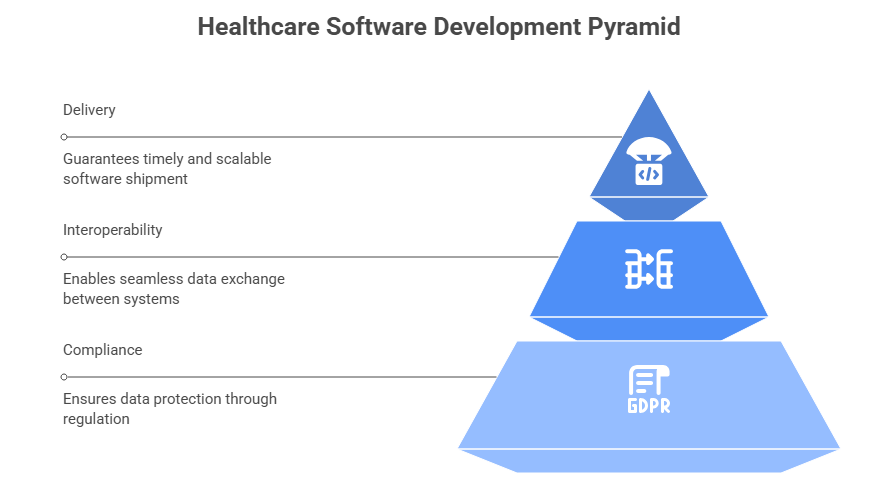
The three areas below, compliance, interoperability, and delivery, give healthcare leaders a structured way to separate proven capability from marketing language. For context on why many organizations move to custom healthcare software development instead of packaged tools, see our analysis of the benefits of custom healthcare app development.
1. Compliance: Can the Vendor Protect Patient Data by Design?
A compliant healthcare software development company builds regulation into architecture, workflows, and contracts from day one.
HIPAA and the Business Associate Relationship
Any vendor that creates, stores, or transmits ePHI for a covered entity is a business associate. That makes a signed Business Associate Agreement (BAA) non-negotiable before development touches real data.
Beyond the contract, ask how the vendor maps its work to the HIPAA Security Rule’s administrative, physical, and technical safeguards. Strong answers include documented risk analyses, role-based access control (RBAC), audit logging of every PHI access, and encryption such as AES-256 at rest and TLS 1.2 or higher in transit. HHS has also proposed Security Rule updates that would make controls like encryption and multi-factor authentication explicit requirements, so ask how the vendor is preparing. Our guide to building HIPAA-compliant mobile apps covers these safeguards in more depth.
GDPR and State Privacy Laws
If you serve patients in the EU or UK, GDPR treats health data as a special category under Article 9. That triggers stricter requirements for lawful basis, data protection impact assessments (DPIAs), and data residency. In the US, state laws such as Washington’s My Health My Data Act extend obligations to consumer health data that HIPAA does not cover.
Certifications and Secure Development Practices
Certifications signal maturity, but only when they are current and in scope. Ask for the ISO 27001 certificate scope, a SOC 2 Type II report, or a HITRUST assessment, and confirm they cover the delivery team, not just a parent entity.
Then examine the secure software development lifecycle (SDLC):
- Threat modeling during design
- Static and dynamic application security testing (SAST/DAST) in the CI/CD pipeline
- Dependency and container scanning
- Independent penetration testing before release
- Controls against third-party tracking pixels and SDKs, which HHS OCR has flagged as a PHI disclosure risk
For products that diagnose or treat, also ask about FDA pathways and IEC 62304. Our overview of Software as a Medical Device (SaMD) development explains when those rules apply.
2. Interoperability: Will the Software Work Inside Your Ecosystem?
Healthcare software creates value only when data moves reliably between systems. A partner’s interoperability capability determines whether your product becomes part of the clinical record or another data silo.
HL7 v2, FHIR, and Where Each Fits
Most hospitals still run on HL7 v2 messaging for admissions (ADT), orders (ORM), and results (ORU). FHIR R4 is the modern, API-first standard used for patient apps, analytics, and third-party integrations. Mature vendors work comfortably with both, often ingesting HL7 v2 feeds and exposing a clean FHIR layer on top.
Regulation is accelerating FHIR adoption. The 21st Century Cures Act restricts information blocking, and the CMS Interoperability and Prior Authorization Final Rule requires impacted payers to stand up FHIR-based APIs, with most deadlines in January 2027.
EHR/EMR Integration in Practice
Ask which EHR platforms the vendor has integrated with and how. Useful proof points include:
- Apps built with SMART on FHIR and OAuth 2.0 launch flows
- Experience navigating vendor programs for Epic, Oracle Health (Cerner), or athenahealth
- Use of integration engines such as Mirth Connect or Rhapsody
- Data mapping to standard terminologies: LOINC, SNOMED CT, ICD-10, and RxNorm
Terminology mapping is often overlooked: two systems can exchange a message successfully and still disagree on what it means. App Maisters EHR platform illustrates how records, workflows, and integrations fit together in practice.
Legacy Compatibility and Scalability
Few organizations can replace legacy systems at once. A capable partner will propose middleware, adapters, or phased migration rather than a risky full cutover.
Ask how the architecture handles EHR API rate limits, FHIR Bulk Data exports for population analytics, and rising transaction volumes. Cloud-native design on HIPAA-eligible infrastructure, supported by cloud consulting and migration expertise, keeps scaling predictable rather than reactive.
3. Delivery: Can the Vendor Ship, Support, and Scale?
Compliance and interoperability matter only if the vendor can deliver working software on a predictable timeline.
Discovery and Requirements
Strong partners start with structured discovery: stakeholder interviews, clinical workflow mapping, data-flow diagrams, and documented functional requirements with acceptance criteria. Watch for vendors who quote a fixed price before understanding your workflows.
Methodology and Communication
Agile delivery in two-week sprints with regular demos works well for most healthcare products. Regulated components may need more formal design controls and traceability. Ask who your day-to-day contact is, how often you will see working builds, and how scope changes are approved.
QA, Testing, and Deployment
Healthcare QA goes beyond functional testing. Look for integration testing against EHR sandboxes, accessibility testing to WCAG 2.1 AA, performance testing, and security validation. A dedicated quality assurance practice with documented test plans is a strong signal. Deployment should follow staged environments with rollback plans and signed BAAs from every cloud provider.
Post-Launch Support
Ask for defined SLAs, response times by severity, patching cadence, and monitoring coverage. Confirm who owns the source code and how knowledge transfers if you change vendors. Relevant, verifiable references, such as a live healthcare app development portfolio, tell you more than any proposal.
A Practical Evaluation Framework
Use this checklist to score shortlisted vendors from 1 to 5 on each criterion. Weight the three areas to match your project: a patient-facing app may weight compliance higher, while an analytics platform may weight interoperability higher.
| Area | Criterion | Evidence to request | Red flag |
|---|---|---|---|
| Compliance | HIPAA readiness | Signed BAA, recent risk analysis summary | Reluctance to sign a BAA |
| Compliance | Security certifications | ISO 27001 scope, SOC 2 Type II, or HITRUST report | Certificate covers another entity |
| Compliance | Secure SDLC | Pipeline scan results, pen test summary | No independent testing |
| Interoperability | Standards expertise | HL7 v2 interface samples, FHIR R4 API docs | FHIR described only in general terms |
| Interoperability | EHR integration | Named EHR integrations, sandbox demo | No production EHR references |
| Interoperability | Legacy and scale | Migration plan, load test results | Full cutover as the only option |
| Delivery | Discovery | Sample requirements document, workflow maps | Fixed quote before discovery |
| Delivery | QA and deployment | Test plan, environment strategy, rollback plan | QA handled only by developers |
| Delivery | Support | SLA terms, code ownership clause | Vague post-launch commitments |
Final Thoughts
Selecting a healthcare software development company comes down to evidence in three areas. Compliance shows whether patient data will be protected. Interoperability shows whether the software will work inside your clinical ecosystem. Delivery shows whether the vendor can ship, support, and scale it. Ask for proof in each area, score vendors side by side, and involve every stakeholder who will live with the result.
App Maisters approaches healthcare projects with that same discipline. The company holds ISO 9001 and ISO 27001 certifications and has delivered work such as a HIPAA and HITRUST-compliant SaaS EHR for psychiatric clinics. If you are evaluating partners for a new platform, integration, or modernization effort, a conversation with our healthcare team can help you pressure-test requirements before you commit.
FAQs
How do I choose the right healthcare software development company?
Start with evidence in three areas: compliance, interoperability, and delivery. Ask for a signed BAA, current security certifications, named EHR integrations, and references from similar projects. App Maisters recommends scoring shortlisted vendors side by side with a weighted checklist so clinical, IT, compliance, and finance stakeholders evaluate the same criteria.
What makes healthcare software HIPAA-compliant?
HIPAA-compliant software protects ePHI through administrative, physical, and technical safeguards. These include risk analysis, role-based access control, encryption in transit and at rest, audit logging, and signed BAAs with every vendor that can access patient data. App Maisters builds these controls into architecture and design from the start rather than adding them before launch.
What certifications should a healthcare software development company have?
Look for ISO 27001 for information security, ISO 9001 for quality management, and a SOC 2 Type II report or HITRUST assessment where relevant. Confirm each certificate is current and covers the team building your product. App Maisters holds ISO 9001 and ISO 27001 certifications and follows HIPAA-aligned secure development practices.
What is the difference between HL7 and FHIR?
HL7 v2 is a long-established messaging standard that hospitals use for admissions, orders, and lab results. FHIR is a newer HL7 standard built on modern web APIs, suited to patient apps, analytics, and third-party integrations. Many organizations need both, which is why App Maisters designs integrations that can ingest HL7 v2 feeds and expose FHIR APIs.
Can a software development company integrate custom apps with Epic or Cerner?
Yes, through approaches such as SMART on FHIR, vendor APIs, HL7 v2 interfaces, and integration engines like Mirth Connect. Each EHR has its own onboarding, sandbox, and security requirements. App Maisters plans for these requirements during discovery so EHR/EMR integration is scoped, tested, and approved before it affects the delivery timeline.
How long does custom healthcare software development take?
Timelines depend on scope, integrations, and compliance testing. Many HIPAA-compliant apps take four to nine months, while platforms with multiple EHR integrations or regulated SaMD components can take longer. App Maisters provides timeline estimates after discovery, once workflows, data flows, and integration requirements are documented.
What questions should I ask a healthcare software vendor before hiring?
Ask whether they will sign a BAA, which EHRs they have integrated with, how they test security, who owns the source code, and what post-launch SLAs they offer. Request sample requirements documents and test plans. App Maisters encourages buyers to ask for this evidence from every vendor they evaluate, including us.