


Selecting a Custom Software Development Company: A Procurement-Ready Scorecard
Selecting a custom software development company should follow a structured, weighted evaluation, not a side-by-side comparison of proposals and hourly rates. Procurement teams should score every vendor across three tracks: technical fit (expertise, methodology, architecture, QA), commercial fit (pricing model, total cost of ownership, IP and contract terms), and risk (security, compliance, governance, vendor stability). The strongest software development partner is the one that can prove delivery capability and manage risk transparently across the full product lifecycle.
Key Takeaways
- Split the evaluation into technical, commercial, and risk tracks, each with a named owner.
- Set criteria and weights before proposals arrive so pricing does not anchor the decision.
- Ask for evidence, such as reference calls, sample documentation, and security policies, rather than accepting claims.
- Compare total cost of ownership over three to five years, not the initial build quote.
- Confirm IP ownership, source code access, and exit terms before signing.
- Score post-launch support as a core criterion, not an optional add-on.
Why Vendor Selection Is a Business Decision
Choosing a custom software development company commits your organization to a relationship that shapes operations, data security, and budget for years. Once a vendor holds your architecture, codebase, and product knowledge, switching becomes slow and expensive.
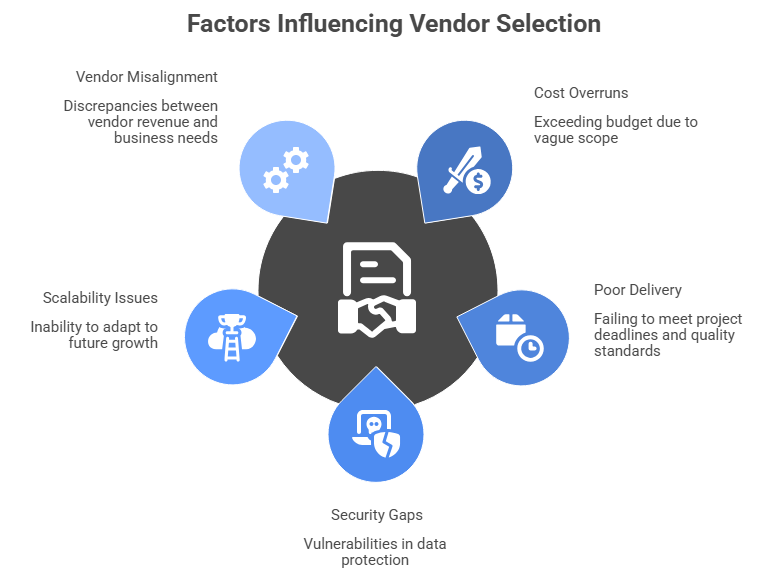
That is why software vendor selection belongs with procurement and business leadership, not engineering alone. Most failed engagements are not caused by weak coding skills. They trace back to:
- Cost overruns driven by vague scope and loose change-control terms
- Poor delivery caused by weak project governance and unclear accountability
- Security gaps when data protection is never defined in the contract
- Scalability issues from architecture chosen for the demo rather than for growth
- Vendor misalignment between how the vendor earns revenue and what your business needs
A procurement-ready scorecard makes the decision defensible to leadership, auditors, and budget holders. It also gives every stakeholder the same yardstick, whether you are hiring locally or evaluating software development outsourcing options.
What Procurement Teams Should Evaluate
The twelve criteria below fall into three evaluation tracks. Keeping them separate prevents a polished demo from masking weak contract terms, or a low price from hiding delivery risk.
Technical Evaluation
- Technical expertise and industry experience: Look for delivery in your domain, including its regulations and core integrations. A healthcare platform demands different fluency than a logistics system. Review the vendor’s industry experience and, for AI-heavy builds, apply a dedicated AI development company evaluation framework.
- Portfolio and case studies: Prioritize projects comparable in scale and complexity, then ask to speak with those clients. Credible client case studies describe the problem, the approach, and the outcome, not just screenshots.
- Development methodology and delivery process: Agile, hybrid, or phase-gated delivery should match how your organization approves budget and releases. Ask how discovery and UI/UX design feed into development.
- Team structure and engineering capabilities: Confirm who will work on your project, their seniority, and whether they are employees or subcontractors.
- Technology stack and scalability: The stack should fit your environment and your ability to hire for it later. Ask how the architecture handles growth in users, data, and integrations, especially for cloud application development.
- Quality assurance and testing: Look for dedicated testers, automated regression testing, and defined acceptance criteria. Mature quality assurance and testing practices reduce rework after launch.
Commercial Evaluation
Owned by procurement and finance.
- Pricing, contract structure, and total cost of ownership: Fixed price suits a well-defined scope. Time and materials suits evolving requirements. A dedicated team or staff augmentation model suits long-term roadmaps. Software development cost also extends beyond the build to hosting, licenses, maintenance, and enhancements.
- Intellectual property and ownership terms: The contract should assign ownership of code, designs, and documentation to you on payment, with clear terms for any pre-existing vendor components.
- Post-launch support and maintenance: Define SLAs, response times, maintenance scope, and ongoing costs before signing.
Risk Evaluation
Owned by procurement, IT security, and legal.
- Security, compliance, and data protection: Request security policies, secure development practices, and certifications such as ISO 27001. Confirm experience with the regulations you face, such as HIPAA. Ask how application security is built into the development lifecycle.
- Communication and project governance: Look for a named accountable lead, a fixed reporting cadence, escalation paths, and direct access to project tools.
- Vendor stability and long-term partnership potential: Assess years in operation, client retention, team size relative to your project, and financial health.
The Procurement-Ready Scorecard
Score each criterion from 1 to 5, multiply by its weight, and total the results. A practical starting split is 40% technical, 30% commercial, and 30% risk; regulated industries often weight risk higher.
| Track | Criterion | What to assess | Questions to ask | Red flags |
|---|---|---|---|---|
| Technical | Expertise and industry experience | Domain delivery, regulatory familiarity | Which similar projects have you delivered in our industry? | Generic answers, no domain references |
| Technical | Portfolio and case studies | Comparable scale, documented outcomes | Can we speak with two clients from similar projects? | No references offered, visuals only |
| Technical | Methodology and delivery | Process fit, sprint cadence, change control | How do you handle scope changes mid-project? | No defined change-control process |
| Technical | Team structure | Seniority, roles, subcontracting | Who will work on our project, and are they employees? | Senior staff in the pitch, juniors in delivery |
| Technical | Tech stack and scalability | Architecture fit, growth path | How will the system perform at three times current load? | Proprietary frameworks that create lock-in |
| Technical | QA and testing | Test strategy, automation, acceptance criteria | What testing happens before each release? | Developers test their own code only |
| Commercial | Pricing and TCO | Pricing model, rate transparency, lifetime cost | What costs should we expect over three years? | Estimate far below every other bid |
| Commercial | IP and ownership | Code ownership, licensing, exit terms | Do we own all code and documentation on payment? | Vendor retains IP or limits source access |
| Commercial | Post-launch support | SLAs, maintenance scope, cost | What support SLAs apply after launch? | Support undefined or “priced later” |
| Risk | Security and compliance | Policies, certifications, secure development | How is our data protected, and what certifications do you hold? | Cannot share policies or sign a DPA |
| Risk | Communication and governance | Reporting, escalation, tool access | What reporting will we receive, and how often? | No single accountable project lead |
| Risk | Vendor stability | Track record, retention, financial health | How long have your key clients stayed with you? | High turnover, short client relationships |
How to Compare Shortlisted Vendors
Proposals are written to win, so a consistent process matters more than the documents themselves. Use these steps to keep the comparison fair and repeatable.
- Lock criteria and weights first: Approve the scorecard before any proposal arrives.
- Issue a standardized brief: Give every vendor the same scope summary, constraints, and questions so responses can be compared line by line.
- Score independently, then calibrate: Technical, commercial, and risk owners score their own tracks alone, then meet to reconcile large gaps.
- Run a working session: Ask each finalist to walk through one real problem from your project. The questions they ask reveal more than a slide deck.
- Validate with references: Ask past clients what went wrong and how the vendor responded.
- Consider a paid discovery phase: A short, scoped discovery and consulting engagement tests collaboration and sharpens estimates before a full commitment.
Normalize pricing before comparing it. Restate every quote against the same assumptions for scope, team composition, timeline, and support period, or you will compare different projects.
Red Flags to Watch Before Signing
Any one of these warrants a direct conversation. Two or more usually justify removing a vendor from the shortlist.
- Unrealistic estimates: A firm price delivered before the vendor has asked meaningful questions about your requirements.
- Vague scope: No written assumptions, exclusions, or definition of “done,” which invites change orders later.
- Weak security practices: Reluctance to share policies, sign a data processing agreement, or explain access controls.
- Unclear ownership terms: IP that transfers only after full project completion, or restricted access to source code and repositories.
- Limited transparency: No access to project tools, vague answers about who is on the team, or undisclosed subcontracting.
- No post-launch plan: Support, warranty periods, and maintenance pricing left for “after go-live.”
- Pressure tactics: Discounts that expire within days or requests to skip reference checks.
Final Selection Checklist
Confirm every item before issuing a purchase order or signing a master services agreement.
- Scorecard criteria and weights approved before proposals were reviewed
- At least two reference calls completed for each finalist
- Security documentation reviewed and accepted by IT
- Named delivery team confirmed in writing
- All pricing normalized to the same assumptions
- Three-to-five-year total cost of ownership modeled
- IP assignment and source code access written into the contract
- Change-control process and rates defined
- Post-launch SLAs, warranty, and support costs agreed
- Exit and knowledge-transfer terms documented
Evaluate the Partner, Not Just the Price
Selecting a custom software development company is a risk-management decision as much as a technology one. The right partner earns its place through business value, proven delivery capability, technical fit, transparent governance, and a credible plan for long-term support. Price matters, but only in the context of total cost and outcomes.
A weighted scorecard turns a subjective choice into a defensible one that stakeholders can audit and repeat. If you are building a shortlist, App Maisters custom software development and enterprise application development teams, backed by ISO 9001 and ISO 27001 certified processes, are glad to walk through our discovery, security, and delivery approach so you can score us alongside any other vendor.
FAQs
How do I choose the right custom software development company?
Start with a weighted scorecard covering technical fit, commercial terms, and risk, then compare shortlisted vendors against the same brief. Verify claims through reference calls, sample documentation, and a working session on a real problem. App Maisters recommends agreeing on criteria and weights before proposals arrive, so price does not anchor the decision.
What questions should I ask a software development company before hiring?
Ask who will work on your project, how scope changes are handled, what testing happens before each release, who owns the code, and what support looks like after launch. Also request security policies and two comparable client references. App Maisters encourages buyers to put these questions in writing so every vendor answers the same set.
How much does custom software development cost?
Cost depends on scope, data readiness, and integration needs, so treat any fixed quote issued before discovery with caution. App Maisters scopes each engagement around your highest-value use case first, which keeps the initial budget contained and lets you see results before expanding.
Is fixed price or time and materials better for software development?
Fixed price works best when requirements are stable and well documented. Time and materials suits projects where scope will evolve through user feedback, and a dedicated team model fits long-term roadmaps. App Maisters helps clients match the contract model to their scope certainty, since a mismatch is a common source of cost overruns and disputes.
Who owns the source code when you outsource software development?
Ownership depends entirely on the contract. Your agreement should assign all code, designs, and documentation to you on payment, grant repository access throughout the project, and define terms for any pre-existing vendor components. App Maisters recommends confirming IP assignment and exit terms during contract review, not after development begins.
How long does it take to build custom software?
Timelines vary with scope, integrations, and approval cycles. A focused MVP can often launch within a few months, while enterprise platforms with complex integrations and compliance requirements take longer. App Maisters builds timelines from a documented scope and phased milestones, so procurement teams can track progress against agreed deliverables.
What are the red flags when hiring a software development company?
Watch for estimates given before meaningful discovery, vague scope with no assumptions list, reluctance to share security policies, restricted source code access, undisclosed subcontracting, and no post-launch support plan. App Maisters advises removing any vendor that shows two or more of these warning signs from the shortlist.