


Chatbot vs. Copilot vs. AI Agent: What Enterprises Are Actually Buying in 2026
Most enterprise leaders no longer ask whether to adopt generative AI. The harder question in 2026 is which kind. Vendors label nearly everything a “copilot” or an “agent,” and procurement teams end up comparing products that solve fundamentally different problems.
The distinction matters because it determines budget, risk, and return. A chatbot that answers questions, a copilot that helps an employee work faster, and an AI agent that completes a process on its own each demand different data access, governance, and integration work. Choosing by label rather than by workflow is one of the quickest ways to stall an enterprise AI program.
At App Maisters, this is the decision we help enterprises make before any build begins. Here is how we separate the three, where each fits, and the framework we use to match technology to process.
Why Enterprises Are Moving Beyond Basic Conversational AI
First-generation chatbots were built to deflect. They handled FAQs, collected contact details, and routed tickets. That was useful, but their value was capped by scripted flows or a knowledge base disconnected from the systems where work actually happens.
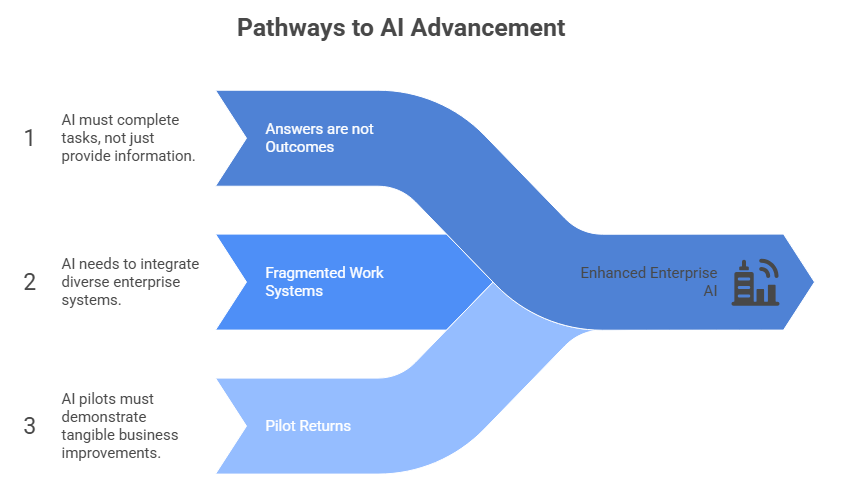
Three pressures are pushing enterprises past that model:
- Answers are not outcomes: A customer told how to change a delivery address still has to change it. The value sits in completing the task.
- Work is fragmented across systems: A single process may touch a CRM, ERP, ITSM platform, and HRIS. Conversation alone cannot bridge them.
- Pilots must show returns: Leadership wants movement in cycle time, cost per transaction, and error rates, not conversation counts.
The strategic shift is from AI that talks to AI that contributes to workflows.
Chatbot vs. Copilot vs. AI Agent at a Glance
| Dimension | AI Chatbot | AI Copilot | AI Agent |
|---|---|---|---|
| Primary role | Answers questions, routes requests | Assists a person inside their tools | Pursues a goal and executes multi-step work |
| Autonomy | Low: responds to prompts | Low to medium: suggests, drafts, summarizes | Medium to high, within defined limits |
| Decision-making | Scripted or model-generated responses | Recommends; the human decides | Plans, selects tools, acts, adjusts |
| Integrations | Knowledge base, sometimes CRM or ticketing | Embedded in productivity, CRM, code, or ERP tools | Read/write access across multiple systems via APIs |
| Workflow scope | Single interaction | Task within a role | End-to-end process |
| Human involvement | Escalation on failure | Human in the loop at every step | Human on the loop: sets rules, reviews exceptions |
| Typical value metric | Deflection rate, response time | Time saved, output quality | Cycle time, cost per transaction, throughput |
What Each Approach Looks Like in Practice
AI Chatbot for Enterprise: Scaling Answers
Chatbots remain the right tool for high-volume, low-risk inquiries: HR policy questions, tier-1 IT help desk requests, order status, and customer FAQs. Modern LLM-powered assistants handle natural language far better than decision-tree bots, but their scope is still an interaction, not a process.
In our enterprise chatbot development and generative AI work, the priority is grounding responses in approved data and defining clean escalation paths to humans, not maximizing conversational range.
AI Copilot: Augmenting the Employee
A copilot works alongside a person, using the context of the tool they already have open. Examples include drafting a sales follow-up from CRM notes, summarizing a claims file for an adjuster, suggesting code, or preparing variance commentary for a finance team.
The human remains accountable. That makes copilots a strong fit for knowledge work involving judgment, variable inputs, or regulatory and reputational stakes, where the goal is faster, more consistent work rather than removing the person.
AI Agents: Owning the Workflow
Autonomous AI agents receive a goal, plan the steps, call tools and APIs, and act, escalating when a case falls outside their boundaries. Consider invoice processing: an agent extracts data, matches it against purchase orders, flags discrepancies, and routes approvals. Similar patterns apply to IT incident triage, KYC document checks, employee onboarding, and inventory replenishment.
Agents deliver value through business process automation, and many have no chat interface at all. That is why App Maisters begins AI agent development with the process and its exception rules, not the model.
Copilots and Agents Work Better Together
The market often frames these as competing choices. In mature deployments, they are layers of the same system.
Take procurement. An agent monitors supplier invoices, reconciles them, and resolves routine mismatches without intervention. When an exception requires judgment, such as a disputed price or a contract deviation, it hands the case to a category manager. That manager’s copilot assembles contract terms, spend history, and recommended options.
The agent handles volume; the copilot supports judgment. This is the pattern we most often recommend: conversation as the interface, agents as the execution layer, and people as decision-makers on high-stakes exceptions.
What to Evaluate Before You Invest
Regardless of label, the same due diligence applies, and its weight rises with autonomy.
- Security and access control: Agents that write to core systems need least-privilege permissions, identity management, and full audit trails.
- Data privacy: Clarify where data is processed, how long it is retained, whether it is used for model training, and how regulated data (PII, PHI, financial records) is handled.
- Integration: Often the hardest part. API maturity, legacy systems, and data quality determine whether an agent can complete work or merely describe it.
- Scalability: Model cost per task at production volume, and plan for monitoring, latency, and performance drift.
- Governance: Assign ownership, define approval thresholds, and establish testing and incident-response procedures before launch.
- ROI: Baseline the process first, then tie the investment to a specific KPI. Gartner has cautioned that over 40% of agentic AI projects could be canceled by the end of 2027 due to escalating costs, unclear business value, or inadequate risk controls.
- Human oversight: Decide explicitly where people approve, review, or override, and build those checkpoints into the workflow.
This is where our AI consulting engagements start. Use-case prioritization and readiness gaps are cheapest to address before technology is selected.
A Practical Framework for Matching Approach to Process
For any candidate workflow, we ask four questions: Is the task a question or an outcome? How structured is the process? What does an error cost? How many systems must the AI act in?
| Process characteristic | Best-fit approach | Example |
|---|---|---|
| High volume, low risk, informational | Chatbot | HR policy queries, order status |
| Judgment-heavy, variable inputs | Copilot | Account planning, contract review prep |
| Structured, multi-step, cross-system | AI agent | Invoice-to-pay, employee onboarding |
| Structured but high stakes | AI agent with human approval gates | Loan document verification, compliance checks |
| Mixed routine and exception work | Agent plus copilot | Claims handling, procurement |
If data quality or governance is not ready, start with a chatbot or copilot to build the foundation, then extend toward agents as confidence grows.
What This Shift Means for Enterprise AI Strategy in 2026
- Budget by workflow, not by product category: Organizations getting traction identify a process, define the outcome, and then choose the technology, rather than buying a “copilot strategy” or an “agent strategy.”
- Treat integration and governance as core investment: They are not overhead. They decide whether a pilot reaches production.
- Expect a hybrid portfolio: Packaged platforms suit broad, common workflows, while custom agents suit processes that differentiate the business. Our guide to generative AI strategy and enterprise ROI covers how to sequence that portfolio.
- Build the operating model early: Clear ownership, evaluation routines, and escalation rules matter more as autonomy increases.
Conclusion
Chatbots, copilots, and AI agents are not rungs on a ladder where the highest always wins. Each solves a different class of problem, and the strongest enterprise programs combine them. The strategic shift in 2026 is away from buying AI by category and toward designing for outcomes.
The most useful question a leadership team can ask is not “Do we need an agent?” but “What business result do we need, and what level of autonomy does this workflow safely support?” App Maisters works with enterprise teams to answer that question first, so the technology follows the workflow.
FAQs
What is the difference between an AI chatbot, an AI copilot, and an AI agent?
A chatbot answers questions, a copilot assists an employee inside the tools they already use, and an AI agent plans and executes multi-step work across systems with limited human input. App Maisters helps enterprises map each one to the right workflow, so they don’t buy an agent where a chatbot would do.
Is ChatGPT a chatbot, a copilot, or an AI agent?
In its standard conversational form, a general-purpose assistant like ChatGPT works as a chatbot or copilot, because it responds to prompts and leaves the action to you. It becomes agent-like only when connected to enterprise data, tools, and approval rules, which is the AI integration work App Maisters builds around existing systems.
Will AI agents replace AI copilots in the enterprise?
Unlikely, because they solve different problems: agents handle high-volume, rules-based process work, while copilots support people on judgment-heavy tasks. App Maisters typically designs them as layers of one system, with agents clearing routine cases and copilots helping employees resolve the exceptions.
When should an enterprise choose an AI agent over an AI chatbot?
Choose an agent when the goal is completing a multi-step process across systems, such as invoice processing or employee onboarding, rather than answering a question. Before recommending AI agent development, App Maisters assesses the workflow’s exception rules, system access, and cost of error.
How much does AI agent development cost, and how do enterprises measure ROI?
Cost depends less on the model and more on the number of integrations, data readiness, level of autonomy, and governance requirements. App Maisters scopes each build against a baseline process KPI, such as cycle time or cost per transaction, so ROI is measurable from the first release.
What are the biggest risks of autonomous AI agents, and how are they managed?
The main risks are excessive system permissions, incorrect or unintended actions, data exposure, and unclear accountability. App Maisters builds least-privilege access, audit trails, and human approval gates into the design rather than adding them after launch.
Can AI agents work with legacy enterprise systems?
Yes, usually through APIs, middleware, or an automation layer, though legacy integration is often the hardest and most time-consuming part of a project. App Maisters evaluates system readiness and data quality early, so the agent can complete business process automation tasks rather than just describe them.