


Cloud-Based Learning Systems for Scalable Digital Education
Cloud-based learning systems have become the default architecture for commercial education, but the reason is commercial rather than technical. What changed is the buying criteria. Enterprise L&D departments, university procurement teams, and corporate clients now assess learning products on uptime guarantees, integration surface, data residency, and reporting depth alongside instructional quality and increasingly, the technical review happens before the content review.
That shift has redrawn where competitive advantage sits in this market. High-quality courseware is abundant and getting cheaper to produce, particularly with AI-assisted authoring. Delivery infrastructure is not. The capacity to scale on demand, personalize across large populations, and pass enterprise security review is now the constraint that determines which providers can accept a major contract and which have to walk away from one.
For EdTech companies, private education providers, universities, online learning businesses, and corporate training organizations, this makes platform architecture a revenue decision rather than an IT one. What follows examines what these systems actually consist of, why the market is consolidating around them, and what separates a platform that scales from one that merely runs in the cloud.
What Cloud-Based Learning Systems Actually Are
A cloud-based learning system is the full technology stack that delivers, manages, and measures learning through cloud infrastructure rather than on-premise servers or a single-tenant install. It is broader than the LMS category most buyers still default to.
In practice, a modern cloud-based learning platform is composed of four interacting layers:
- The delivery layer handles content presentation across web, mobile, and embedded experiences adaptive streaming, offline sync, and interfaces that behave the same on an office laptop and a mid-range Android phone on a weak connection.
- The management layer governs enrollment, cohorts, credentials, instructor workflows, and commerce. For B2B education businesses it carries the most operational weight, because it encodes how you actually sell: seat-based licensing, multi-tenant client portals, white-labeled academies, subscription tiers.
- The data layer captures learner interaction at event-level granularity not just completions, but where attention stalls, which assessment items discriminate poorly, which paths correlate with retention.
- The intelligence layer turns that data into action: recommendation engines, adaptive sequencing, automated interventions, and predictive signals on learner risk.
A true cloud LMS is defined by architecture, not hosting location. Lifting a monolith onto a cloud VM produces a cloud-hosted system, not a cloud-native one. Every advantage below depends on containerization, service decomposition, elastic compute, and API-first design not on where the servers sit.
Why Education Providers and Enterprises Are Making the Move
The migration to digital learning solutions built on cloud infrastructure is being driven by four commercial pressures rather than by technology enthusiasm.
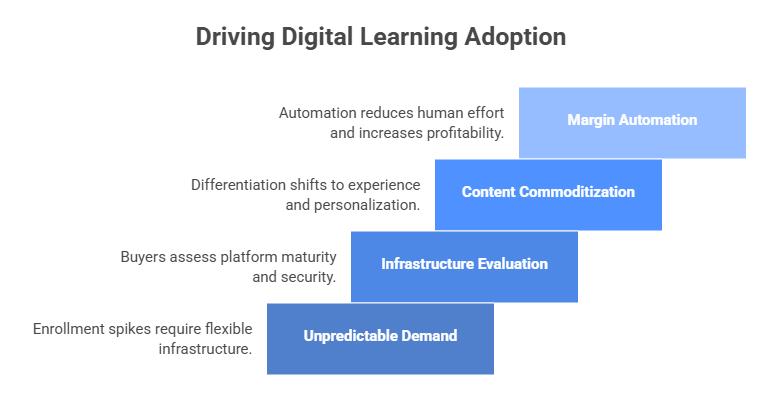
- Demand has become unpredictable: Enrollment is spiky by nature a product launch, a compliance deadline, a viral course, a client’s onboarding wave. Fixed-capacity infrastructure forces a permanent choice between overprovisioning and degradation: paying for peak year-round, or losing learners the moment you acquire them.
- Buyers now evaluate infrastructure: Enterprise L&D teams and university procurement routinely ask about uptime SLAs, SOC 2 status, integration surface, and data portability during evaluation. Platform maturity is now a sales qualification criterion, not a post-sale concern.
- Content is no longer the differentiator: Quality instructional material is abundant and increasingly commoditized by AI-assisted production. Differentiation is shifting toward experience, personalization, and demonstrable outcomes all platform capabilities.
- Margins depend on automation: In subscription and seat-based models, gross margin is set by how much human effort each additional learner requires. Manual enrollment, grading, reporting, and support scale linearly with revenue. Automation breaks that link.
The Six Commercial Advantages That Matter
- Scalability: A scalable learning platform built on auto-scaling groups and stateless services absorbs a tenfold traffic increase without an architecture change or an emergency procurement cycle. That capability comes from the cloud development and migration work beneath the product, not the product itself. You can then say yes to a large enterprise contract without a six-month readiness project.
- Cost efficiency: The obvious shift is capex to consumption-based opex, but the deeper saving is operational. Managed databases, serverless functions for burst workloads, and tiered archival storage compress infrastructure cost per active learner as volume grows inverting on-premise economics, where per-learner cost plateaus or rises.
- Accessibility: CDN edge distribution reduces latency for distributed cohorts, while progressive web app patterns and offline-first design extend reach into low-bandwidth markets. For businesses expanding internationally, this is a market-access issue, not a UX refinement.
- Security and compliance: Commercial education handles a volatile mix of personal data, payment information, assessment integrity, and client confidential material. Enterprise-grade architecture means encryption in transit and at rest, role-based access control, tenant isolation, audit logging, and alignment to FERPA, GDPR, and SOC 2 as your markets require. These controls are far cheaper to design in than to retrofit.
- Analytics: Event-level data enables the reporting enterprise clients increasingly write into contracts: completion trajectories, competency mapping, skill-gap analysis, cohort benchmarking, and ROI tied to business metrics. Analytics has quietly become a renewal driver.
- Personalization: Cloud infrastructure makes it computationally practical to maintain a distinct learning path per individual across large populations something that is architecturally infeasible on constrained systems.
AI, Adaptive Learning, and the Mobile Layer
The most significant near-term change in education technology solutions is the movement of AI from a feature to a substrate. Recommendation, assessment, and intervention logic now sit at the product core the shift we explore in more depth in our piece on AI-driven mobile learning and adaptive learning systems.
Adaptive engines now sequence content dynamically on demonstrated mastery, response latency, and error patterns compressing time-to-competency for advanced learners while remediating those who struggle. Conversational AI tutors provide explanation on demand, cutting the support burden that traditionally scales with enrollment.
Operations gains are equally material: automated assessment generation and grading, intelligent content tagging, compliance reporting, and intervention workflows triggered by disengagement signals. Each removes a manual process that would otherwise scale with your learner count.
Mobile learning has moved past responsive design into a distinct modality microlearning modules, spaced-repetition notifications, and offline-capable content. For corporate training providers serving deskless and field-based workforces, a genuine mobile app development strategy determines whether the product is usable at all.
Features That Define a Scalable Cloud Platform
Few off-the-shelf products cover all of the following, which is why scaling education businesses typically pair a commercial core with purpose-built eLearning app development. Prioritize:
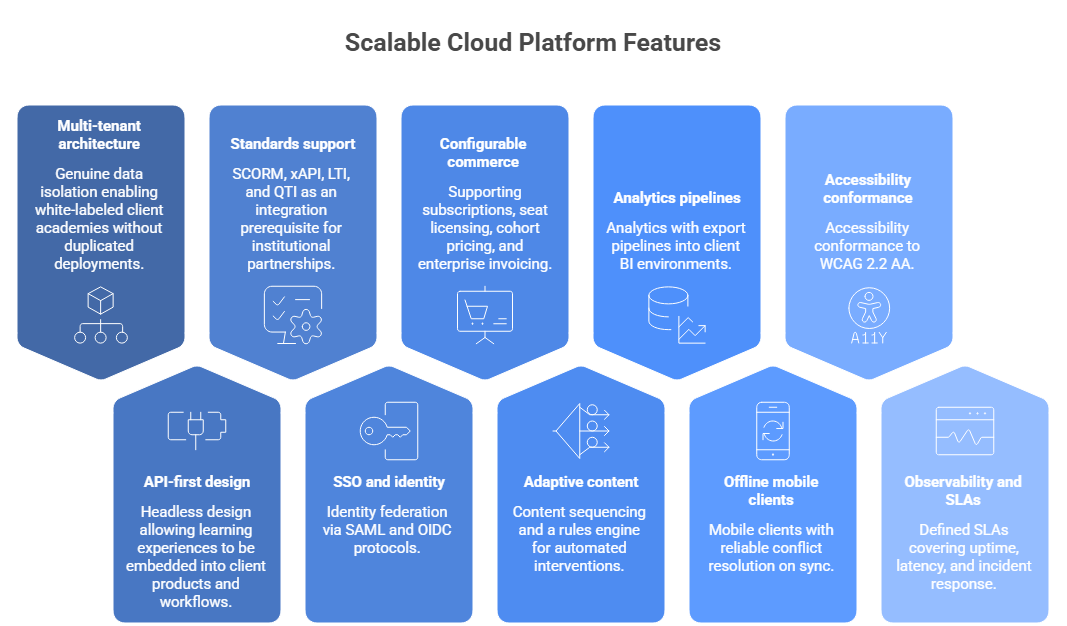
- Multi-tenant architecture with genuine data isolation, enabling white-labeled client academies without duplicated deployments
- API-first and headless design, so learning experiences can be embedded into client products and workflows
- Standards support SCORM, xAPI, LTI, and QTI as an integration prerequisite for institutional partnerships
- SSO and identity federation via SAML and OIDC
- Configurable commerce supporting subscriptions, seat licensing, cohort pricing, and enterprise invoicing
- Adaptive content sequencing and a rules engine for automated interventions
- Analytics with export pipelines into client BI environments
- Offline-capable mobile clients with reliable conflict resolution on sync
- Accessibility conformance to WCAG 2.2 AA
- Observability and defined SLAs covering uptime, latency, and incident response
Migration and Implementation: What Determines Success
Cloud migration failures rarely stem from infrastructure. They stem from data, integration, and adoption where education technology projects most often slip.
Begin with a capability and data audit. Legacy learning data is almost always inconsistent duplicated learner records, orphaned enrollments, incompatible competency taxonomies. Data modeling is the longest pole in the tent, and it belongs before platform selection, not after.
Sequence in phases. Move a low-risk cohort or product line first, validate performance and reporting integrity against the legacy system in parallel, then expand. Big-bang cutovers carry unacceptable academic-calendar risk.
Map the integration surface early: HRIS and payroll for corporate clients, SIS for institutional partners, CRM, payment processing, and content authoring tools. Integration complexity, not core platform work, drives most timeline overruns.
Plan for change management with the same seriousness as engineering. Instructor and administrator adoption determines realized value; a technically successful migration with poor adoption returns nothing.
Finally, establish a measurement baseline before you migrate. Without pre-migration completion rates, support ticket volumes, and cost-per-learner figures, you cannot demonstrate ROI afterward.
The Opportunity Ahead
The next phase of digital education will be defined by systems that adapt continuously to each learner, generate and validate content with human oversight, verify credentials portably across employers and institutions, and connect learning activity to business outcomes. Skills-based talent models are creating durable enterprise demand for platforms that evidence capability rather than seat time.
Organizations building on flexible, API-first cloud foundations now can adopt these capabilities incrementally. Those on rigid legacy systems will face a rebuild.
Building With App Maisters
Predictive maintenance initiatives often struggle because of incomplete records, inconsistent asset names, poor sensor quality, limited examples of actual failures, legacy-system constraints, and resistance from maintenance personnel.
A practical implementation should begin with a limited number of high-value assets. The company should establish baseline downtime and maintenance costs, evaluate available data, develop and validate the model, integrate alerts into existing workflows, and measure results before expanding.
Human validation remains important. Excessive false alerts can quickly reduce technician confidence, while missed failures can create operational risk. Successful systems combine machine learning with engineering rules and feedback from experienced reliability teams.
Building With App Maisters
App Maisters designs and engineers cloud-based learning platforms for EdTech companies, private education providers, universities, online learning businesses, and corporate training organizations. Our eLearning app development services span greenfield platform builds, legacy LMS modernization, and cloud migration for organizations scaling into enterprise and international markets.
If you are planning a migration, evaluating a rebuild, or preparing your platform for a step-change in demand, talk to our team about a technical and commercial assessment of your current stack.
FAQs
What is a cloud-based learning system?
A cloud-based learning system delivers, manages, and measures learning through cloud infrastructure instead of on-premise servers. It spans content delivery, enrollment and commerce, learning analytics, and AI personalization. App Maisters builds these systems as cloud-native platforms, so capacity, cost, and performance scale with your learner base rather than against it.
What is the difference between a cloud LMS and an on-premise LMS?
An on-premise LMS runs on hardware you own, patch, and outgrow. A cloud LMS runs on elastic infrastructure the provider maintains, removing capital expenditure and manual upgrade cycles. App Maisters draws a further distinction: a legacy system lifted onto a cloud server is merely cloud-hosted, not cloud-native, and delivers few of the scalability benefits buyers expect.
How much does it cost to build a cloud-based learning platform?
Cost depends on feature scope, platform count, integration surface, and whether you need AI personalization. A focused MVP sits well below a full multi-tenant platform with adaptive learning and enterprise reporting. App Maisters provides a transparent, itemized estimate within 24 hours of scoping, so budget decisions rest on figures rather than ranges.
Is a cloud-based learning platform secure enough for enterprise clients?
Yes, when security is designed in rather than retrofitted. That means encryption in transit and at rest, single sign-on, role-based access control, tenant isolation, and audit logging. As an ISO 9001 and ISO 27001 certified partner, App Maisters architects eLearning platforms to meet FERPA, GDPR, and SOC 2 expectations from the first sprint.
Can we migrate existing SCORM courses and learner data to a cloud LMS?
Generally yes most cloud platforms support SCORM, xAPI, and LTI. The harder problem is data hygiene: duplicated learner records, orphaned enrollments, and inconsistent competency taxonomies rarely migrate cleanly. App Maisters begins every migration with a data audit, because content transfer is routine while historical learner data almost never is.
How long does a cloud LMS migration or platform build take?
A well-scoped MVP typically takes a few months; enterprise-grade multi-tenant platforms take longer. App Maisters works in two-week sprints and sequences migrations in phases a low-risk cohort first, validated in parallel against the legacy system so you launch on core value without exposing an academic or compliance calendar to risk.
How does AI improve cloud-based learning systems?
AI shifts the platform from static delivery to adaptive instruction: dynamic content sequencing based on demonstrated mastery, conversational tutoring on demand, automated assessment and grading, and early intervention triggered by disengagement signals. App Maisters treats this intelligence layer as core architecture, and builds AI governance and bias monitoring in alongside it.