


AI-Driven Mobile Learning Apps with Adaptive Learning Systems
One-size-fits-all training is quietly draining enterprise budgets. Employees abandon generic courses, students disengage from static content, and L&D teams struggle to prove ROI. Meanwhile, organizations that have deployed AI-driven mobile learning apps with adaptive learning systems are reporting faster time-to-competency, higher completion rates, and measurable performance gains.
The market reflects this shift. The global adaptive learning market is projected to grow from $5.26 billion in 2026 to $10.92 billion by 2030 at a 20% CAGR, while the broader mobile learning market is estimated at $95.77 billion in 2026, on track to reach $200.24 billion by 2031. For CTOs, CIOs, and EdTech founders, the question is no longer whether to build adaptive learning capability it’s how to build it right.
What Is Adaptive Learning and Why Mobile Changes the Equation
Adaptive learning is an AI-driven instructional approach in which the app continuously analyzes each learner’s behavior response accuracy, time-on-task, hesitation patterns, retention curves and dynamically adjusts content difficulty, sequence, format, and pacing in real time.
Instead of pushing every learner through the same linear course, an adaptive system builds a unique pathway for each user:
- A struggling learner receives remedial micro-lessons before advancing
- A fast learner skips mastered material and moves to higher-order challenges
- A visual learner sees more diagrams and video; a text-oriented learner gets structured reading
Mobile amplifies the impact. Smartphones capture richer behavioral signals (session frequency, micro-interactions, context of use) and enable learning in the flow of work. Research compiled by eLearning industry analysts indicates mobile learners complete training roughly 45% faster and retain significantly more information than desktop-only users a compounding advantage when paired with adaptive personalization.
The AI Technology Stack Behind Adaptive Learning Apps
Enterprise-grade adaptive learning platforms combine five AI capabilities, each solving a distinct problem. Building them well requires specialized AI development services spanning machine learning engineering, LLM integration, and data analytics:
AI Technology | Role in the App | Business Outcome |
Machine Learning (ML) | Builds learner models from performance data; predicts knowledge gaps | Personalized pathways, reduced seat time |
Large Language Models (LLMs) | Power AI tutors, generate practice questions, explain concepts conversationally | 24/7 tutoring at near-zero marginal cost |
Natural Language Processing (NLP) | Evaluates free-text answers, analyzes sentiment, enables voice interaction | Deeper assessment beyond multiple choice |
Recommendation Engines | Surface the next-best content item based on learner profile and peer patterns | Higher engagement and completion rates |
Predictive Analytics | Flags at-risk learners before they drop off or fail | Proactive intervention, lower attrition |
Industry data shows roughly 67% of adaptive learning platforms now use AI-driven recommendation engines, and 59% of institutions apply predictive analytics to close learning gaps meaning these capabilities are rapidly becoming table stakes rather than differentiators.
Reference Architecture: How an Adaptive Learning App Is Built
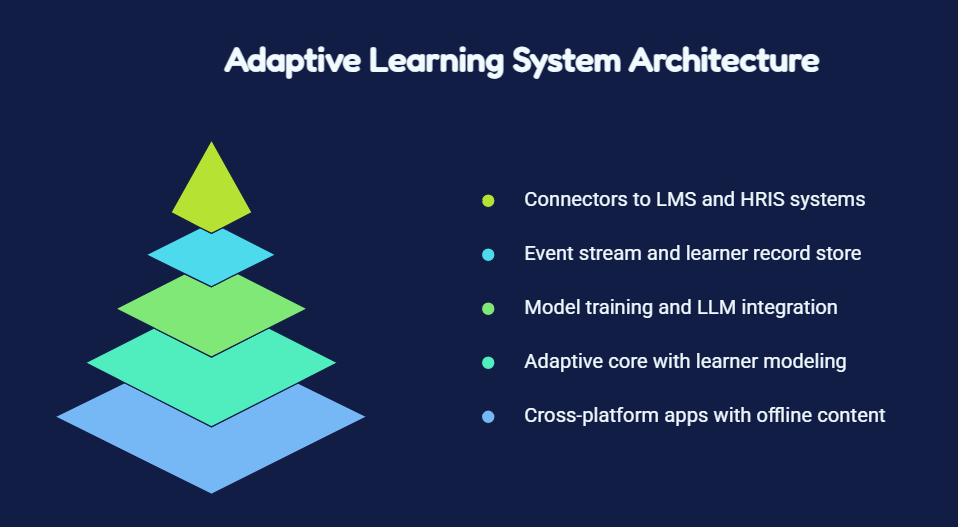
A production adaptive learning system typically comprises five layers:
- Mobile experience layer: Cross-platform apps built with Flutter or React Native delivering offline-capable content, gamification, and accessibility compliance the foundation of any modern mobile application development
- Learning engine layer. The adaptive core: learner modeling, knowledge graphs mapping skills and prerequisites, and the sequencing algorithm that selects the next activity.
- AI/ML services layer: Model training pipelines, LLM integration (with retrieval-augmented generation to ground tutor responses in your approved curriculum), NLP scoring services, and recommendation APIs.
- Data layer: An event stream capturing xAPI/SCORM-compliant learning records, a learner record store, and analytics warehousing.
- Integration layer: Connectors to your LMS, HRIS, SSO (SAML/OIDC), and BI tools critical for enterprises where learning data must feed talent and compliance systems.
The Development Process: From Discovery to Deployment
A disciplined build typically follows six phases:
- Discovery and learning-science design define competency frameworks, learner personas, and adaptivity rules before writing code
- Data strategy determine what signals you’ll capture and how models will be trained, validated, and monitored for bias
- MVP development a focused first release covering one course domain with core adaptive logic
- AI model integration and tuning calibrate difficulty algorithms against pilot cohort data
- Security hardening and compliance validation penetration testing, privacy review, accessibility audit
- Launch, measurement, and iteration A/B test adaptive strategies against fixed pathways to quantify lift
The most common failure mode we see is skipping phase one: adaptivity built without a competency model degenerates into a content shuffler, not a learning engine.
Business Benefits That Justify the Investment
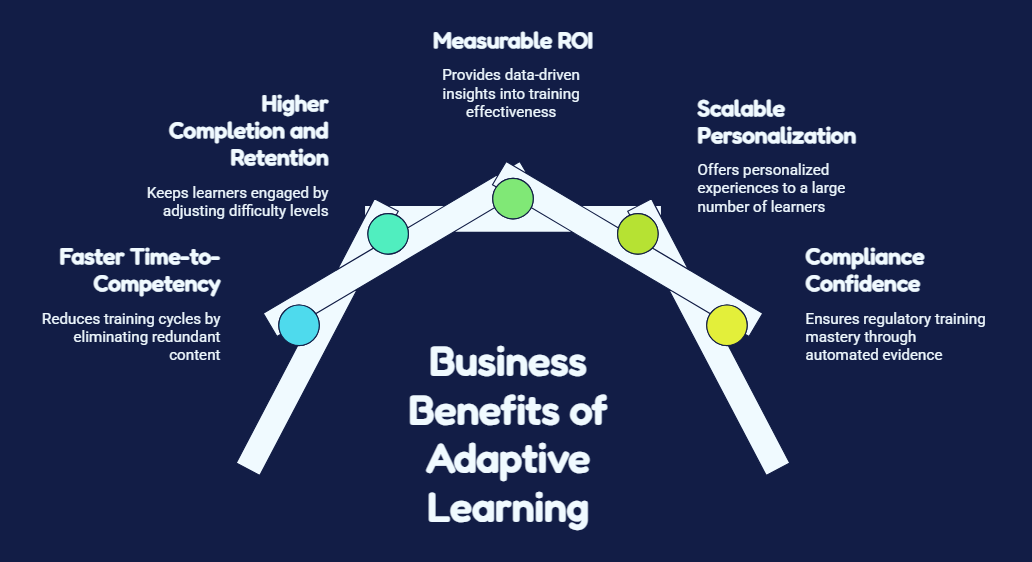
- Faster time-to-competency. Adaptive sequencing eliminates redundant content, compressing training cycles for onboarding and certification.
- Higher completion and retention. Personalized difficulty keeps learners in the optimal challenge zone, reducing both boredom and frustration.
- Measurable ROI. Predictive analytics turn L&D from a cost center into a performance function with dashboards executives actually use.
- Scalable personalization. One AI tutor serves 50 or 50,000 learners the economics improve with scale.
- Compliance confidence. Automated evidence trails demonstrate regulatory training mastery, not just attendance.
Corporate demand validates these outcomes: the corporate mobile learning segment alone is projected to grow from $49.19 billion in 2026 to $105.55 billion by 2030.
Real-World Use Cases
- Enterprise workforce development: Adaptive compliance and skills training that shortens certification timelines in regulated industries such as healthcare, finance, and energy
- K-12 and higher education: Platforms in the mold of DreamBox and Knewton that adjust math and language instruction to each student’s demonstrated mastery
- Language learning: Consumer apps like Duolingo demonstrate the engagement power of adaptive difficulty and spaced repetition at massive scale
- Government and public sector: Adaptive training for procurement, cybersecurity awareness, and citizen-facing workforce programs a natural fit for agencies modernizing under digital transformation mandates through specialized government app development partners
- Healthcare education: Clinical simulation apps that adapt scenario complexity to practitioner performance
Challenges, Security, and Responsible AI
Adaptive learning apps process sensitive behavioral and performance data, which raises the bar considerably:
- Data privacy and compliance: FERPA and COPPA for education, HIPAA for clinical training, GDPR/CCPA for global deployments privacy-by-design is non-negotiable
- Algorithmic fairness: Models must be audited so adaptive pathways don’t systematically disadvantage learner groups
- LLM governance: AI tutors require grounding, guardrails, and human review workflows to prevent inaccurate instruction
- Security architecture: Encryption at rest and in transit, role-based access control, SOC 2-aligned practices, and regular penetration testing
Market research confirms these are the real adoption barriers: roughly 42% of organizations cite integration challenges and 35% cite data privacy concerns as primary restraints. Choosing a development partner with formal security credentials (ISO 27001) materially de-risks the program.
Future Trends to Build For
- Generative AI content pipelines that produce and localize adaptive assessments on demand
- Multimodal tutoring combining voice, vision, and text for richer assessment
- Emotion-aware adaptivity using engagement signals to adjust pacing
- Skills-based credentialing with portable, verifiable micro-credentials
- Agentic learning assistants that plan a learner’s week, not just the next question
With Asia-Pacific pacing global mobile learning growth at an 18%+ regional CAGR, platforms architected for multilingual, low-bandwidth delivery will capture disproportionate share.
Why Invest Now
Three forces make 2026 the inflection point: LLM costs have fallen far enough to make AI tutoring economically viable at scale; adaptive capability is shifting from differentiator to expectation as two-thirds of platforms adopt AI; and the data advantage compounds every month of learner interactions makes your models harder for competitors to replicate. Organizations that wait are not just delaying a feature; they’re forfeiting the training data moat.
Build Your Adaptive Learning Advantage with App Maisters
App Maisters is a Houston-based digital transformation partner with ISO 9001 and ISO 27001 certifications, deep AI consulting expertise, and a proven track record delivering mobile applications for enterprises, startups, and government agencies. From competency-model design and LLM integration to secure, compliant deployment, our teams take adaptive learning platforms from concept to measurable outcomes.
Ready to explore what an AI-driven learning app could do for your organization? Explore our full range of services or schedule a free consultation with our AI and mobile experts today.
FAQs
How is adaptive learning different from personalized learning?
Personalized learning is the goal; adaptive learning is the AI-driven mechanism that achieves it automatically and continuously, without manual instructor configuration.
Can adaptive features be added to an existing learning app?
Yes. If your app already captures interaction data, an adaptive engine can be layered in typically starting with recommendation-driven sequencing before advancing to full learner modeling.
How much learner data is needed before AI personalization works?
Rules-based adaptivity works from day one. ML-driven models generally become reliable after a pilot cohort of a few hundred learners generates several weeks of interaction data.
Which platform approach is best native or cross-platform?
For most adaptive learning apps, cross-platform frameworks like Flutter or React Native deliver 90%+ code reuse without compromising the learning experience, reserving native development for AR/VR-heavy use cases.
How do you prevent an AI tutor from giving wrong answers?
Through retrieval-augmented generation grounded in approved curriculum, response guardrails, confidence thresholds, and human-in-the-loop review for flagged interactions.
How do you measure the ROI of an adaptive learning app?
Track four metrics against a pre-launch baseline: time-to-competency, course completion rate, assessment pass rate, and downstream performance indicators such as error rates or certification renewals. A/B testing adaptive pathways against fixed pathways during pilot gives you a defensible lift figure for executive reporting.
Does an adaptive learning app integrate with our existing LMS?
Yes. Modern adaptive platforms exchange data with enterprise LMS and HRIS systems through xAPI, SCORM, and LTI standards, so learner records, completions, and compliance evidence flow into the systems your organization already relies on no rip-and-replace required.