


Building Scalable Enterprise Mobile Apps in 2026
Enterprise mobile applications are no longer secondary interfaces for desktop systems. They have become operational platforms through which employees approve transactions, clinicians access patient information, field teams manage assets, and customers interact with critical services.
In 2026, scalability means more than accommodating a growing user base. An enterprise application must scale across transaction volumes, geographies, device types, integrations, AI workloads, security requirements, and changing business processes without compromising reliability or user experience.
This requires architecture decisions grounded in measurable business outcomes. Organizations considering enterprise mobile app development should therefore treat scalability as a product and operating-model concern, not merely an infrastructure feature.
Key Enterprise Mobile App Trends in 2026
Several developments are reshaping enterprise mobility strategies.
AI Is Moving Into Operational Workflows
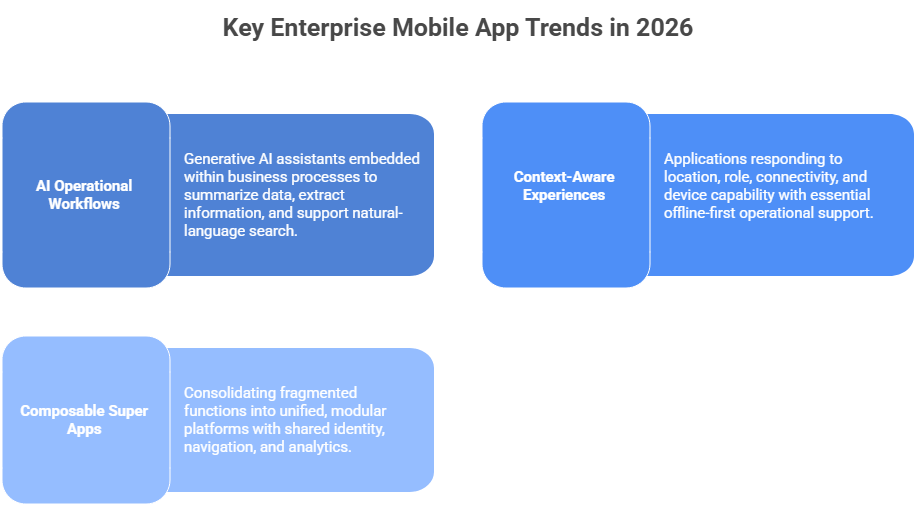
Generative AI is progressing from standalone chat interfaces to context-aware assistants embedded within business processes. Mobile applications can now summarize service histories, extract information from documents, recommend next actions, generate field reports, and support natural-language search.
McKinsey’s global AI survey found that organizations are broadening AI use, but most are still working to translate pilots into scaled business impact. The differentiator is not model access; it is the redesign of workflows, governance, data, and adoption practices around AI.
For example, an insurance application can help an adjuster photograph damage, identify missing evidence, summarize the inspection, and prepare a draft report. The adjuster remains accountable, while AI reduces administrative friction.
Mobile Experiences Are Becoming Context-Aware
Applications increasingly respond to location, role, connectivity, device capability, and real-time operational conditions. A logistics app may present different workflows to a driver, dispatcher, and warehouse supervisor, even though all three use the same underlying platform.
Offline-first operation is also becoming essential for healthcare, government, manufacturing, utilities, agriculture, and field-service environments. Reliable synchronization, conflict resolution, and encrypted local storage should be architectural requirements rather than later enhancements.
Super Apps and Composable Platforms Are Converging
Enterprises are consolidating fragmented functions into unified mobile platforms. Instead of maintaining separate apps for communication, approvals, scheduling, reporting, and service requests, organizations are creating modular experiences with shared identity, navigation, data, and analytics.
The strongest approach is composable: business capabilities remain independently deployable while the user experiences one coherent application.
Designing a Scalable Mobile App Architecture
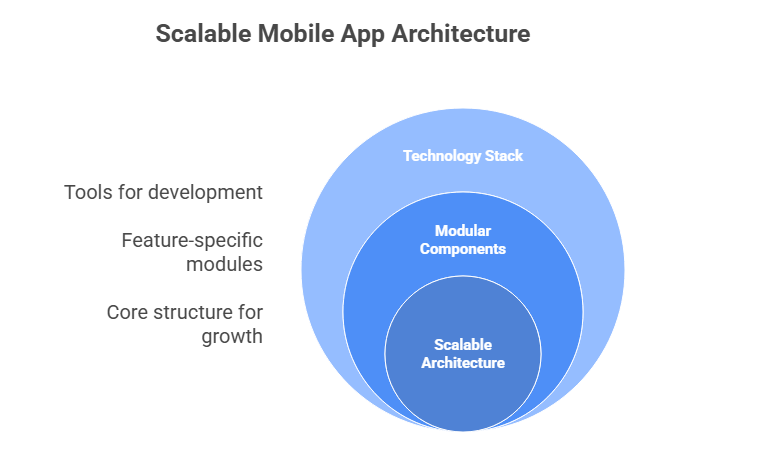
A scalable architecture separates presentation, business rules, integrations, data access, and platform services. This separation reduces the risk that a change in one area destabilizes the entire application.
Use Modular, Domain-Aligned Components
Mobile clients should be organized into feature modules such as identity, messaging, reporting, payments, or case management. Backend services should follow business domains rather than arbitrary technical layers.
Microservices can support independent scaling and deployment, but they are not automatically the right answer. A well-structured modular monolith may be more effective when domain boundaries are still evolving. Services should be separated when there is a clear need for independent ownership, release frequency, resilience, or scaling.
Select the Technology Stack Around the Workload
Native development with Swift and Kotlin remains appropriate for applications requiring advanced device capabilities, intensive graphics, precise performance, or deep operating-system integration.
Flutter and React Native are strong options for enterprises seeking shared delivery across iOS and Android. However, the decision should account for native-module requirements, accessibility, long-term maintainability, and the organization’s engineering capabilities not code sharing alone.
Backend platforms commonly combine Java, .NET, Node.js, Python, relational databases, document stores, caching, and event-streaming technologies. The correct combination depends on transaction consistency, analytics needs, integration patterns, and latency targets.
Integrating AI and Generative AI Responsibly
Enterprise AI should be introduced where it improves a defined workflow or decision—not where it merely makes the application appear innovative.
Suitable mobile use cases include:
- Conversational access to approved enterprise knowledge
- Document, call, and case summarization
- Computer vision for inspections and inventory
- Predictive maintenance and anomaly detection
- Personalized recommendations and next-best actions
- Voice-enabled data capture for field personnel
Organizations exploring enterprise AI development services should establish an AI gateway between mobile clients and model providers. This layer can manage model routing, prompt templates, authorization, sensitive-data filtering, rate controls, logging, and fallback behavior.
Retrieval-augmented generation should restrict responses to authorized enterprise content. High-impact outputs require citations, confidence indicators, validation rules, and human review. Agentic capabilities need even tighter controls: approved tools, bounded permissions, transaction limits, complete audit trails, and explicit confirmation before consequential actions.
Building on Cloud-Native Infrastructure and APIs
Cloud-native design provides elasticity, deployment consistency, observability, and regional resilience. The CNCF Annual Cloud Native Survey reported that 98% of surveyed organizations had adopted cloud-native techniques, while 82% of container users were running Kubernetes in production.
Containers and Kubernetes are valuable for complex, high-scale environments, but serverless functions and managed services can be better for event-driven or variable workloads. Architecture should reflect operational requirements rather than defaulting to a fashionable platform.
An API gateway should centralize authentication, routing, throttling, versioning, and monitoring. Backend-for-frontend services can optimize responses for mobile clients, reducing unnecessary network calls and payload sizes. Event-driven architecture can decouple processes such as notifications, analytics, document processing, and integration with ERP or CRM platforms.
Enterprises modernizing AI and mobile workloads can also examine how cloud platforms support enterprise AI transformation without tightly coupling applications to a single model or infrastructure provider.
Enterprise-Grade Security, Privacy, and Compliance
Security must extend from the device to the API, cloud environment, data layer, AI system, and software supply chain.
A zero-trust mobile architecture should include:
- Phishing-resistant authentication, MFA, and secure biometrics
- OAuth 2.0 and OpenID Connect with short-lived tokens
- Role- and attribute-based access controls
- Encryption in transit and at rest
- Secure device storage and certificate pinning where justified
- API schema validation, throttling, and abuse detection
- Mobile application shielding and runtime integrity checks
- Secrets management and automated credential rotation
- Software composition analysis and signed build artifacts
- Centralized security monitoring and incident response
Privacy-by-design requires data minimization, purpose limitation, retention controls, consent management, and auditable deletion workflows. Applicable obligations may include GDPR, CCPA/CPRA, HIPAA, PCI DSS, SOC 2 controls, FedRAMP requirements, or sector-specific regulations.
Compliance should be mapped to technical controls and verifiable evidence within the delivery pipeline. A checklist completed shortly before launch is not sufficient.
Performance, Scalability, and User Experience
Users experience scalability as responsiveness and reliability. They do not distinguish between a slow interface, an overloaded API, or an inefficient database query.
Teams should define service-level objectives for launch time, API latency, crash-free sessions, synchronization reliability, and successful transaction completion. Load testing should model realistic peaks, including authentication bursts, notification campaigns, large file uploads, and AI inference requests.
Caching, asynchronous processing, pagination, database indexing, connection pooling, and content delivery networks can improve responsiveness. Mobile clients should use background synchronization, compressed media, incremental loading, and graceful degradation when connectivity is weak.
Device and operating-system fragmentation remain material risks. App Maisters analysis of mobile fragmentation and feature reliability highlights the importance of traffic-based device matrices, adaptive layouts, feature flags, and hardware-capability detection.
Accessibility must receive equal attention. WCAG-aligned contrast, scalable text, screen-reader support, predictable navigation, adequate touch targets, and alternatives to gesture-only interactions improve usability for everyone.
Development and Maintenance Considerations
Scalable products require scalable delivery practices. Recommended foundations include:
- Automated builds, testing, security scanning, and deployment
- Trunk-based development or disciplined short-lived branches
- Infrastructure as code and reproducible environments
- Feature flags and controlled release strategies
- Contract testing for APIs and external integrations
- Centralized logs, metrics, traces, and crash analytics
- Dependency governance and scheduled platform upgrades
- Product analytics tied to operational outcomes
Maintenance should be planned as continuous product stewardship. Mobile operating systems, SDKs, privacy requirements, AI models, device form factors, and enterprise integrations will continue to change after launch.
Common Scalability Challenges and How to Address Them
Tight Coupling to Legacy Systems
Direct mobile-to-legacy integrations make every change risky. Introduce an API and orchestration layer that shields the mobile experience from legacy protocols and data structures.
Synchronous Processing Everywhere
Long-running synchronous workflows create timeouts and cascading failures. Move suitable operations to queues and event-driven workers, then provide users with clear progress states.
Scaling Without Observability
Adding infrastructure does not resolve inefficient queries, memory leaks, or failing dependencies. Use distributed tracing, meaningful service-level indicators, and automated alerts tied to user impact.
Uncontrolled AI Usage
Direct model calls can create inconsistent behavior, privacy exposure, and latency spikes. Centralize AI access, classify data, evaluate outputs, monitor model behavior, and provide deterministic fallbacks.
Fragmented Product Ownership
A scalable architecture cannot compensate for unclear accountability. Assign ownership by business capability and establish governance for APIs, data, design systems, security, and releases.
ROI and Business Value
Enterprise mobile ROI should be measured through business results rather than download numbers.
Relevant measures include reduced process completion time, higher field-worker productivity, fewer manual errors, faster service response, improved self-service adoption, lower abandonment, increased first-time resolution, stronger compliance evidence, and reduced operational disruption.
Leaders should baseline these measures before implementation and connect each major feature to an expected outcome. This creates a disciplined roadmap in which architecture, experience, and AI investments can be evaluated against measurable operational value.
Future-Readiness and Emerging Technologies
The next generation of enterprise mobile applications will combine multimodal AI, on-device inference, spatial computing, digital twins, passkeys, private 5G, edge processing, and increasingly autonomous workflows.
Future-readiness does not require adopting every emerging technology. It requires preserving options. Enterprises should maintain modular boundaries, portable data, model abstraction, open API standards, device-capability checks, and replaceable infrastructure components.
On-device AI will become particularly important for privacy-sensitive, offline, and low-latency use cases. Meanwhile, agentic AI systems will move from answering questions to coordinating bounded multistep activities. Their adoption should progress in proportion to the maturity of identity, governance, observability, and human oversight.
Final Thoughts
A scalable enterprise mobile app is not simply an application that can support more users. It is a secure, observable, adaptable business platform that can absorb new workflows, integrations, devices, AI capabilities, and regulatory obligations without repeated reinvention.
The strongest programs begin with domain-aligned architecture, measurable service objectives, governed AI, cloud-native integration, privacy-by-design, and continuous operational ownership.
Organizations evaluating their next enterprise mobility initiative can explore App Maisters mobile application development capabilities to assess how these principles can be translated into a resilient, future-ready solution.
FAQs
What makes an enterprise mobile app scalable?
A scalable enterprise mobile app can support increasing users, data, transactions, integrations, and features without reducing performance or reliability. App Maisters achieves this through modular architecture, cloud-native infrastructure, optimized databases, secure APIs, and automated monitoring.
What is the best architecture for a scalable mobile application?
The best architecture depends on the application’s workflows, transaction volumes, and integration requirements. App Maisters typically evaluates modular monoliths, microservices, event-driven architecture, and backend-for-frontend patterns to create a maintainable and scalable mobile app architecture.
How do you build a mobile app that can handle millions of users?
Building for millions of users requires elastic cloud infrastructure, load balancing, caching, asynchronous processing, database optimization, API throttling, and continuous performance testing. App Maisters designs enterprise mobile applications around realistic usage peaks and service-level objectives.
Which technology stack is best for enterprise mobile app development?
Native Swift and Kotlin are suitable for advanced performance and device integration, while Flutter and React Native support efficient cross-platform development. App Maisters selects the enterprise mobile app technology stack according to security, scalability, user experience, integration, and long-term maintenance requirements.
How can AI and generative AI be integrated into enterprise mobile apps?
AI and generative AI can support intelligent search, document summarization, predictive analytics, computer vision, personalization, and workflow automation. App Maisters integrates AI through governed APIs, retrieval-augmented generation, access controls, human oversight, and continuous model monitoring.
How do you secure a cloud-based enterprise mobile application?
A secure cloud-based mobile app should implement encryption, multifactor authentication, role-based access control, protected APIs, secure device storage, threat monitoring, and privacy-by-design. App Maisters aligns these controls with applicable requirements such as HIPAA, GDPR, PCI DSS, SOC 2, and FedRAMP.
How can an existing mobile app be made more scalable?
An existing app can be improved by identifying performance bottlenecks, decoupling legacy integrations, modularizing tightly connected components, optimizing databases, modernizing APIs, and introducing cloud-native services. App Maisters begins with an architecture and performance assessment before defining a phased modernization roadmap.