


Mobile Fragmentation Kills Features Before Users Ever See Them
You’ve spent weeks designing the perfect feature. The UI is polished, the logic is tight, and the internal demo earns applause. Then it ships and half your users never experience it correctly. Some see broken layouts. Others hit a crash wall. A segment can’t access it at all.
This isn’t a niche Android edge case. It’s a systemic challenge every mobile app development company faces costing businesses millions in delayed features, emergency patches, and abandoned roadmap items. In 2026, as on-device AI and foldables push complexity higher, fragmentation is getting harder not easier to manage.
The Scale Is Staggering in 2026
Android holds 70.6% of global active devices while iOS commands 28.7%. That Android dominance, however, comes at a steep engineering cost. The platform currently runs across more than 24,000 distinct device models in active use globally, according to DeviceAtlas and Scientia Mobile not models that have ever existed, but ones active right now.
The OS version spread makes it worse. As of early 2026, Android 10 still runs on 7.8% of devices, Android 11 on 15.2%, and Android 12 on 28.5%. Android 15 holds roughly 22–24% of the market, while Android 16 sits at only 13.3% adoption despite launching in 2025. Developers must maintain compatibility across seven major Android versions receiving meaningful traffic simultaneously Android 11 through 17.
iOS tells a different story. iOS 18 has reached 84.2% of active iPhones twelve months post-release, giving iOS teams far more headroom to drop legacy support quickly. Still, 20+ active iPhone models spanning multiple OS versions means fragmentation never fully disappears, even in Apple’s controlled ecosystem.
Features Don’t Just Break — They Get Cut Before Launch
Here’s the uncomfortable truth rarely surfaced in product postmortems: fragmentation doesn’t just cause post-launch bugs. It causes features to be removed before users ever see them.
Every time a team discovers that a feature behaves inconsistently across device variants say, an on-device AI recommendation engine that runs smoothly on a Snapdragon 8 Gen 3 flagship but degrades silently on a budget MediaTek device they face a brutal calculation: invest more engineering weeks patching every edge case, or scope it down.
Too often, they scope it down
A single feature requiring parallel implementation across multiple stacks can balloon from 16 developer-weeks to 24 weeks of engineering effort, a cost difference reaching $76,800 for one feature alone. Industry surveys show engineers lose 3–5 hours per week to fragmentation-related troubleshooting time taken directly from innovation. Across a mid-sized mobile team, that drain can reach millions of dollars annually.
2026’s New Fragmentation Forces
Three forces are escalating fragmentation complexity this year specifically.
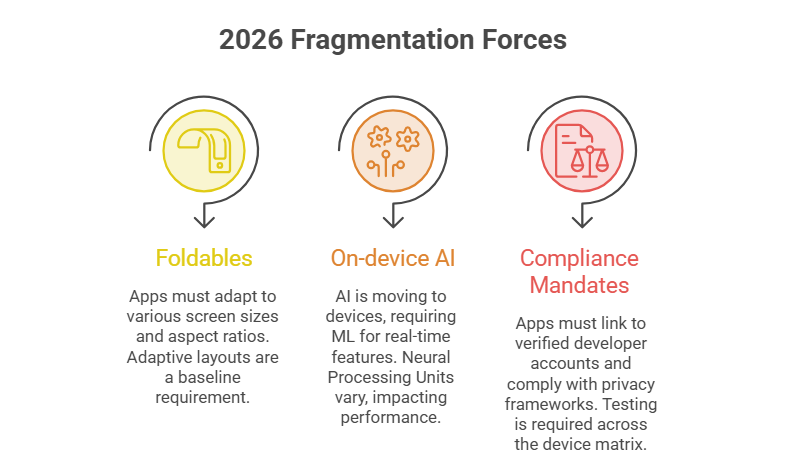
- Foldables going mainstream: The Samsung Galaxy Z Fold series, Google Pixel Fold, and a wave of Chinese foldable devices have redefined what “screen size” means. Apps must now transition seamlessly between folded and unfolded states across screen sizes from 4.7″ to 7.6″ and multiple aspect ratios. In 2026, building adaptive layouts is no longer optional it’s a baseline requirement.
- On-device AI raising hardware stakes: 2026 is the year AI has moved from the cloud to the device. Android 16 introduced on-device AI notification summaries, and modern apps are expected to leverage on-device ML for real-time voice, image, and personalization features. But Neural Processing Units vary enormously across device tiers. A feature that performs beautifully on a flagship can fail silently on the budget Android devices that account for hundreds of millions of active users in emerging markets.
- New compliance mandates: Starting September 2026, all apps on certified Android devices must link to a verified developer account with mandatory identity verification. Frameworks including DPDPA, HIPAA, and PCI-DSS now assume privacy-first, on-device architectures adding implementation that must be tested across the full device matrix.
Where Fragmentation Actually Kills Features
Fragmentation strikes across four dimensions. OS version fragmentation forces conditional implementations across seven live Android versions, often resulting in features being restricted to a subset of users or cut entirely. OEM skin fragmentation means Samsung One UI, Xiaomi MIUI, and OnePlus OxygenOS alter battery management, background process limits, and rendering behavior a feature passing QA on stock Android can fail on Samsung because One UI’s aggressive battery optimization kills the background service it depends on. Screen and form factor fragmentation spans 320px legacy phones to 1,440px+ phablets and now foldable variable states, each multiplying responsive design requirements. Cross-platform stack fragmentation occurs when teams split across native iOS, native Android, and multiple frameworks without a unified strategy every OS update and compliance mandate then requires parallel implementation, scaling costs linearly with each stack maintained.
How Winning Teams Fight Back
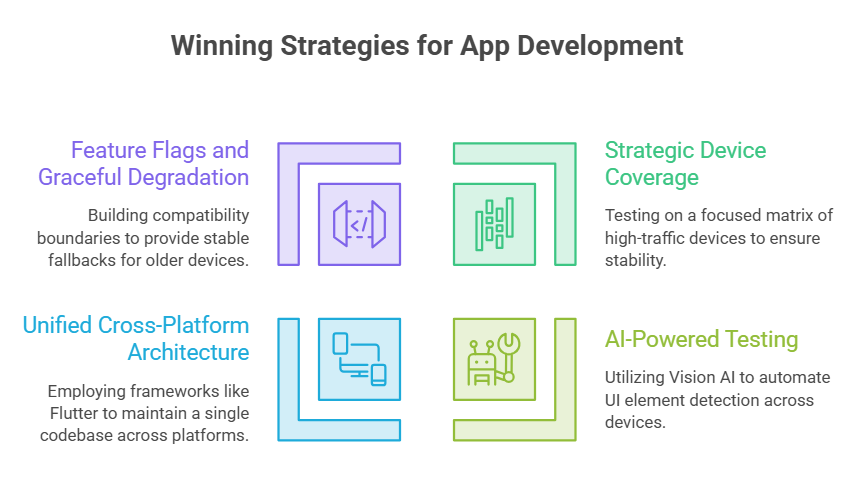
- Strategic device coverage: Apps tested on a focused matrix of 20–40 high-traffic devices maintain crash-free rates above 99%. The winning approach is traffic-weighted selection let your user analytics drive the test matrix. A failure on a device used by 35% of your users matters far more than one affecting 0.5%.
- AI-powered testing: Platforms now use Vision AI to locate UI elements across a Galaxy S24, iPhone 16, and Pixel 9 without device-specific selectors, eliminating the per-device maintenance overhead that made large matrices unsustainable. Cloud platforms like BrowserStack, Sauce Labs, and Firebase Test Lab give teams real-device access at scale without a physical lab.
- Unified cross-platform architecture: Flutter 3.x delivers a single codebase across iOS, Android, web, desktop, and foldables cutting development costs by roughly 30%. Flutter is now used by 42% of developers globally, and Kotlin Multiplatform is the standout choice for teams needing shared business logic with native UI performance.
- Feature flags and graceful degradation: Build compatibility boundaries into the feature spec upfront. Flags tied to OS version or hardware capability checks let modern devices enjoy richer experiences while older ones receive stable fallbacks instead of crashes the single most impactful habit that separates teams who ship complete features from teams who cut them.
Fragmentation Is a Revenue Problem, Not Just a Technical One
When features get cut due to compatibility chaos, retention drops. When fragmentation bugs reach users, app store ratings fall and in 2026, Android Vitals data directly influences Google Play discoverability. When engineers spend 3–5 hours weekly on device-specific firefighting, roadmaps slip by weeks every quarter. More than 80% of enterprises will have deployed AI-enabled apps by 2026 per Gartner, but AI features are hardware-dependent in ways previous features were not. Teams without fragmentation-aware architecture simply cannot ship their most compelling capabilities to the majority of their users.
The Bottom Line
The 2026 mobile landscape is the most complex in the industry’s history 24,000+ active Android device models, seven OS versions in play, foldables reshaping UI assumptions, on-device AI raising hardware stakes, and new compliance mandates landing mid-roadmap. None of this means your best features have to die before users see them.
That’s where App Maisters comes in. As a Houston-based, ISO-certified digital transformation firm specializing in AI/ML, mobile and web development, and cloud solutions, App Maisters brings the engineering depth and cross-platform expertise to navigate fragmentation at scale. Whether you’re launching a new mobile product or rearchitecting an existing one, App Maisters builds mobile solutions that ship complete features not compromised ones.
Ready to build mobile apps that work everywhere your users are? Connect with App Maisters today.
FAQs
What is mobile fragmentation and why does it matter for app development?
Mobile fragmentation refers to the diversity of devices, OS versions, screen sizes, and manufacturer customizations that apps must run across simultaneously. In 2026, Android alone spans 24,000+ active device models and seven major OS versions. For mobile app development teams, this means a feature that works perfectly on one device can crash or break entirely on another and fragmentation doesn’t just create bugs, it forces teams to cut features before users ever see them.
Is mobile fragmentation only an Android problem?
Android gets most of the attention 1,300+ manufacturers, 24,000+ active device models but iOS isn’t immune. With 20+ active iPhone models across four to five concurrent OS versions, plus foldables adding new layout dimensions, fragmentation affects every platform. The difference is degree: Android fragmentation is broader and harder to predict, while iOS is narrower but still demands deliberate compatibility planning.
How does device fragmentation increase mobile app development costs
A single feature requiring parallel implementation across multiple stacks can balloon from 16 developer-weeks to 24 a cost difference reaching $76,800 for one feature alone. Engineers also lose an estimated 3–5 hours per week to fragmentation-related troubleshooting. Across a full roadmap, these costs compound fast. Partnering with a firm like App Maisters, which builds fragmentation-aware architecture from day one, can significantly reduce that overhead.
What is the best way to test a mobile app across multiple devices in 2026?
The most effective approach is traffic-weighted device selection use your actual user analytics to prioritize the devices and OS versions that matter most. Apps tested on a focused matrix of 20–40 high-traffic devices consistently maintain crash-free rates above 99%. Pair that with cloud platforms like BrowserStack or Firebase Test Lab for real-device coverage at scale, without the cost of a physical device lab.
Does coss-platform development solve the fragmentation problem?
It significantly reduces it. Flutter and React Native provide a unified rendering layer across iOS and Android, cutting development costs by roughly 30% and eliminating duplicate codebases. Flutter 3.x in 2026 runs a single codebase across phones, tablets, foldables, and desktop. That said, OEM battery behaviors and hardware-dependent AI features still require compatibility planning. App Maisters combines cross-platform architecture with targeted QA and feature flags to cover the gaps frameworks alone can’t close.
How does mobile fragmentation affect AI-powered app features?
On-device AI is the most fragmentation-sensitive feature category in 2026. AI capabilities depend on Neural Processing Units that vary enormously across device tiers a feature that performs flawlessly on a flagship can fail silently on budget Android devices used by hundreds of millions globally. Every AI feature needs hardware-capability detection and graceful degradation paths built in from the spec stage, not added as an afterthought.
How can App Maisters help my business overcome mobile fragmentation?
App Maisters is a Houston-based, ISO-certified and SBA 8(a)-certified digital transformation firm specializing in mobile app development, AI/ML, and cross-platform architecture. Rather than treating fragmentation as a QA afterthought, App Maisters embed to every development phase from architecture selection to traffic-weighted device testing and post-launch monitoring. Whether you’re building new or modernizing an existing app, App Maisters ensures your features reach every user, on every device, as intended.