


Key Features of Low-Latency Edge AI Mobile Applications
For a decade, most mobile teams treated artificial intelligence as something that happened somewhere else. A user tapped a button, a payload travelled to a cloud endpoint, a model returned a prediction, and the interface updated. That round trip was fine when AI meant a recommendation carousel. It stops being fine the moment AI sits inside the interaction itself: a warehouse associate scanning damaged pallets, a technician diagnosing equipment from a live camera feed, a shopper using visual search at the shelf, a customer completing identity verification during onboarding.
The economics are unforgiving. Google’s research found that more than half of mobile users abandon an experience that takes longer than three seconds to respond, and analyses published through 2025 and 2026 continue to confirm that threshold holds. At the same time, Gartner has projected that roughly 75 percent of enterprise-generated data would be created and processed outside a traditional centralized data center or cloud, up from around 10 percent in earlier baselines.
The market has followed the workload. Grand View Research values the global edge AI market at 24.9 billion dollars in 2025, rising to an estimated 30.0 billion dollars in 2026 and 118.7 billion dollars by 2033, a 21.7 percent compound annual growth rate. The hardware is already in your customers’ hands: Counterpoint Research forecasts that generative AI capable smartphones will make up 45 percent of global shipments in 2026 and more than half by 2027.
What “Low Latency” Actually Means Here
Low latency means the application completes a full sense, infer, and respond cycle fast enough that the user perceives the result as part of their own action rather than a system reply. Human factors research places that perceptual boundary near 100 milliseconds, with roughly one second as the limit for uninterrupted flow of thought.
In practice, cloud-only inference on mobile typically lands somewhere between 250 milliseconds and 1.5 seconds end to end. On-device inference commonly lands between 40 and 150 milliseconds. The decisive difference is network transit, and it is decisive not because of its average but because of its variance. A median of 90 milliseconds means very little when the 99th percentile on a congested cell tower is 1.4 seconds. Edge AI removes that tail risk instead of merely shaving the mean.
Core Features of Low-Latency Edge AI Mobile Applications
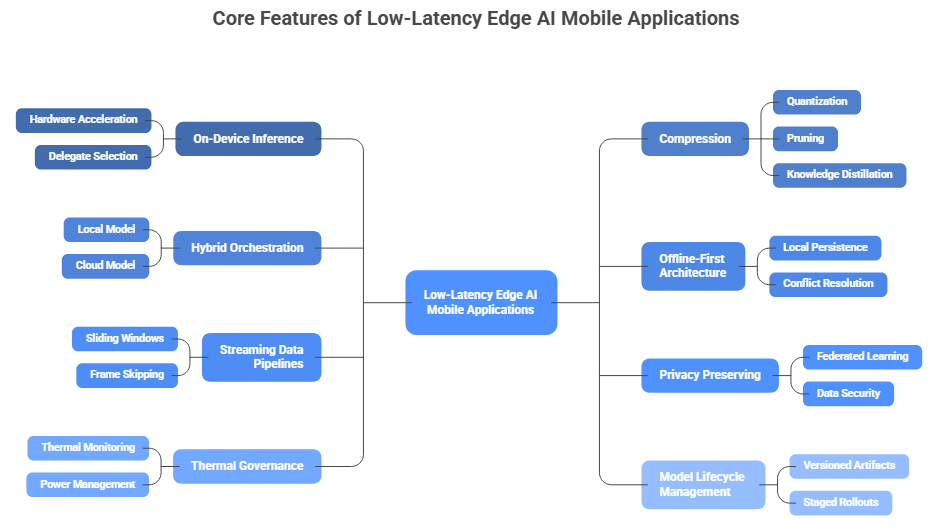
On-Device Inference With Hardware Acceleration
The foundation is inference executing on the device’s own silicon. Modern chipsets expose neural processing units, GPUs, and digital signal processors through runtimes such as Core ML, LiteRT, ONNX Runtime Mobile, and ExecuTorch. The discipline that matters is delegate selection and fallback: profile each model across available accelerators, pin the workload to the fastest compatible path, and degrade cleanly to CPU on older hardware rather than stalling. This is where experienced mobile app development engineering separates itself from a proof oaaaf concept.
Compression Built Into the Build Pipeline
A model sized for a data center will not fit a mid-range Android phone. Compression is a first-class part of delivery, not a cleanup step. Four techniques carry most of the weight: quantization from FP32 to INT8 or INT4, which commonly yields two to four times faster inference at modest accuracy cost; pruning of low-contribution weights and channels; knowledge distillation of a compact student model from a larger teacher; and selecting mobile-native architectures rather than shrinking an oversized model after the fact. Mature teams track accuracy loss as a documented budget with a hard ceiling, validated on device before release.
Intelligent Hybrid Edge and Cloud Orchestration
Very few commercial products are purely on-device. Strong architectures route each request to the cheapest tier that can satisfy it. A compact local model handles detection and classification instantly, a confidence threshold escalates ambiguous cases to a larger cloud model, and results reconcile asynchronously. The user gets instant feedback in the common case and accepts a short wait in the rare one.
Dimension | Cloud-Only AI | On-Device Edge AI | Hybrid Orchestration |
Typical response time | 250 ms to 1.5 s | 40 to 150 ms | 40 ms to 800 ms by tier |
Works offline | No | Yes | Partially |
Model size ceiling | Effectively unlimited | Bound by memory and thermals | Tiered |
Per-inference cost | Recurring compute and egress | Near zero after deployment | Optimized |
Data control | Depends on region and provider | Strongest, data can stay local | Configurable |
Best fit | Heavy reasoning, batch analytics | Real-time perception, private data | Most commercial products |
Offline-First Architecture
Field service, retail floor, logistics, agriculture, and construction applications operate where connectivity is intermittent by default. Offline-first design treats disconnection as a normal state, with local persistence, deterministic conflict resolution, queued sync, and an interface that communicates staleness honestly instead of pretending to be live.
Streaming, Event-Driven Data Pipelines
Batch thinking kills latency. Low-latency applications process continuous sensor, audio, and video streams incrementally, using sliding windows, frame skipping under thermal load, region-of-interest cropping, and early-exit inference. The goal is a steady frame budget rather than a fast average with visible stutters. This becomes especially demanding when the app coordinates with connected hardware, which is why IoT development and mobile engineering need to be planned as one system.
Privacy Preserving by Design
When inference happens on device, raw biometric, clinical, financial, or location data never has to leave it. That materially simplifies compliance posture under HIPAA, GDPR, and CCPA, and it is frequently the reason a regulated enterprise buyer approves the project at all. Federated learning extends the principle to training, so model updates travel while source data stays put.
Thermal, Power, and Memory Governance
Sustained inference generates heat, and a throttled device is a slow device. Production-grade applications monitor thermal state and battery level, adapt inference cadence and precision dynamically, cap memory pressure to avoid background termination, and expose a low-power mode. The constraint is tightest on wearable devices, where every milliwatt is contested.
Over-the-Air Model Lifecycle Management
Models drift. Shipping a new model should never require an app store release. Enterprise edge AI needs versioned model artifacts delivered over the air, staged rollouts with automatic rollback, per-cohort evaluation, and on-device telemetry reporting latency percentiles, accelerator utilization, and confidence distributions without exporting sensitive payloads.
Commercial Use Cases Where Milliseconds Change Outcomes
- Manufacturing and energy: on-device visual inspection flags surface defects inside the line cycle rather than after it, and vibration models on handheld devices support predictive maintenance in facilities with no reliable uplink
- Retail and eCommerce: shelf compliance scanning, visual product search, and self-checkout loss prevention that cannot afford a network stall at the point of sale
- Logistics and field services: real-time damage assessment at delivery, augmented reality overlays for asset identification, and guided repair in basements, tunnels, and remote sites
- Healthcare and life sciences: point-of-care triage, on-device speech to text for clinical notes, and remote monitoring that keeps protected health information local
- Financial services: document capture, liveness detection, and behavioral risk signals that cut both fraud exposure and cloud inference spend
Best Practices for Building Low-Latency Edge AI Apps
- Define the latency budget in milliseconds before selecting a model: Write down the 95th percentile target for the primary interaction and treat it as a release gate.
- Benchmark on your worst supported device, not your best: Flagship performance tells you almost nothing about the mid-range install base.
- Version models independently of the app binary: Decoupled lifecycles are what make continuous improvement possible.
- Instrument percentiles, never averages: Report p50, p95, and p99 inference and end-to-end latency per device tier.
- Design the escalation path explicitly: Decide in advance which cases go to the cloud, what the user sees while waiting, and what happens when the call fails.
- Test degraded conditions deliberately: Thermal throttling, low battery, 3G, and airplane mode belong in the QA matrix.
- Treat model governance as security work: Encrypt artifacts at rest, validate signatures before load, and log inference access for audit.
Challenges Worth Planning For
Device fragmentation remains the dominant cost driver, since accelerator support and driver quality vary widely across the Android ecosystem. Accuracy and size trade-offs are product decisions, not just engineering ones. Debugging is harder because failures happen on devices you cannot attach to. Model artifacts shipped to devices can be extracted, so intellectual property protection needs deliberate design. Edge AI also widens the skill surface required, because mobile engineering, machine learning, DevOps, and security have to operate as one group.
Build for the Interaction, Not the Endpoint
Low latency does not come from one clever framework. It comes from connected decisions: right-sized models, accelerated execution, honest offline behavior, disciplined thermal management, tiered orchestration, and a model lifecycle that keeps improving after launch. Teams that treat those as core product features ship applications that feel instant. Teams that treat them as optimizations for later usually ship something users abandon in three seconds.
App Maisters has been building enterprise mobile, AI and machine learning, and digital transformation solutions from Houston since 2014, serving businesses of all sizes across retail, manufacturing, healthcare, energy, and financial services. Our delivery practices are backed by ISO 9001 and ISO 27001 certifications, and our mobile app development teams work with product and technology leaders to set latency budgets, compress and validate models, design hybrid edge and cloud architectures, and stand up the pipelines that keep edge intelligence current.
FAQs
What is edge AI in mobile app development?
Edge AI in mobile app development means running AI models directly on the user’s device or on nearby edge infrastructure instead of a distant cloud server. App Maisters builds on-device inference into mobile products so predictions return in milliseconds, even when the network is slow or unavailable.
What is the difference between edge AI and cloud AI?
The difference is where processing happens. Cloud AI sends data to a centralized server, which adds network latency and bandwidth cost. Edge AI processes data locally for real-time inference and stronger data privacy. App Maisters typically recommends a hybrid edge and cloud architecture so each workload runs on the tier that fits it best.
How does edge AI reduce latency in a mobile app?
It removes the network round trip entirely. On-device inference using the NPU or GPU commonly returns results in 40 to 150 milliseconds versus 250 milliseconds to 1.5 seconds for cloud-only paths. App Maisters sets a measurable latency budget at the design stage and validates it against 95th percentile performance on real devices.
Do edge AI mobile apps work offline?
Yes. Because the model lives on the device, core AI features keep working without connectivity. App Maisters uses offline-first architecture with local persistence, queued sync, and deterministic conflict resolution, which matters for retail floor, field service, logistics, and manufacturing applications.
Does on-device AI drain battery life?
Poorly optimized implementations do. Well-engineered ones often use less energy than repeated cloud transmission. App Maisters applies model quantization, NPU acceleration, adaptive inference cadence, and thermal-aware throttling so sustained AI workloads do not degrade battery or device performance.
How much does it cost to build an edge AI mobile app?
Cost depends on model complexity, the number of device tiers you support, and whether inference is on-device, hybrid, or edge-server based. App Maisters scopes edge AI projects by use case and provides a phased estimate, usually beginning with a proof of concept that validates latency and accuracy targets before full build.
Which industries benefit most from low-latency edge AI applications?
Manufacturing, retail and eCommerce, logistics, healthcare, energy, and financial services see the clearest returns, because their workflows depend on instant decisions at the point of activity. App Maisters delivers edge AI, IoT, and mobile solutions across these sectors under ISO 9001 and ISO 27001 certified processes.