


How to Build HIPAA-Compliant Mobile Apps for Hospitals
Healthcare is fast becoming a software discipline. Every referral, diagnosis, medication order, and follow-up now leaves a digital trace, and increasingly that trace runs through a mobile app in a clinician’s or patient’s hand. That shift carries real risk. According to IBM’s 2026 Cost of a Data Breach Report, a healthcare breach now averages $4.99 million per incident, the highest of any industry for the fourteenth consecutive year, and takes roughly 279 days to identify and contain.
The message is clear. Building a mobile app for a hospital is not a feature exercise. It is a compliance, security, and patient-trust exercise from the first line of code. This guide walks through exactly how to build HIPAA-compliant mobile apps for hospitals, from regulatory requirements to architecture, cost, and where the rules are heading next. It builds on the same principles we apply across our custom mobile app development work.
Understanding HIPAA Compliance Requirements for Mobile Apps
HIPAA governs how protected health information (PHI) is created, stored, transmitted, and accessed. When PHI is handled electronically inside an app, it becomes electronic protected health information (ePHI), and it falls under the HIPAA Security Rule.
Two roles matter here. A hospital is a covered entity. Any vendor that builds, hosts, or maintains the app and can access ePHI is a business associate, which means a signed Business Associate Agreement (BAA) is mandatory before development touches live data.
The Security Rule organizes protection into three categories of safeguards:
- Administrative safeguards: risk analysis, workforce training, access management, and documented policies.
- Physical safeguards: controls over the devices, servers, and facilities where ePHI lives.
- Technical safeguards: encryption, access controls, audit logging, and transmission security.
What Counts as PHI in a Mobile App
PHI is broader than a diagnosis. It includes names, dates, medical record numbers, device identifiers, geolocation tied to care, appointment details, and even metadata that can re-identify a patient. A good design principle: if a data point can be traced back to an individual and their care, treat it as PHI.
Essential Security Features Every HIPAA-Compliant App Needs
Compliance is a floor, not a ceiling. Every hospital-grade app should build in the following:
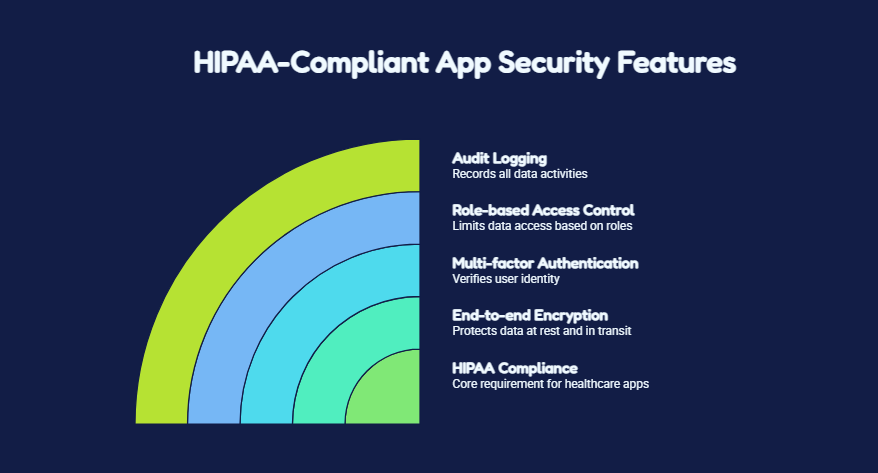
- End-to-end encryption: AES-256 for data at rest and TLS 1.2 or higher for data in transit.
- Multi-factor authentication (MFA): for clinicians, administrators, and remote access to ePHI.
- Role-based access control (RBAC): users see only the data their role requires.
- Automatic session timeout and remote wipe: critical for lost or stolen mobile devices.
- Comprehensive audit logging: every access, edit, and export of ePHI recorded and reviewable.
- Secure local storage: no PHI cached in plain text, screenshots, or push-notification previews.
Architecture Best Practices for HIPAA-Compliant Apps
Strong architecture makes compliance sustainable rather than a scramble before each audit.
Adopt Zero-Trust and Data Minimization
Assume no request is trusted by default. Authenticate and authorize every call to the backend, segment networks, and collect only the PHI the workflow genuinely needs. Less data stored means less data to protect and less exposure if something goes wrong.
Keep PHI Off the Device Where Possible
Favor a thin-client model where sensitive data lives in a hardened, HIPAA-eligible cloud backend and the app renders it on demand. Pair this with API gateways, encrypted tokens, and short-lived sessions so that a compromised handset does not become a compromised record system.
Design for Interoperability
Hospitals rarely start from zero. Build on HL7 FHIR standards so the app exchanges data cleanly with EHR systems such as Epic and Cerner, rather than creating another data silo.
The HIPAA-Compliant App Development Process
A disciplined, phased process keeps compliance embedded end to end:
- Risk analysis and discovery: map data flows, identify every point where ePHI is touched, and document risks. OCR enforcement data consistently shows that a missing or inadequate risk analysis is the single most common HIPAA failure.
- Compliance-first design: define RBAC roles, consent flows, and encryption strategy before UI design is finalized.
- Secure development: use secure coding standards, dependency scanning, and code review for every release.
- Testing and validation: functional QA plus penetration testing and vulnerability scanning.
- Deployment on HIPAA-eligible infrastructure: with signed BAAs from every cloud and third-party provider.
- Monitoring and maintenance: continuous logging, patching, and periodic re-assessment.
App Maisters follows this framework across its mHealth app development engagements, treating compliance as a design input rather than a final checkbox.
Common HIPAA Compliance Mistakes to Avoid
Even experienced teams stumble on the same issues:
- Skipping or outdating the risk analysis: It is required under current rules and is the top cited violation.
- Treating encryption as optional: Unencrypted ePHI remains a leading cause of penalties.
- Missing BAAs: Every vendor with data access, including analytics and crash-reporting tools, needs one.
- Leaking PHI through third parties: Advertising pixels and SDKs have caused some of the largest healthcare exposures on record.
- Weak logging: If you cannot prove who accessed what and when, you cannot demonstrate compliance.
Technologies and Integrations for Hospital Apps
The right stack balances performance, security, and interoperability.
| Layer | Recommended Approach | Why It Matters |
|---|---|---|
| Cloud hosting | AWS, Azure, or Google Cloud on HIPAA-eligible services with a signed BAA | Foundation for compliant storage and processing |
| Interoperability | HL7 FHIR, SMART on FHIR | Clean, standards-based EHR integration |
| Authentication | OAuth 2.0, MFA, biometric login | Controls access to ePHI |
| Encryption | AES-256 at rest, TLS 1.2+ in transit | Core technical safeguard |
| Mobile frameworks | Native (Swift, Kotlin) or cross-platform (Flutter, React Native) | Performance versus faster multi-platform delivery |
The native-versus-cross-platform decision depends on device features and budget. Our guides to hybrid app development and native iOS app development break down that trade-off in detail.
Implementation Challenges to Plan For
Hospitals face predictable hurdles: integrating with legacy EHRs, driving clinician adoption without disrupting workflows, securing an expanding fleet of personal and hospital-owned devices, and keeping pace with evolving regulations. Each is manageable with the right partner, but each needs to be budgeted for early rather than discovered mid-project.
Partner with a Healthcare App Development Team That Builds Compliance In
Building a HIPAA-compliant mobile app for a hospital is demanding, but it does not have to be risky. App Maisters is an ISO 9001 and ISO 27001 certified digital transformation company that partners with hospitals, clinics, and health-tech innovators to design secure, interoperable applications. Our healthcare portfolio includes HIPAA-compliant products such as AM Telehealth, a remote care platform with video consultations and e-prescribing, built for businesses of all sizes across the care continuum.
If you are planning a patient portal, telehealth platform, or clinical tool, explore our healthcare app development capabilities or contact App Maisters to scope a compliant, future-ready build.
FAQs
What makes a mobile app HIPAA-compliant?
It must protect ePHI through administrative, physical, and technical safeguards, including encryption, access controls, audit logging, and signed BAAs with every vendor that can access patient data.
Do all healthcare apps need to be HIPAA-compliant?
Any app that creates, stores, or transmits identifiable patient data on behalf of a covered entity must comply. Purely general-wellness apps with no PHI may fall outside HIPAA, but the line is easy to cross.
How long does it take to build a HIPAA-compliant hospital app?
Most projects run four to nine months depending on complexity, integrations, and testing depth. Compliance work is embedded throughout rather than added at the end.
Is cloud hosting HIPAA-compliant?
Major providers offer HIPAA-eligible services, but they are only compliant when configured correctly and covered by a signed BAA. Compliance is a shared responsibility.
What happens if a hospital app is not HIPAA-compliant?
Violations can trigger significant OCR penalties, breach costs averaging millions of dollars, litigation, and lasting reputational damage.
Can existing hospital apps be made HIPAA-compliant?
Yes. A gap assessment identifies missing safeguards, after which encryption, access controls, logging, and infrastructure changes can be remediated, though early design is always cheaper.
Why choose App Maisters for HIPAA-compliant app development?
App Maisters combines ISO-certified security practices, FHIR-based interoperability, and a compliance-first development process, with proven HIPAA-compliant healthcare products already in production.