


Building Mobile Apps for Remote Oil Field Operations
The oil field has never been a friendly place for technology. Crews work hundreds of miles from the nearest cell tower, in heat, dust, and pressure that destroy consumer-grade hardware and yet the pressure to digitize has never been higher. Operators that still run remote sites on paper logs and radio calls are quietly bleeding money every single day.
The numbers explain why. The digital transformation market in oil and gas reached roughly $72.23 billion in 2025 and is projected to climb to nearly $124.94 billion by 2030, growing at about 11.6% annually, according to Mordor Intelligence. North America alone accounts for roughly a third of that spending. IoT and AI are the fastest-moving segments and both depend on one thing that field crews can actually hold in their hands: a mobile app.
This guide breaks down what it takes to build mobile apps for remote oil field operations the challenges, the must-have features, realistic costs and timelines, and the ROI that makes the investment defensible to your CFO.
Why Remote Oil Field Operations Need Mobile Apps
Unplanned downtime is the silent killer of oilfield economics. Industry research shows an offshore operation averages around 27 days of unplanned downtime per year, and even 3.65 days can cost more than $5 million. Estimates of the cost of a single idle hour range from $125,000 to over $260,000 depending on the operation.
A purpose-built mobile app attacks that loss directly. It puts inspection checklists, work orders, asset data, and safety reporting into the hands of every technician online or off so problems get caught and logged before they cascade into a shutdown.
Key takeaways:
- Paper-based and radio-driven workflows create reporting lag that turns small faults into expensive failures.
- Mobile apps centralize field data, giving operations and IT a single real-time view across dispersed sites.
- Digitized field workflows improve safety compliance and shrink the documentation burden that slows crews down.
Key Challenges in Oil Field App Development
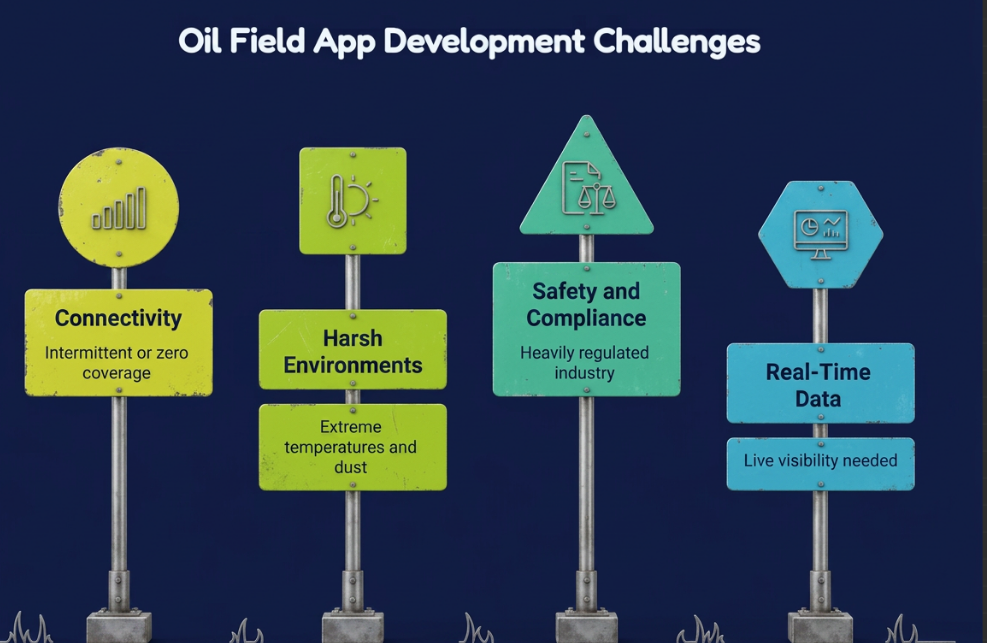
Building for the oilfield is not the same as building a standard enterprise app. Four constraints shape every decision.
Connectivity in Remote Sites
Most well sites, pipelines, and offshore platforms have intermittent or zero cellular coverage. An app that assumes a live connection is useless the moment a crew drives past the last tower. Connectivity has to be treated as optional, not guaranteed.
Harsh Operating Environments
Devices face extreme temperatures, vibration, dust, moisture, and explosive (hazardous-area) zones. Apps must run on ruggedized and intrinsically safe hardware, support glove-friendly touch targets, and remain readable in direct sunlight.
Safety and Compliance
Oil and gas is among the most heavily regulated industries on earth, governed by OSHA, EPA, PHMSA, and a web of state rules. Apps must capture auditable records, enforce permit-to-work procedures, and protect data non-trivial when fines can run thousands of dollars per day of violation.
Real-Time Data Demands
Operations leaders need live visibility into pressure, flow, temperature, and equipment health. Bridging the gap between field sensors and an enterprise dashboard reliably, securely, and with low latency is the central engineering problem.
Must-Have Features for Oil Field Mobile Apps
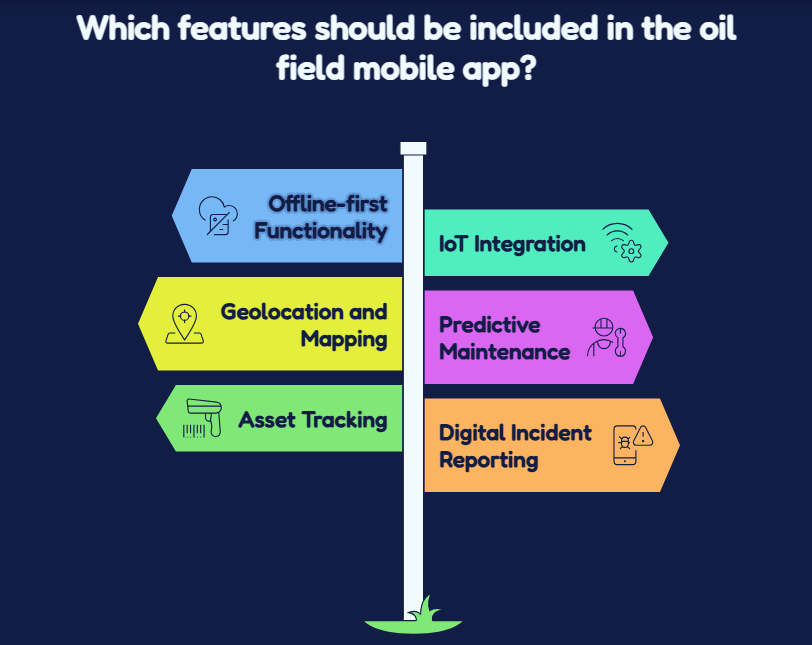
The right feature set separates an app that crews actually use from one that gathers dust.
- Offline-first functionality: This is non-negotiable. The app must let crews complete inspections, log readings, and file reports with no signal, then sync automatically and resolve conflicts once connectivity returns.
- IoT and sensor integration: IoT and sensor integration direct connections to wellhead sensors, SCADA systems, and edge devices stream condition data vibration, temperature, pressure into the app and onward to the cloud.
- Geolocation and mapping: GPS-tagged assets, route optimization for pumpers, and geofenced safety zones help crews navigate sprawling lease areas and prove where work was done.
- Predictive maintenance: Machine-learning models trained on sensor data flag equipment likely to fail weeks in advance turning emergency repairs into scheduled ones.
- Asset tracking: Barcode, RFID, or QR scanning gives a real-time inventory of pumps, valves, tools, and vehicles across every site.
- Digital incident reporting: One-tap hazard and near-miss reporting with photo capture, e-signatures, and automatic routing to safety managers keeps compliance airtight.
A practical scenario: a pumper on a 40-well route loses signal an hour into the day. With an offline-first app, every meter reading, photo, and equipment note is captured locally. When the truck returns to coverage, all of it syncs and a vibration anomaly flagged at well #17 has already triggered a predictive-maintenance work order before the compressor ever fails.
Tech Stack and Architecture Considerations
Architecture is where oilfield apps succeed or fail.
The dominant pattern is an offline-first, edge-to-cloud architecture. Data is captured and processed locally on the device or a nearby edge gateway, with intelligent sync to the cloud when bandwidth allows. This keeps the app functional anywhere and reduces the volume of data pushed over expensive satellite links.
For the build itself, mobile app development frameworks like Flutter and React Native let operators deploy to iOS and Android (and ruggedized variants) from one codebase cutting cost and time without sacrificing native sensor access. Cloud back ends typically run on AWS or Azure, both of which offer oil-and-gas-specific IoT services.
Other essentials include local databases (SQLite, Realm) for offline storage, MQTT or similar lightweight protocols for IoT messaging over constrained networks, and end-to-end encryption with role-based access control to satisfy security audits the kind backed by ISO 27001 certification.
Benefits and ROI
The business case is unusually clear in oil and gas. Predictive maintenance alone delivers measurable returns: the U.S. Department of Energy estimates it saves 8–12% over preventive maintenance and 30–40% over reactive maintenance. Major operators report comparable gains Shell has cited a roughly 20% reduction in unplanned downtime and a 15% drop in maintenance costs from predictive technology, while ADNOC reported a 20% maintenance-cost reduction across hundreds of machines.
Most predictive-maintenance and field-mobility programs report ROI within 6 to 12 months. Beyond the hard savings, operators gain faster compliance reporting, fewer safety incidents, longer asset life, and a workforce that spends more time on wrenches and less on paperwork.
Bottom line: A well-built field app doesn’t just digitize a workflow it pays for itself by preventing the multi-million-dollar downtime events that define oilfield risk.
Build With a Partner Who Knows the Field
Building software that survives the oilfield and satisfies the auditors takes more than a development shop. It takes a partner fluent in offline-first architecture, IoT, enterprise security, and the regulatory environment your business lives in.
App Maisters is a Houston-based digital transformation firm built for exactly this work. As an ISO 9001 and ISO 27001-certified company with SBA 8(a) and MBE credentials, we bring engineering rigor, security discipline, and energy-sector proximity to every engagement serving both commercial enterprises and government clients. From MVP to enterprise platform, we design field apps that work where the work happens.
If you’re ready to turn remote-site downtime into uptime, let’s talk. Contact App Maisters for a discovery session and a tailored roadmap for your operation.
FAQs
How long does it take to build a mobile app for oil field operations?
A basic inspection app takes about 3–4 months; a full enterprise platform with IoT and predictive analytics typically runs 7–12 months. A phased MVP can put a working tool in the field faster.
How much does an oil field mobile app cost?
Expect roughly $40,000–$80,000 for a basic app, $80,000–$150,000 for a mid-tier build, and $150,000–$300,000+ for an enterprise platform with SCADA and analytics integration.
Can the app work without internet at remote sites?
Yes. An offline-first architecture lets crews capture data, complete inspections, and file reports with no connectivity, then sync automatically when a signal returns.
How do these apps integrate with existing SCADA and IoT systems?
Through APIs, edge gateways, and lightweight messaging protocols like MQTT, the app connects to wellhead sensors, SCADA, and ERP systems to stream real-time data securely.
Are oil field mobile apps secure and compliant?
A properly built app uses end-to-end encryption, role-based access, and auditable records to meet OSHA, EPA, PHMSA, and data-security standards best supported by an ISO 27001-certified partner.
What ROI can we expect from a field mobility app?
Most operators see ROI within 6–12 months, driven largely by reduced unplanned downtime, lower maintenance costs, and faster compliance reporting.
Should we build native or cross-platform?
For most oilfield use cases, cross-platform frameworks like Flutter or React Native deliver native-level performance and full sensor access while cutting cost and time-to-market.