


Edge AI 2026: Powering Instant Decisions on Every Device
A delivery drone reroutes around a sudden gust of wind before its cloud connection would have even finished loading. A factory sensor flags a bearing about to fail, three seconds before the vibration pattern becomes catastrophic. A hospital wearable spots an irregular heartbeat and alerts a nurse before the patient feels a thing.
None of this happens in a data center. It happens on the device, in milliseconds, with no round trip to the cloud. That is Edge AI in 2026, and it has quietly become one of the most consequential shifts in enterprise technology.
The numbers back up the urgency. The global edge AI market reached roughly $33.30 billion in 2026 and grow at a CAGR of 15.87% to $81.12 billion by 2032. Edge AI chip shipments alone are expected to hit 1.6 billion units this year, a clear signal that intelligence is migrating from centralized servers to the devices in our pockets, on our factory floors, and inside our vehicles.
What Is Edge AI in 2026?
Edge AI is the practice of running trained AI models directly on local hardware, smartphones, cameras, sensors, gateways, and industrial controllers, rather than sending data to a remote cloud server for processing. The model lives close to where the data is generated, so inference happens instantly and locally.
In 2026, this idea has matured well past niche IoT experiments. Compact, highly optimized language and vision models now run comfortably on smartphone-class chips. Purpose-built NPUs ship standard in consumer electronics. And on-device AI has become a checkbox feature in everything from cars to point-of-sale systems.
What separates 2026’s edge AI from earlier attempts is efficiency. Model compression, quantization, and specialized silicon mean a device can run sophisticated inference without needing a permanent internet connection or a server rack nearby. This is the foundation of modern on-device AI: the intelligence travels with the hardware, not the network.
Why Edge AI Is Transforming Industries
Three forces are driving enterprise adoption at once:
- Latency intolerance. Autonomous systems, industrial safety controls, and real-time fraud detection cannot wait for a network round trip. Milliseconds matter.
- Data gravity and privacy pressure. Regulations and customer expectations increasingly demand that sensitive data, medical records, biometric data, financial transactions, stay local instead of streaming to third-party servers.
- Connectivity gaps. Oil rigs, rural clinics, manufacturing plants, and moving vehicles cannot always guarantee stable bandwidth. Edge AI keeps intelligent systems functional offline.
Manufacturing currently leads edge computing adoption, with automotive and IT/telecom close behind, according to industry tracking from Grand View Research and The Business Research Company. Healthcare is accelerating fast too, with hospital AI adoption expected to approach 90% by the end of 2026. These aren’t experimental pilots anymore; they’re core infrastructure decisions.
Key Technologies Enabling Edge AI
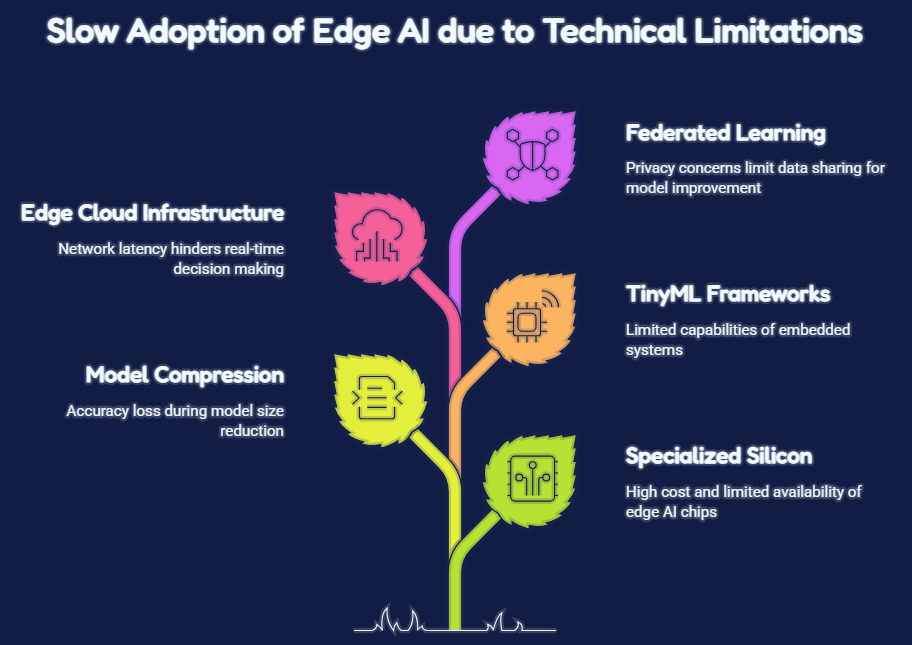
A handful of technical building blocks make today’s edge AI boom possible:
1. Specialized Silicon (NPUs, TPUs, Edge GPUs)
Chipmakers including NVIDIA, Qualcomm, Apple, and MediaTek have pushed dedicated neural processing units into everyday hardware. NVIDIA alone controls close to 39% of edge AI computing revenue, with its Jetson platform now supported by roughly two million developers.
2. Model Compression and Quantization
Techniques like pruning, distillation, and low-bit quantization shrink large models into forms small enough to run on constrained hardware, without gutting accuracy.
3. TinyML and Lightweight Frameworks
Frameworks purpose-built for microcontrollers and embedded systems let manufacturers embed inference directly into sensors and industrial equipment.
4. Edge Cloud Infrastructure
Faster, lower-latency networks complement, rather than replace, on-device intelligence, enabling hybrid architectures where edge devices handle instant decisions and periodically sync with the cloud for retraining and analytics. Getting this handoff right usually comes down to solid cloud development foundations behind the scenes.
5. Federated Learning
Devices can improve shared models by learning locally and sending only model updates, not raw data, back to a central system. This preserves privacy while still improving performance over time.
Real-World Enterprise Use Cases
Edge AI is already reshaping how enterprises operate:
- Manufacturing: Computer vision on the production line catches defects in real time, and predictive maintenance sensors flag equipment issues before costly downtime.
- Retail: Smart shelves and checkout cameras detect stockouts and prevent shrinkage without shipping video feeds to the cloud.
- Healthcare: Wearables and bedside monitors analyze vitals on-device, flagging anomalies instantly while keeping patient data local for compliance.
- Automotive: Advanced driver-assistance systems and autonomous vehicles process camera and LIDAR data on the vehicle itself, since a delayed cloud response is not an option.
- Logistics and Field Operations: Handheld scanners and drones make routing and inspection decisions without needing constant connectivity.
- Smart Cities: Traffic cameras and public safety sensors process footage locally, reducing bandwidth costs while improving response times.
For enterprises building their own connected products, this is where a strong AI app development partner matters, translating these use cases into production-grade, on-device systems rather than one-off proofs of concept.
Challenges to Consider
Edge AI isn’t a plug-and-play upgrade. Enterprise leaders should plan around:
- Hardware constraints: Not every device can run every model; compression and hardware selection require real engineering trade-offs.
- Fragmented device ecosystems: Managing model updates across thousands of heterogeneous devices is operationally complex.
- Model drift: On-device models can go stale without a solid retraining and deployment pipeline.
- Talent gaps: Edge AI blends embedded systems engineering, ML expertise, and mobile development, a rare combination in-house.
This is precisely why enterprises increasingly look outward. Partnering with an experienced AI development company shortens the learning curve and avoids expensive missteps in hardware selection and deployment architecture.
Security and Privacy Considerations
Running AI on-device reduces some risks (less raw data in transit) but introduces new ones. Enterprises need to account for:
- On-device model theft: Deployed models can potentially be extracted or reverse-engineered from hardware.
- Firmware and endpoint security: Every edge device becomes a potential attack surface.
- Update integrity: Over-the-air model updates must be signed and verified to prevent tampering.
- Compliance alignment: Even with data staying local, enterprises still need auditable governance frameworks, particularly in regulated industries like healthcare, finance, and government.
Enterprises operating in the public sector face an added layer of scrutiny here, and mature enterprise AI deployments typically pair edge architecture with dedicated cybersecurity practices covering vulnerability assessment, endpoint hardening, and secure update pipelines.
Edge AI vs. Cloud AI: A Practical Comparison
Factor | Edge AI | Cloud AI |
Latency | Milliseconds, local inference | Seconds, dependent on network |
Connectivity | Works offline | Requires stable connection |
Data Privacy | Data stays on-device | Data transmitted to servers |
Compute Power | Constrained by device hardware | Virtually unlimited scale |
Cost Structure | Higher upfront hardware cost | Ongoing cloud/compute costs |
Best For | Real-time, safety-critical, offline scenarios | Large-scale training, complex analytics |
Model Updates | More complex to distribute | Centralized and simpler |
In practice, most mature enterprises land on a hybrid model: cloud infrastructure for training, analytics, and heavy lifting, edge devices for instant, local decision-making. The two aren’t competitors so much as complementary layers of the same intelligent system.
Beyond 2026: What’s Next for Edge AI
- Smaller, smarter foundation models built for edge deployment will keep narrowing the gap with cloud-hosted models.
- Edge-cloud orchestration platforms will manage device fleets as one coordinated system instead of isolated endpoints.
- Agentic edge AI will emerge: devices that take multi-step actions locally and coordinate with nearby devices, not just infer.
- Vertical-specific edge AI solutions will proliferate in healthcare, automotive, and smart infrastructure as specialized chips mature.
- Sustainability pressure will push more workloads to the edge, since distributed, efficient inference uses less energy than constant cloud round trips.
How Enterprises Can Successfully Adopt Edge AI
- Start with a high-value, low-risk use case: Predictive maintenance or defect detection are common, well-understood entry points.
- Audit your hardware realistically: Know what your existing devices can and cannot run before committing to a model architecture.
- Build for hybrid from day one: Design systems that use the edge for speed and the cloud for scale, not one or the other.
- Invest in a secure deployment pipeline: Signed updates, endpoint monitoring, and version control aren’t optional at enterprise scale.
- Partner strategically: Few internal teams have deep expertise across embedded systems, ML engineering, and mobile app development simultaneously. The fastest path to production is usually through an experienced partner who has already solved these problems.
Build Your Edge AI Advantage with App Maisters
Edge AI rewards the organizations that move early and build it right. App Maisters has spent over a decade helping startups, enterprises, and government agencies design and ship intelligent, scalable applications, from AI/ML strategy and proof-of-concept validation to full production deployment across mobile, cloud, and connected devices.
Whether you’re exploring Edge AI development for a new product line or modernizing an existing system with Edge AI solutions, our team brings the combination of AI engineering, mobile expertise, and enterprise-grade security your project needs. Backed by ISO 9001 and ISO 27001 certifications, we help you move from concept to deployment without compromising on compliance or performance.
Ready to bring instant, on-device intelligence to your product? Talk to App Maisters AI development team and turn Edge AI from a roadmap item into a competitive advantage.
FAQs
What is Edge AI and how is it different from Cloud AI?
Edge AI runs AI models directly on local devices like smartphones, sensors, and cameras, while Cloud AI processes data on remote servers. App Maisters helps enterprises decide which workloads belong on-device for speed and which belong in the cloud for scale, often blending both into one hybrid architecture.
Is Edge AI better than Cloud AI for real-time applications?
Yes, for latency-sensitive use cases like autonomous vehicles, fraud detection, and industrial safety systems, Edge AI responds in milliseconds without waiting on a network round trip. App Maisters Edge AI development approach is built around exactly these real-time, mission-critical scenarios.
How much does Edge AI development cost for a business?
Cost depends on device hardware, model complexity, and how many endpoints need to be managed, so there’s no single flat rate. App Maisters typically starts with a scoped proof of concept to give enterprises an accurate, project-specific estimate before full-scale Edge AI solutions development begins.
Can Edge AI work without an internet connection?
Yes, that’s one of its core advantages. Because inference happens on the device itself, Edge AI systems built by App Maisters continue operating in low-connectivity environments like factories, rural clinics, and moving vehicles.
Is on-device AI more secure than cloud-based AI?
On-device AI keeps sensitive data local, which reduces exposure during transmission, but it introduces its own risks like firmware tampering and model extraction. App Maisters pairs Edge AI development with dedicated endpoint security and secure update pipelines to close those gaps.
Which industries benefit most from Edge AI solutions?
Manufacturing, healthcare, automotive, retail, and logistics currently see the strongest returns from Edge AI, mainly through predictive maintenance, real-time monitoring, and offline-capable operations. App Maisters has delivered enterprise AI and app development work across several of these verticals.
How do I get started with Edge AI development for my business?
The most reliable starting point is a single, well-defined use case, like defect detection or predictive maintenance, rather than a full-scale rollout. App Maisters works with enterprises to identify that first use case, assess existing hardware, and build a production-ready Edge AI roadmap from there.