


Artificial Intelligence Applications Designed for Modern Industries
Artificial intelligence has moved from boardroom buzzword to operational backbone. What began as experimental pilots has matured into production systems that run forecasts, screen transactions, inspect products, and serve customers around the clock. Businesses are no longer asking whether AI belongs in their strategy; they are asking how quickly they can put it to work.
Across healthcare, manufacturing, finance, retail, and logistics, organizations are adopting AI to innovate faster, reduce waste, and stay ahead of competitors who are doing the same. The companies pulling ahead are not necessarily the largest, but the ones treating AI as a core capability rather than a side project.
That shift requires the right partner. App Maisters helps startups, enterprises, and government agencies design and deploy custom AI applications tailored to real business goals. With more than a decade of experience and 400+ delivered solutions, App Maisters turns ambitious AI ideas into measurable results.
Understanding AI Applications
AI applications are software systems that perform tasks usually requiring human intelligence, learning from data and improving over time. They are built from several complementary technologies. Machine learning identifies patterns in data to make predictions and decisions. Natural language processing (NLP) lets software understand and generate human language, powering chatbots, document analysis, and sentiment detection. Computer vision interprets images and video, enabling everything from defect detection to medical imaging. Predictive analytics combines these techniques to forecast outcomes such as demand, churn, or equipment failure.
Businesses invest in AI because it delivers value where it matters most. It improves efficiency by automating repetitive work, sharpens decision-making with data-driven insight, elevates customer experience through personalization, and lowers costs by optimizing resources and reducing errors. Together, these capabilities help organizations do more with less while creating room to focus on higher-value work.
Key Benefits of AI for Modern Industries
The advantages of AI extend across nearly every function of a modern business, but four benefits stand out.
- Automation: AI streamlines repetitive, rules-based tasks such as data entry, invoice processing, scheduling, and report generation. By handling the routine, automation frees teams to concentrate on creative and strategic work, while also increasing speed and consistency.
- Smarter decision-making: Predictive analytics and risk assessment models analyze vast datasets to surface insights people would miss. Whether forecasting sales, flagging credit risk, or anticipating maintenance needs, AI gives leaders the foresight to act proactively instead of reactively.
- Customer engagement: AI-powered chatbots and virtual assistants provide instant, around-the-clock support, while recommendation engines and personalization tailor experiences to each user. The result is higher satisfaction, stronger loyalty, and more meaningful interactions at scale.
- Operational efficiency: From optimizing resource allocation to minimizing waste and reducing human error, AI makes operations leaner. It monitors processes continuously, identifies bottlenecks, and recommends improvements that compound into significant cost savings over time.
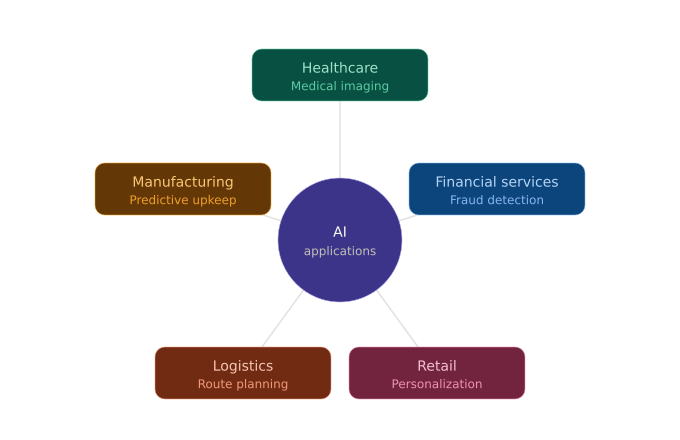
- Industry Applications of AI: AI is not a one-size-fits-all technology. Its real power emerges when it is shaped around the specific challenges of an industry.
Healthcare
In healthcare, AI is improving both clinical outcomes and operational efficiency. Computer vision models analyze X-rays, MRIs, and CT scans to detect anomalies earlier and support radiologists with a reliable second opinion. AI-driven patient monitoring tracks vital signs in real time and alerts clinicians to deterioration before it becomes critical. Predictive diagnostics use historical and population data to identify patients at risk of conditions such as sepsis or readmission.
Beyond the clinical side, AI eases the heavy administrative burden that drains provider time. Intelligent document processing, automated coding, and smart scheduling reduce paperwork and free staff to focus on patients. The benefits are tangible: better diagnostic accuracy, faster treatment, lower costs, and a more patient-centric model of care.
Manufacturing
Manufacturing has become one of AI’s most rewarding proving grounds. Predictive maintenance uses sensor data to anticipate equipment failures before they cause costly downtime, replacing fixed maintenance schedules with condition-based action. AI-powered quality control inspects products at high speed, catching microscopic defects that human eyes routinely miss and ensuring consistent standards across every unit.
Supply chain optimization is another major win. Machine learning models forecast demand, balance inventory, and adjust production planning to reduce waste and improve throughput. By connecting data from the factory floor to the wider supply network, manufacturers gain end-to-end visibility. The benefits are clear: higher productivity, fewer disruptions, improved safety, and meaningfully lower operating costs advantages that strengthen competitiveness in a tight global market.
Financial Services
Financial institutions rely on AI to protect assets and accelerate service. Fraud detection models analyze transaction patterns in real time, flagging anomalies and stopping suspicious activity before losses occur. Automated underwriting evaluates applications using a richer set of data signals, speeding approvals while improving accuracy. AI-driven customer service handles routine inquiries instantly, freeing agents for complex cases.
The benefits span security, speed, and compliance. AI strengthens defenses against financial crime, shortens turnaround on lending and onboarding, and helps institutions meet strict regulatory requirements through consistent, auditable decision-making.
Retail and E-Commerce
Retail and e-commerce thrive on personalization, and AI delivers it at scale. Recommendation engines—often built on deep learning analyze browsing and purchase behavior to suggest products customers are most likely to want. Intelligent inventory management forecasts demand to keep shelves stocked without overstocking, and dynamic pricing adjusts in real time to market conditions and competitor activity.
These capabilities translate directly into business outcomes: increased sales through relevant recommendations, leaner inventory costs, and stronger customer retention driven by experiences that feel personal and timely.
Logistics and Transportation
In logistics and transportation, AI keeps goods moving efficiently. Route optimization analyzes traffic, weather, and delivery windows to plan the fastest, most fuel-efficient paths. Fleet management systems monitor vehicle health and driver behavior to improve safety and reduce maintenance costs. Demand forecasting anticipates volume spikes so resources are positioned where they are needed.
The payoff is faster, more reliable delivery and significant cost reduction advantages that matter enormously in an industry defined by thin margins and rising customer expectations.
Emerging AI Technologies
The AI landscape continues to evolve quickly, and several emerging technologies are reshaping what businesses can build.
Generative AI creates new content text, images, code, and more powering automated content creation, design assistance, and intelligent copilots that boost productivity across teams. Computer vision is expanding beyond inspection into areas like autonomous navigation, retail analytics, and energy auditing. Conversational and agentic AI moves past simple chatbots toward autonomous agents that can reason, plan, and complete multi-step tasks with minimal supervision. Predictive AI, grounded in advanced machine learning, continues to sharpen forecasting across demand planning, risk, and maintenance.
In practice, these technologies often combine: a logistics firm might pair predictive AI with computer vision, while a healthcare provider blends generative AI with diagnostic imaging to accelerate workflows.
Challenges in Implementing AI
Adopting AI is rewarding, but it comes with real hurdles. Data quality and availability often top the list—models are only as good as the data feeding them, and many organizations struggle with fragmented or incomplete information. Integration with legacy systems can be complex, requiring careful planning to connect modern AI with established infrastructure. Security and compliance demand rigorous attention, especially in regulated sectors handling sensitive data. Finally, organizational adoption can stall without the right change management, training, and leadership buy-in to bring teams along. Recognizing these challenges early is the first step to overcoming them.
How App Maisters Helps Businesses Adopt AI
App Maisters bridges the gap between AI’s promise and practical results. Rather than offering off-the-shelf tools, the team builds custom AI solutions tailored to the unique demands of each industry, from healthcare and manufacturing to finance and government.
The approach is end-to-end. It begins with AI and ML strategy consulting to align initiatives with business goals, moves through proof of concept and custom development, and continues with integration into existing systems, deployment, and ongoing optimization. As an ISO-certified company with U.S.-based leadership and deep technical expertise across machine learning, generative AI, and computer vision, App Maisters ensures solutions are secure, scalable, and built to last.
Most importantly, the focus stays on measurable business results and ROI because AI should earn its place by delivering value you can see.
Final Thoughts
Artificial intelligence is reshaping how modern industries operate, from sharper diagnoses in healthcare and smarter factories in manufacturing to safer transactions in finance, personalized shopping in retail, and faster delivery in logistics. The organizations that embrace it thoughtfully are building durable advantages that will compound for years.
Realizing that potential takes the right partner one who understands both the technology and your business. App Maisters brings the strategy, engineering, and industry expertise to turn AI ambitions into working solutions.
Ready to put AI to work for your business? Contact App Maisters today to start building AI applications designed for your industry.
FAQs
What are AI applications and how do they help businesses?
AI applications use machine learning, NLP, computer vision, and predictive analytics to perform intelligent tasks. App Maisters builds custom AI applications that automate work, improve decision-making, and reduce costs.
Which industries benefit most from AI applications?
Healthcare, manufacturing, financial services, retail, and logistics gain the most. App Maisters delivers industry-specific AI solutions tailored to each sector’s challenges.
How much does it cost to develop a custom AI application?
Cost depends on complexity, data, integration, and compliance needs. App Maisters scopes each project with a clear, ROI-focused estimate after an initial strategy assessment.
How long does it take to build an AI application?
Timelines vary with scope, from a few weeks for a focused tool to several months for enterprise systems. App Maisters uses an agile, phased approach to deliver value quickly.
What are the biggest challenges in implementing AI?
Common hurdles include poor data quality, legacy integration, security, and slow adoption. App Maisters addresses these with strong data governance, secure practices, and end-to-end support.
What is the difference between generative AI and predictive AI?
Predictive AI forecasts outcomes like demand or risk, while generative AI creates content such as text and images. App Maisters builds solutions across both.
How can my business get started with AI adoption?
Start with a clear strategy. App Maisters guides businesses from AI consulting and use-case planning through development, deployment, and ongoing optimization—focused on measurable ROI.