


Building a HIPAA-Compliant AI Chatbot: Architecture, Guardrails, and Audit Trails
Healthcare organizations are putting AI chatbots to work on appointment scheduling, benefits questions, symptom intake, refill requests, and post-discharge follow-up. The business case is clear: patients expect answers outside office hours, and clinical and administrative teams are already stretched. Yet the moment a chatbot handles a patient’s name, a date of service, or a diagnosis, it becomes part of the organization’s regulated data environment.
That is why HIPAA cannot be a final-stage checklist item. Decisions made early, such as which large language model (LLM) to call, where conversation logs live, and how a patient’s identity is verified, determine whether the system can be operated compliantly at all. Retrofitting controls into a chatbot designed as a general-purpose assistant almost always costs more than designing for PHI protection from day one, which is why chatbot initiatives work best as part of a broader AI-driven digital transformation in healthcare rather than as isolated pilots.
This guide walks healthcare IT leaders through the architecture, security guardrails, and audit trails a HIPAA-compliant AI chatbot requires, and clarifies where responsibility sits when third-party AI services are involved.
What Makes an AI Chatbot HIPAA-Compliant?
Protected health information (PHI) is individually identifiable health information held or transmitted by a covered entity or its business associate, in any form. Electronic PHI (ePHI) is the subset created, stored, or transmitted electronically. In a chatbot, PHI rarely sits in one place: it appears in patient messages, records retrieved from the EHR, prompts sent to the model, generated responses, logs, and analytics exports.
Three HIPAA rules shape the design. The Privacy Rule governs how PHI may be used and disclosed, including the minimum necessary standard. The Security Rule requires administrative, physical, and technical safeguards for ePHI, beginning with a documented risk analysis. The Breach Notification Rule requires notifying affected individuals without unreasonable delay, and no later than 60 days after discovery, when unsecured PHI is breached, with notice to HHS and, for larger breaches, the media.
Business Associate Agreements (BAAs) tie these obligations to vendors. Any party that creates, receives, maintains, or transmits PHI on your behalf, whether a cloud host, LLM API provider, vector database, logging platform, or SMS gateway, is a business associate. HHS has made clear that a cloud provider storing encrypted ePHI is still a business associate even if it holds no decryption key.
HIPAA-Compliant Technology vs. a HIPAA-Compliant Organization
No product is HIPAA-compliant on its own, and HHS does not certify technology. HIPAA obligations attach to covered entities and business associates. A chatbot can be engineered to support compliance through its safeguards, but compliance is achieved by how the organization configures, operates, documents, and monitors it. Whether HIPAA applies at all depends on who operates the chatbot and on whose behalf, which is why consumer health and wellness apps can fall outside HIPAA while still facing state privacy laws and FTC rules.
Healthcare Chatbot Architecture: The Essential Components
A sound healthcare chatbot architecture separates concerns so that PHI flows only where it must, and every hop is authenticated, encrypted, and logged.
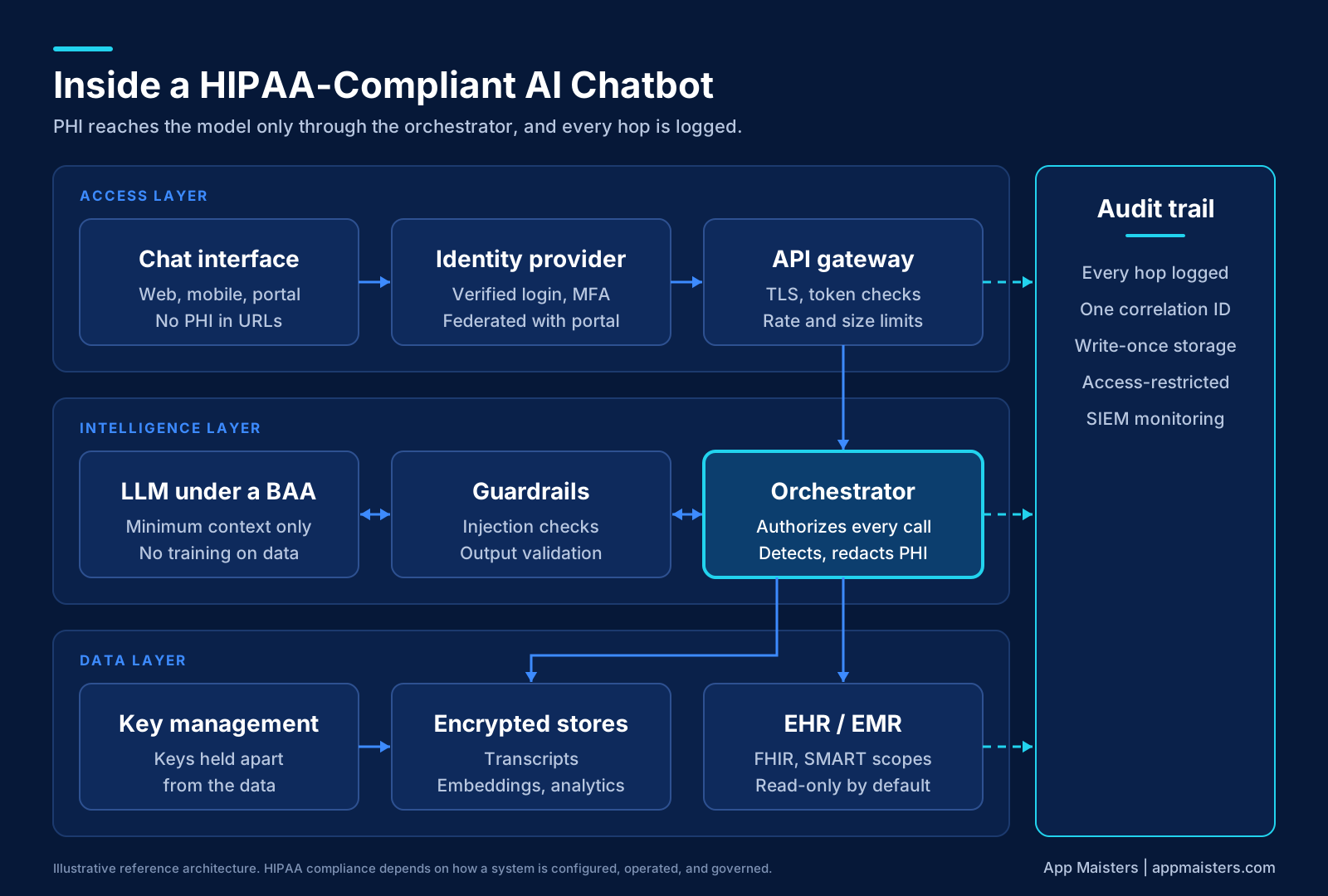
Requests pass through authentication and the API gateway; the orchestrator then enforces access, minimizes PHI, and routes calls to guardrails, the model, and clinical data, while every hop writes to the audit trail.
Access Layer: User Interface, Authentication, and API Gateway
Whether the chatbot lives in a website widget, a mobile app, or a patient portal, the interface should treat unauthenticated users as anonymous: general information only. Anything patient-specific requires identity verification, ideally federated with the organization’s existing patient portal identity provider, with multi-factor authentication for staff. Session timeouts matter, and PHI should never appear in URLs or push notification previews.
An API gateway sits between every client and the backend. It enforces TLS on all traffic, validates tokens, applies rate and payload limits, and acts as a single choke point for request logging. The client should never call the model or the EHR directly.
Intelligence Layer: LLM Integration and PHI-Aware Processing
Model selection is as much a contractual decision as a technical one. Options include enterprise LLM APIs and cloud AI services offered under a BAA, or open-weight models hosted inside your own environment. BAA eligibility is service-specific and configuration-specific, so confirm prompt retention, abuse-monitoring storage, and training use in writing for the exact service you deploy.
An orchestration layer manages every model call. It classifies each message, detects identifiers, and redacts or tokenizes PHI before data reaches any service that does not need it. When the chatbot uses retrieval-augmented generation (RAG), retrieval is scoped to the authenticated patient and the user’s role, so the model only sees the minimum necessary context.
Data Layer: Encrypted Storage and EHR/EMR Integration
Transcripts, vector embeddings, and analytics belong in separate stores, each encrypted at rest with keys managed in a dedicated key management service. Embeddings derived from patient conversations should be treated as ePHI.
For healthcare AI integration with clinical systems, HL7 FHIR APIs with SMART on FHIR scopes are the modern default, with HL7 v2 interfaces through an integration engine for older systems. Default to read-only scopes, and route write-backs such as appointment booking through explicit, logged transactions. Teams that have delivered secure EHR platform development will recognize these patterns.
Identity and Access Management
Identity and access management (IAM) covers people and machines. Each microservice gets its own service identity with narrowly scoped permissions, staff access follows role-based or attribute-based policies, and emergency “break-glass” access is permitted only through a documented, logged procedure.
Essential AI Security Guardrails for Healthcare Chatbots
Guardrails fall into two groups: controls that implement a HIPAA standard, and controls that are best practice for LLM systems but not named in the regulation. Both matter, and decision-makers should know which is which.
| Guardrail | What it means in a chatbot | Regulatory status |
|---|---|---|
| Data minimization | Send the model only the fields a task needs; scope retrieval to one patient | Implements the Privacy Rule minimum necessary standard |
| Role-based access control | Patients see only their own records; staff see what their role permits | Implements Security Rule access control standards |
| Encryption | TLS in transit; strong encryption at rest for transcripts, embeddings, and logs | Addressable today; a proposed Security Rule update would make it required |
| Prompt injection protection | Isolate system instructions; treat user input and retrieved text as untrusted | Best practice; supports the required risk analysis |
| Output validation | Check responses for policy, scope, and clinical red flags before delivery | Best practice |
| PHI leakage prevention | Scan outputs and logs for identifiers that do not belong to the authenticated user | Best practice method for meeting Privacy Rule disclosure limits |
| Human escalation | Route urgent symptoms, complaints, and low-confidence answers to staff | Best practice and a clinical safety requirement |
| Model-provider data handling | BAA, zero or limited prompt retention, no training on your data | BAA is required; retention and training terms are negotiated |
The most important architectural principle is that authorization never lives inside the model. A system prompt saying “only discuss this patient’s records” is not an access control, because prompt injection, including indirect injection hidden in retrieved documents, can override it. Access decisions belong in the orchestration and data layers, enforced before any data reaches the prompt.
Escalation deserves the same rigor. Define triggers such as chest pain, self-harm language, or medication errors, and give the chatbot a scripted handoff to a human or emergency guidance rather than a generated answer. These controls become even more consequential as chatbots evolve into agentic AI systems that take actions, such as booking appointments or updating records on a patient’s behalf.
Building Reliable Audit Trails for a HIPAA-Compliant AI Chatbot
The Security Rule’s audit controls standard requires mechanisms that record and examine activity in systems containing ePHI, and organizations must regularly review that activity. HIPAA does not prescribe exactly what to log, so the design has to answer one practical question: could you reconstruct any conversation, and every data access behind it, months later?
What to Capture
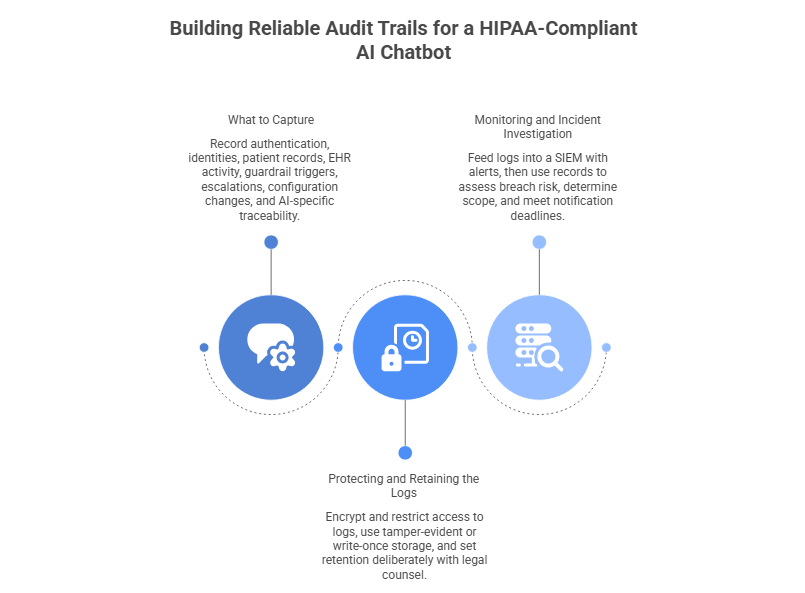
A useful audit trail records authentication events, the identity of each user and service, which patient records were queried, every EHR read and write, guardrail triggers, escalations, and administrative configuration changes. For AI-specific traceability, log the model version, the prompt template version, and the retrieval sources used for each response. Without these, it is impossible to explain why the chatbot said what it said.
A single correlation ID should follow each request across the gateway, orchestrator, model call, and EHR call, so investigators can trace one interaction end to end.
Protecting and Retaining the Logs
Chatbot audit logs almost always contain ePHI themselves. They need encryption, restricted access, tamper-evident or write-once storage, and a BAA with any third-party logging or observability vendor.
On retention, HIPAA requires covered entities to keep required documentation, such as policies and risk assessments, for six years. It does not set a specific retention period for audit logs, so many organizations align log retention with that six-year horizon or with state medical record laws. Set the period deliberately with legal counsel, and balance it against data minimization.
Monitoring and Incident Investigation
Logs only protect the organization if someone watches them. Feed them into a SIEM with alerts for bulk record queries, off-hours access, repeated injection attempts, and responses flagged for PHI leakage. When an incident occurs, these records are what allow the organization to complete the breach risk assessment, determine scope, and meet notification deadlines with evidence rather than estimates.
The Future of Enterprise Mobile App Development
A healthcare deployment carries obligations that a typical enterprise chatbot for business operations does not. Five issues come up in nearly every HIPAA-compliant AI development project.
Third-party AI providers
A BAA covers specific services, not a vendor’s entire catalog, and terms change. Maintain an inventory of every service that touches PHI, review subprocessors, and recheck retention and training terms whenever a provider updates its policies or you switch models.
Model training with sensitive data
Fine-tuning on raw patient conversations risks the model memorizing and repeating PHI. Retrieval-augmented generation usually delivers the same accuracy gains with far less exposure. Where training is necessary, use data de-identified under HHS’s Safe Harbor or Expert Determination methods, and involve your privacy officer, because using PHI to develop a model raises its own Privacy Rule questions about permitted purpose.
Integration complexity
EHR API access, FHIR version differences, and legacy HL7 interfaces often consume more of the timeline than the AI itself. Budget for vendor approvals and sandbox testing early.
Regulatory accountability
Outsourcing development or hosting does not transfer accountability. Business associates are directly liable for many HIPAA requirements, but the covered entity remains responsible for its vendor oversight. State laws add obligations; California, for example, requires disclosure when generative AI drafts certain clinical communications to patients. Substance use disorder records may also fall under 42 CFR Part 2.
Ongoing compliance monitoring
The Security Rule expects risk analysis to be updated as the environment changes, and a model upgrade is a change. Re-test guardrails with adversarial red-teaming after each release, and consider the NIST AI Risk Management Framework as a structure for governance. HHS proposed a significant Security Rule update in January 2025 that would make encryption and multi-factor authentication required; as of November 2026 it has not been finalized, but designing to it now avoids rework later.
Conclusion: Secure, Scalable Healthcare Conversations by Design
A well-designed HIPAA-compliant AI chatbot can absorb routine patient and staff inquiries, extend access beyond office hours, and connect conversations to clinical systems without creating unmanaged risk. The difference between a chatbot that supports compliance and one that undermines it is rarely the model. It is the architecture around the model: how identity is verified, how PHI is minimized and isolated, how access is enforced outside the prompt, and how every interaction is logged for review.
App Maisters brings healthcare software development and AI engineering experience to this work, from HIPAA-aligned EHR and telehealth platforms to conversational AI deployed in regulated environments. As an ISO 27001 and ISO 9001 certified company, we approach healthcare AI chatbot development security-first and consulting-first, helping organizations assess readiness, choose BAA-backed model deployments, and build guardrails and audit trails that their compliance teams can stand behind.
FAQs
Is ChatGPT HIPAA compliant enough to power a patient-facing chatbot?
Consumer versions of general-purpose AI assistants are not covered by a BAA and should never receive PHI. Some providers offer BAAs for specific enterprise or API services under defined configurations. Even then, the chatbot built on top still needs its own access controls, guardrails, and audit logging.
Does a chatbot that only schedules appointments need to follow HIPAA?
Usually, yes. When a provider’s chatbot links a patient’s identity to an appointment, that information is PHI, because it reveals a relationship with a healthcare provider. Scheduling bots need the same authentication, encryption, BAAs, and logging as clinical ones.
Are vector embeddings created from patient conversations considered PHI?
HIPAA does not address embeddings directly, but embeddings derived from PHI and linked to a patient record should be treated as ePHI. Research has shown that original text can sometimes be partially reconstructed from embeddings, so encrypt and access-control vector stores like any other PHI repository.
Does de-identifying chat data remove HIPAA obligations?
Properly de-identified data is no longer PHI. HHS recognizes two methods: Safe Harbor, which removes 18 specified identifiers, and Expert Determination. Free-text conversations are difficult to de-identify reliably, because patients mention names, places, and dates in unpredictable ways.
Is encryption mandatory under HIPAA for chatbot data?
Under the current Security Rule, encryption is an addressable specification, meaning you must implement it or document an equivalent alternative. In practice it is expected, and properly encrypted data can avoid breach notification if lost. A pending rule update would make it explicitly required.
How long should HIPAA chatbot conversation logs be retained?
HIPAA sets a six-year retention period for required documentation but no specific period for audit logs or transcripts. Many organizations align with six years or with state medical record laws. Define the period in policy, and avoid keeping full transcripts longer than needed.
Who is liable if an AI vendor exposes PHI from our chatbot?
Business associates, including AI and cloud vendors, are directly liable for Security Rule compliance and certain Privacy Rule obligations. The covered entity remains responsible for having a BAA, responding to known vendor violations, and notifying affected patients. A BAA must require the vendor to report breaches to you.