


Cloud Migration Services: A 6R Framework That Survives Contact With Reality
Every cloud migration plan looks decisive on paper. Each application carries a label, each wave has a date, and the business case shows savings within two years.
Then discovery begins. An integration nobody documented links the ERP to a warehouse system. A database license turns out to cost far more on cloud infrastructure than on today’s servers.
Those surprises compound. A McKinsey survey of nearly 450 CIOs and IT leaders found the average company spent 14 percent more on migration than planned each year. Thirty-eight percent saw their migrations slip by more than three months.
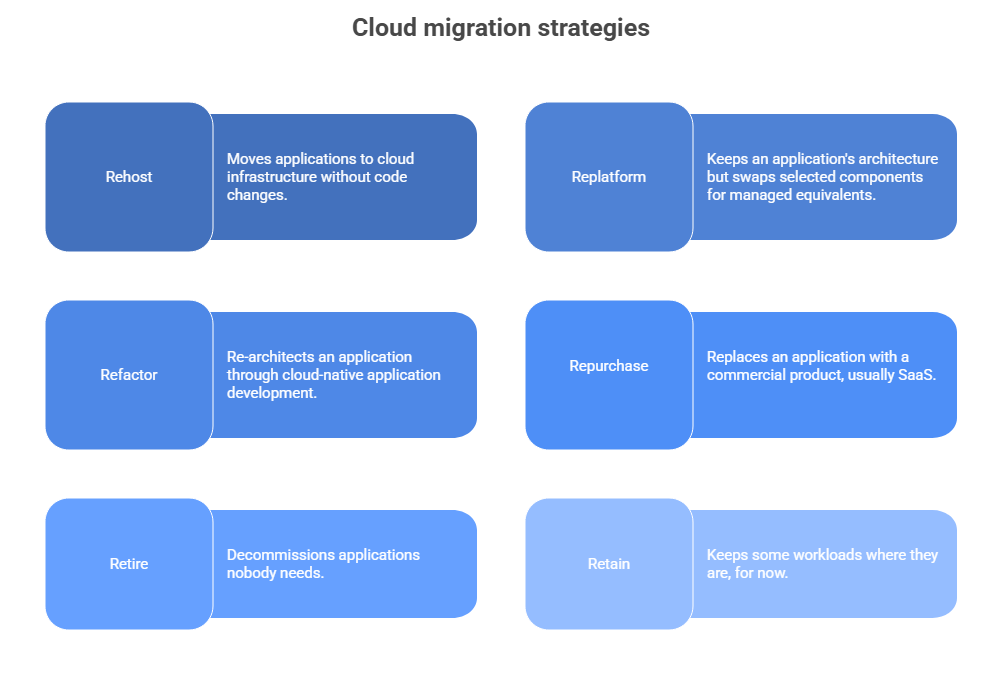
The 6R framework (rehost, replatform, refactor, repurchase, retire, and retain) remains the clearest vocabulary for these decisions. The trouble is how it gets used: as labels assigned once, before anyone has examined dependencies, contracts, or team skills.
This guide treats each strategy as a hypothesis to test against those realities. It is also the right lens for evaluating cloud migration services, because a capable partner pressure-tests the labels instead of simply executing them.
The 6 Rs of Cloud Migration, Tested Against Reality
AWS’s current prescriptive guidance lists seven strategies, adding relocate for moving workloads onto a cloud version of the same platform, such as VMware. The six below still frame most portfolio decisions. For each one, the useful question is not only what it is, but where it tends to break.
Rehost (Lift and Shift): Fast Exit, Deferred Savings
Rehosting moves applications to cloud infrastructure without code changes. Replication tools keep systems serving users until cutover, which makes rehost the workhorse of large migration waves.
It fits hard deadlines such as an expiring data center lease or an unfunded hardware refresh. Developers need no retraining, since the work is mostly infrastructure.
Where it breaks: a server sized for peak load on premises gets billed for peak load around the clock. Flexera’s 2026 State of the Cloud findings estimate that 29 percent of IaaS and PaaS spend is wasted, and more than half of organizations still rely on on-demand pricing.
The fix is unglamorous: rightsize from utilization data before cutover, commit to discounts for steady workloads, and put a dated optimization review in the plan. “Optimize later” rarely happens on its own.
Replatform: Managed Services Without a Rewrite
Replatforming keeps an application’s architecture but swaps selected components for managed equivalents. A self-managed SQL Server database moves to a managed database service, or virtual machines move into containers without code changes.
It fits stable, valuable applications whose real burden is operational: patching, backups, failover, and the specialists needed to run them. The payoff is lower operations overhead and, often, lower licensing costs.
Where it breaks: small changes cascade. A managed database may not support a scheduler, cross-database query, or extension the application quietly depends on, and every workaround adds scope.
Freeze the list of components that will change before work starts. Then budget for regression and performance testing on each one, because managed services rarely behave exactly like the systems they replace.
Refactor: Modernization That Has to Earn Its Cost
Refactoring re-architects an application through cloud-native application development: containers, serverless functions, managed messaging, and independently deployable services. It is the right call when the architecture itself limits the business.
Typical signals: releases take months, scaling requires manual heroics, or a monolith cannot support a new channel. It is also the costliest path, which is why AWS’s large-migration guidance recommends modernizing after migration wherever possible.
Where it breaks: big-bang rewrites stall, and the business pays to run old and new systems in parallel. Refactor incrementally with the strangler fig pattern, routing traffic through a stable interface while capabilities move one at a time.
Tie each increment to a measurable outcome, such as release frequency or cost per transaction. Microservices your team cannot monitor or operate are not modernization. They are new technical debt.
Repurchase: Trading Custom Code for SaaS
Repurchasing replaces an application with a commercial product, usually SaaS. Common moves include replacing a homegrown CRM with a Salesforce implementation, shifting on-premises email to Microsoft 365, or swapping a custom HR system for a cloud HR suite.
It fits capabilities that are necessary but not differentiating, where mature products already exist. Infrastructure, patching, and upgrades become the vendor’s responsibility.
Where it breaks: the work shifts from infrastructure to data and process. Years of customizations encode business rules that will not transfer, and integrations, identity, and historical data each need a plan.
Separate customizations that reflect genuine competitive advantage from those that reflect habit, and adapt processes to the product where you can. Before signing, review how subscription costs scale and what the exit terms say about your data.
Retire: The Cheapest Migration Is the One You Skip
Discovery almost always surfaces applications nobody needs. AWS guidance flags applications averaging under 5 percent CPU and memory use, plus those with no inbound connections in 90 days.
Retiring them shrinks migration scope, licensing costs, and attack surface at once, and the decision is cheaper made early. In one case McKinsey documented, a pharmaceutical company that fell behind plan cut its cloud plans roughly in half and decommissioned more applications instead of migrating them.
Where it breaks: switching off a server is the easy part. Retention rules may require archived data to stay searchable for years, and a quarterly report can depend on a system no one claimed.
Run a scream test by disabling access for a defined period before decommissioning. Archive data in a readable format, and get written sign-off from data owners.
Retain: A Deliberate Decision With an Expiry Date
Some workloads should stay where they are, for now. Data residency rules, specialized plant-floor hardware, a mainframe that needs its own plan, or a system upgraded last year can all justify retaining.
Retain also makes sense when a vendor’s SaaS version is months away, or when other applications must move first.
Where it breaks: retain quietly becomes a parking lot. Retained systems still need secure connectivity, shared identity, and consistent monitoring alongside the workloads that moved. Their cost per workload also rises as data center overhead spreads across fewer systems.
Give every retained workload an owner, a documented reason, and a review date.
How to Choose the Right Cloud Migration Strategy for Each Workload
Strong strategy choices come from evidence, not from the framework itself. Four practices keep them honest.
Map dependencies before assigning strategies
Combine discovery tooling with owner interviews to learn which systems exchange data, how often, and through which interfaces. Tightly coupled applications should move in the same wave, whatever their individual labels say.
Score business value and technical health together
Rate each workload on business value, technical condition, regulatory constraints, and the event driving its timeline. A valuable system in poor health points toward refactor or repurchase, while a stable commodity system facing a lease deadline points toward rehost.
Prove the plan with a first wave
Keep the first wave small enough to manage and representative enough to teach you something. In one phased AWS migration, App Maisters moved five of an enterprise’s most critical applications first, and that phase set the pattern for the rest of the suite.
Treat every decision as a sequence
Many workloads should rehost now and replatform later, but only if “later” has a budget, an owner, and a date. Revisit remaining decisions after each wave using real cost and performance data. McKinsey found that companies migrating on time and on budget were more likely to build the full roadmap, including security and compliance, before they started.
Need a second opinion on your plan?
Our cloud consulting and roadmap services map each workload to the right strategy and sequence before migration waves are locked in.


Building a Cloud Migration Plan That Holds Up
The 6R framework rarely fails on its own. It fails when strategies are assigned before discovery, judged on technical grounds alone, or treated as final.
Plans that survive treat every label as provisional until dependencies, contracts, costs, and skills confirm it. That discipline matters for businesses of all sizes, because even a modest portfolio can need all six strategies at once.
As an ISO 27001-certified AWS and Azure partner, App Maisters delivers cloud migration services that cover portfolio assessment, wave planning, migration, and post-migration optimization.
Ready to move from labels to a plan?
Schedule a cloud migration assessment with our team to see where each workload in your portfolio should land.
FAQs
What are the 6 Rs of cloud migration?
The 6 Rs are rehost (lift and shift), replatform, refactor, repurchase, retire, and retain. Each describes what happens to an application during the move: unchanged, partly optimized, redesigned, replaced with SaaS, switched off, or kept on premises for now. AWS now adds a seventh, relocate, for moving workloads onto a cloud version of the same platform. App Maisters evaluates every workload against all of these options before assigning a strategy.
What is the difference between rehost, replatform, and refactor?
Rehosting moves an application to cloud infrastructure without code changes. Replatforming keeps the core architecture but swaps components for managed services, such as moving a self-managed database to a managed one. Refactoring redesigns the application around cloud-native patterns like containers and serverless functions. Effort, cost, and long-term flexibility all rise in that order. App Maisters consultants recommend the right option for each workload, including when to rehost now and modernize later.
How do you choose the right cloud migration strategy?
Start with discovery. Map how applications depend on each other, then score each workload on business value, technical health, regulatory constraints, and the deadline driving its timeline. Valuable systems held back by their architecture point toward refactor or repurchase, while stable systems facing a hard deadline usually suit rehost. App Maisters’ cloud consultants assess current infrastructure first, then recommend a strategy per workload using Well-Architected Framework principles to reduce migration risk.
How long does a cloud migration take?
Timelines depend on portfolio size, dependencies, and the strategies chosen. A single, well-understood application can often move in weeks. Enterprise portfolios usually migrate in waves over many months, and refactoring takes longest. Slippage is common: McKinsey’s 2021 survey found 38 percent of companies saw migrations run more than three months late. App Maisters firms up timelines during the assessment and planning stages of its structured process, before execution and optimization begin.
How much does cloud migration cost?
Cost depends on the number of workloads, the strategies chosen, data volumes, and how long old and new environments run in parallel. Budget for discovery, migration labor, testing, licensing changes, data transfer, and training, plus a contingency. McKinsey’s 2021 survey found the average company spent 14 percent more on migration than planned each year. App Maisters prices cloud engagements by scope and complexity, and plans post-migration savings with a mix of reserved, on-demand, and spot capacity.
What are the biggest risks of cloud migration?
The most common risks are hidden dependencies that break at cutover, budget overruns, security and compliance gaps, downtime, and cloud skills shortages. Costs can also stay high after the move: Flexera’s 2026 State of the Cloud data estimates 29 percent of IaaS and PaaS spend is wasted. App Maisters holds ISO 27001 and ISO 9001 certifications. It pairs migrations with security and compliance assessments and uses Well-Architected Framework reviews to close gaps early.
What do cloud migration services include?
Comprehensive cloud migration services usually cover assessment and planning, migration execution, testing and validation, and post-migration optimization. App Maisters’ cloud migration services follow that path across AWS, Azure, and Google Cloud. They also include cloud-native development, DevOps automation, security and compliance reviews, and certified-trainer workshops that help internal IT teams earn cloud certifications. Businesses of all sizes engage App Maisters for anything from a single workload to a full portfolio.