


Enterprise Mobile App Development in 2026: Native, React Native, or Flutter?
Every enterprise mobile initiative eventually reaches the same fork in the road: build natively for iOS and Android, or build once with a cross-platform framework. In 2026, that choice carries more weight than it did even three years ago. Mobile apps now run field operations, patient engagement, frontline productivity, and customer self-service, and the framework you pick shapes release velocity, security, total cost of ownership, and AI readiness for years.
The gap between the options has also narrowed. React Native’s New Architecture and Flutter’s Impeller rendering engine have closed much of the historical performance gap, while SwiftUI and Jetpack Compose have made native development faster than ever. The question for CIOs and product leaders is no longer which option is “good enough.” It is which option fits a specific business case, team, and risk profile.
Below, we compare all three on the criteria enterprise buyers weigh most, then offer a practical way to decide.
The Enterprise Mobile Landscape in 2026
Mobile apps have become core business infrastructure, a shift we explored in our analysis of the impact of mobile applications on modern society. Three forces now shape how enterprises build them.
- AI is moving into the app itself: Gartner predicts that 40% of enterprise applications will integrate task-specific AI agents by the end of 2026, up from less than 5% in 2025. Your framework has to support on-device inference and agent workflows cleanly.
- Mobile is now a primary attack surface: Verizon’s 2025 Mobile Security Index found that 85% of organizations saw mobile attacks increase, and 75% raised mobile security spending over the prior year. Security cannot be bolted on after launch.
- Cross-platform tooling has matured: React Native 0.82, released in October 2025, is the first version to run entirely on the New Architecture. Flutter’s 2026 roadmap completes the move to the Impeller renderer on Android. Even so, most apps remain native: per Appfigures data, about 11% of 2024 app releases used Flutter and 7% used React Native.
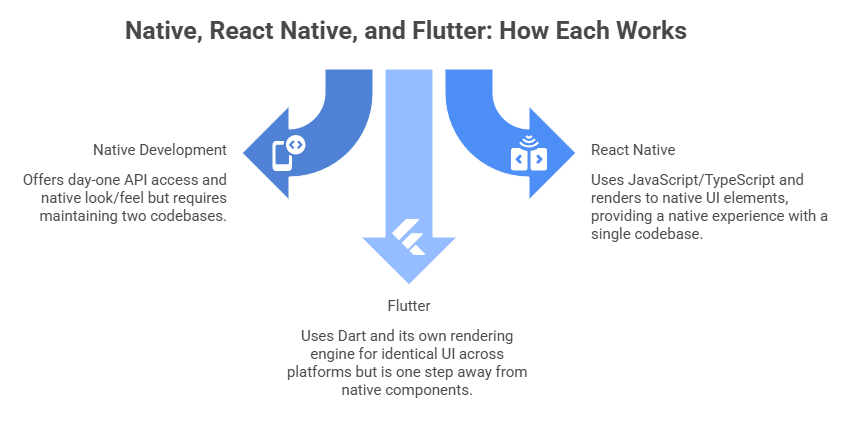
Native development means building a separate app for each platform with its own language and toolkit: Swift and SwiftUI for iOS, Kotlin and Jetpack Compose for Android. You get day-one access to every operating system API, and two codebases to maintain. Our iOS app development and Android app development teams work in this model.
React Native, created by Meta, lets teams write in JavaScript or TypeScript using React. Its components render to real platform UI elements, so apps look and behave like native apps.
Flutter, built by Google, uses the Dart language and draws every pixel with its own rendering engine. That delivers identical UI across iOS, Android, web, and desktop, at the cost of sitting one step away from native UI components.
Native vs. React Native vs. Flutter: Head-to-Head
| Criterion | Native (Swift, Kotlin) | React Native | Flutter |
|---|---|---|---|
| Performance | Highest ceiling, with full hardware and OS access | Near-native for most business apps; the New Architecture removed the old bridge bottleneck | Near-native, with smooth and consistent rendering through Impeller |
| Scalability | Scales well, but needs two parallel teams and roadmaps | Proven at Shopify and Meta scale; shares talent and logic with React web | One codebase extends across mobile, web, and desktop |
| Security | Direct use of keychain, biometrics, and platform security APIs from day one | Strong with discipline; third-party package governance is the main risk | Strong; compiled code resists reverse engineering, but plugins need vetting |
| Development speed | Slowest, since most features are built twice | Fast, with a large JavaScript talent pool and over-the-air updates | Fast, with hot reload and a rich widget library |
| Cost | Highest build and run cost | Lower: one team, reusable web skills | Lower: one team, one UI layer |
| Maintenance | Two codebases and two release cycles | Version upgrades need planning; dependency hygiene matters | Fewer native dependencies, but a smaller Dart talent pool |
| Enterprise fit | Mission-critical, hardware-heavy, or compliance-sensitive apps | Customer and employee apps in React-based organizations | Brand-led, design-heavy, or multi-platform products |
Pros and Cons of Each Approach
Native
- Pros: the best performance and UX fidelity, immediate access to new OS capabilities, and the cleanest path to deep hardware integration such as NFC, AR, and background processing.
- Cons: two codebases double the effort to keep features in parity, hiring runs on two separate pipelines, and time to market is longest.
React Native
- Pros: reuses React web skills and logic, draws on the largest talent pool of the three, and renders real native components.
- Cons: complex native modules still require iOS and Android expertise, upgrades between versions can be demanding (a trade-off Shopify itself has acknowledged), and community libraries need strict governance.
Flutter
- Pros: pixel-consistent UI, strong rendering performance, and one codebase that reaches web and desktop.
- Cons: a smaller Dart talent pool, UI that imitates rather than uses native components (so platform design changes depend on framework updates), and larger app binaries.
Which Technology Fits Which Enterprise Use Case
| Enterprise use case | Best fit | Why |
|---|---|---|
| Field service apps with offline sync and device hardware | Native or React Native | Deep hardware access; React Native works when hardware needs are standard |
| Healthcare apps handling protected health information | Native or React Native | Direct use of platform security and accessibility features |
| Customer-facing commerce, banking, and loyalty apps | React Native | Shared React web stack, fast iteration, native look and feel |
| Internal employee portals and workflow apps | Flutter or React Native | One codebase, lower cost, consistent UX across device fleets |
| Brand-led products built on a custom design system | Flutter | Pixel-level control and identical UI on every platform |
| AR, real-time media, wearables, or heavy on-device AI | Native | Maximum performance and earliest access to OS AI frameworks |
| Products spanning mobile, web, kiosk, and desktop | Flutter | A single UI layer across every target |
For regulated sectors, our healthcare app development work maps compliance before choosing a framework, and our guide to healthcare app development cost shows how that choice shapes budget.
A Practical Recommendation for Decision-Makers
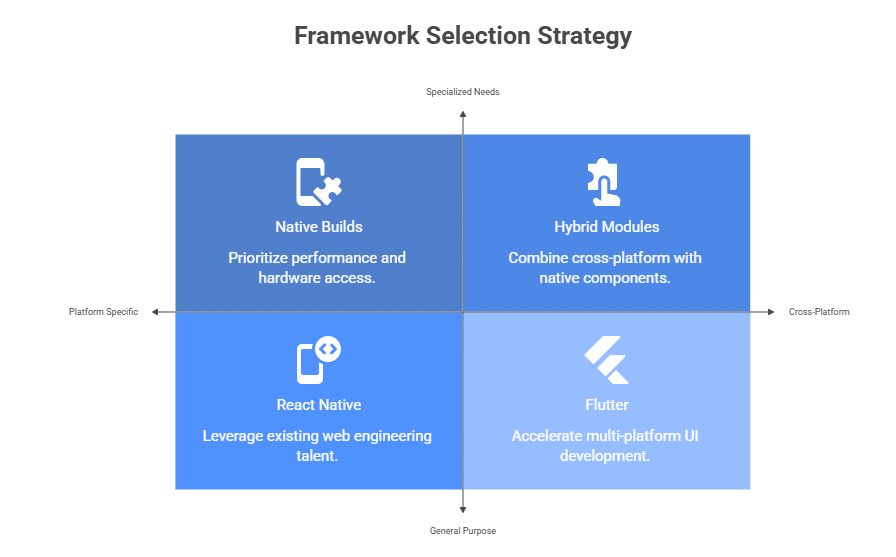
There is no universal winner, but there is a sound default. For most enterprise business applications in 2026, a cross-platform framework is the right starting point, and the choice between React Native and Flutter should follow your existing talent and design strategy. Reserve fully native builds for cases where performance, hardware, or platform fidelity is the product.
Four questions settle most decisions:
- Is device capability the product? If the app depends on AR, advanced Bluetooth, real-time media, or demanding on-device AI, go native.
- What does your engineering organization already know? A React web team makes React Native the lower-risk choice. A greenfield team with strong design ambitions may move faster in Flutter.
- How many platforms must you serve in three years? If web, desktop, or kiosk targets are on the roadmap, Flutter’s single UI layer earns its keep.
- What is your compliance exposure? All three can meet regulatory needs, but native and React Native reach platform security features most directly.
A hybrid model is also legitimate: build most of the app cross-platform and drop to native modules only where needed.
The Future of Enterprise Mobile App Development
Three shifts will define the next phase:
- AI becomes a framework requirement: As agents spread across enterprise software, mobile stacks must support on-device models, conversational UI, and secure agent back ends. Plan AI integration into the architecture from the start.
- The line between native and cross-platform keeps blurring: Kotlin Multiplatform lets teams share business logic, and optionally UI, while keeping native shells. Its Compose Multiplatform for iOS reached a stable release in May 2025. Expect more shared-logic architectures built with Kotlin app development instead of all-or-nothing choices.
- Security and governance move earlier: Enterprises will expect dependency scanning, software bills of materials, and zero-trust patterns from the first sprint.
The goal is not a permanent framework choice but an architecture that can evolve.
Build Your Enterprise Mobile App With App Maisters
The right framework comes from a clear view of your users, systems, and risk profile. App Maisters has built mobile and enterprise software since 2014, delivering 500+ projects for 400+ clients, including government agencies, healthcare organizations, and growing enterprises. Our ISO 9001 and ISO 27001 certified teams build in native iOS and Android, React Native, and Flutter, so our recommendations follow your requirements, not our preferences.
Whether you are launching, modernizing, or adding AI, we will help you choose the right stack and deliver it with confidence. Talk to our enterprise mobile app development team to schedule a technology assessment for your next initiative.
FAQs
Which is better for enterprise apps, Flutter or React Native?
App Maisters recommends choosing based on your team and roadmap rather than a universal winner. React Native suits organizations with React web teams and apps that should feel fully native on each platform. Flutter suits brand-led products that need identical UI across iOS, Android, web, and desktop. Both deliver near-native performance for most business applications.
Is native app development better than cross-platform in 2026?
App Maisters advises native development when the device itself is the product, such as AR, real-time media, wearables, advanced Bluetooth, or demanding on-device AI. For most enterprise business apps, cross-platform frameworks now offer near-native performance with one codebase, which makes them the sensible default.
Is React Native still worth using in 2026?
App Maisters considers React Native a mature, enterprise-ready choice. Version 0.82, released in October 2025, runs entirely on the New Architecture, and Shopify, Microsoft, and Meta use React Native in production. Its JavaScript and TypeScript foundation also simplifies hiring for organizations with existing React teams.
Is Flutter good for enterprise applications?
App Maisters builds enterprise apps with Flutter when consistent design and multi-platform reach matter most. Google’s 2026 roadmap commits to completing the Impeller renderer on Android and making WebAssembly the default on the web. The main trade-offs are a smaller Dart talent pool and UI that draws its own widgets instead of using native components.
Which is more secure: native, React Native, or Flutter?
App Maisters secures apps on all three, because security depends more on architecture than on framework. Native offers the most direct access to keychains, biometrics, and new OS protections. React Native and Flutter can meet the same standards through dependency governance, encrypted storage, certificate pinning, and regular security testing.
Is cross-platform app development cheaper than native?
App Maisters generally recommends cross-platform when budget efficiency matters, since one team maintains one codebase instead of two. Actual savings depend on how many features need custom native modules, integration complexity, and compliance scope. Native remains worth the higher investment when performance or hardware access is central to the product.
Can an existing native app be migrated to React Native or Flutter?
App Maisters recommends incremental migration over a full rewrite in most cases. Both React Native and Flutter can be embedded into an existing native app screen by screen, so teams move high-value features first while stable native code stays in place. Kotlin Multiplatform offers another route by sharing business logic while keeping native UI.