


Healthcare App Development Cost in 2026: Complete Breakdown
Healthcare app development costs between $25,000 and $1.2 million or more in 2026, depending on the type of app. A basic wellness app MVP starts around $25,000 to $60,000 and ships in 2 to 4 months. A production telemedicine platform runs $100,000 to $250,000. A custom EHR system or an enterprise clinical decision support system can exceed $500,000 and take 18 months or longer. Compliance, integrations, and AI complexity are the three factors that move the number most.
Key Takeaways
- Three cost tiers. Wellness apps and patient portals are the entry point. Telemedicine, analytics, and remote monitoring sit mid-range. Clinical decision support, AI apps, and EHR systems are the expensive end.
- Integrations drive overruns, not features. Expect integrations and data migration to add 20% to 30% on top of a build, plus 10% to 25% for scope movement.
- Compliance adds 10% to 20%. Build it in from sprint one. Retrofitting costs several times more.
- Maintenance runs 15% to 25% of build cost per year, higher with AI models or connected devices.
- Offshoring cuts rates, not effort. Compliance, integration, and clinical validation work does not shrink with the hourly rate.
- AI is the least predictable line item. Dataset acquisition and labeling, not model choice, decide feasibility.
- An MVP is a different product, not a cheaper one. A scaled-down enterprise platform costs MVP money and proves nothing.
Healthcare software is one of the few categories where a budget conversation cannot be separated from a compliance conversation. A consumer fitness tracker and a clinical decision support system may share the same tech stack, but they do not share the same risk profile, audit requirements, or integration burden. That difference is where most healthcare app budgets are won or lost.
This guide breaks down healthcare app development cost across eight distinct categories of healthcare software. For each one you will find realistic 2026 cost ranges, delivery timelines, core feature sets, benefits, common use cases, and the specific factors that push the number up or down.
Every figure here is a planning range, not a quote. The cost to develop a healthcare app varies with scope, engineering location, technology choices, the number and type of integrations, the depth of regulatory compliance required, AI complexity, and the level of clinical validation your stakeholders expect. Two teams can build the “same” telemedicine platform and land three times apart on price because one of them had to integrate with four hospital EHR systems and the other did not.
Quick Answer: Healthcare App Development Cost at a Glance
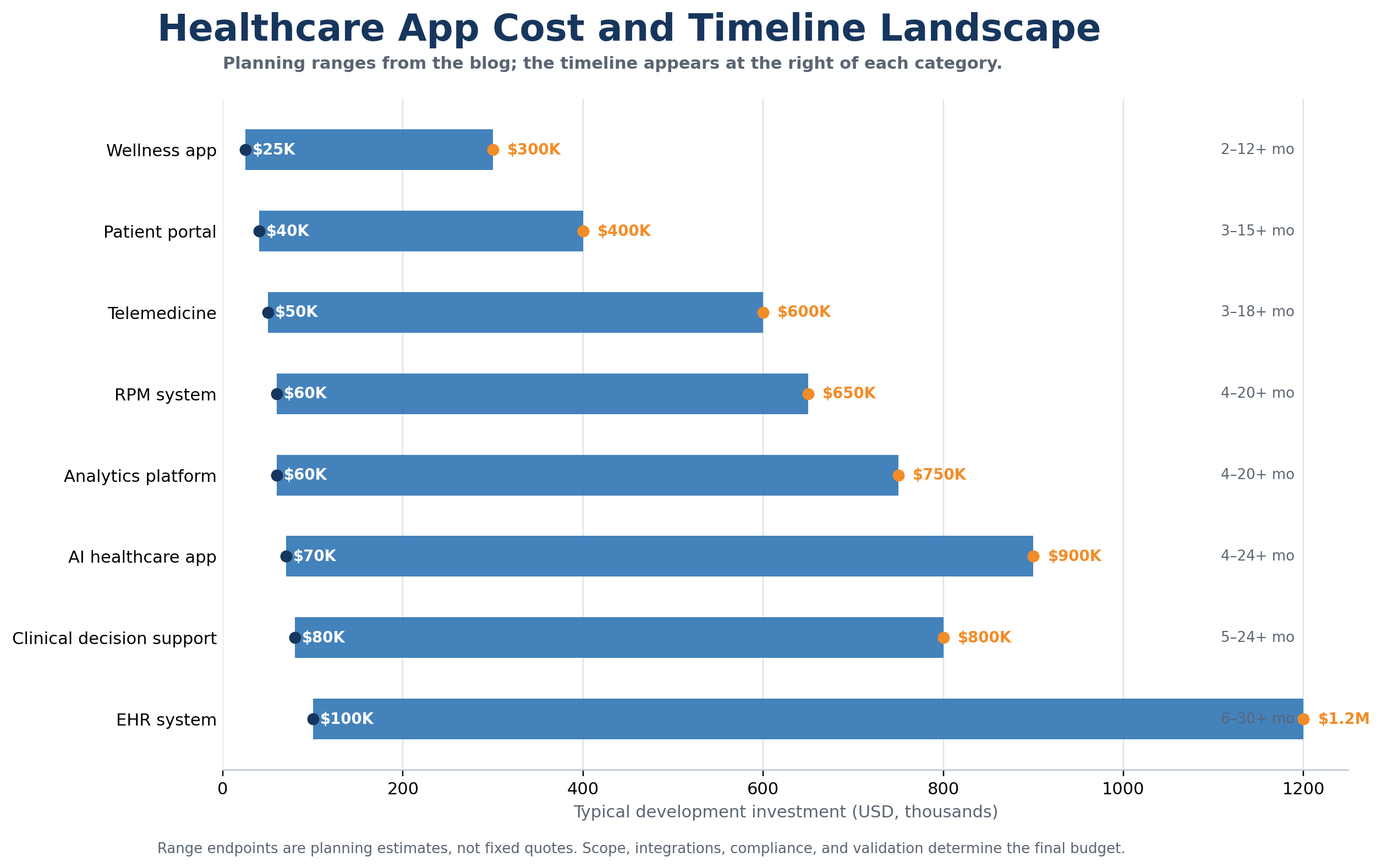
App Type | Typical Cost Range (2026) | Typical Timeline | Complexity | Primary Cost Driver |
Wellness App | $25,000 to $300,000+ | 2 to 12+ months | Low to Medium | Content, engagement features, wearable sync |
Patient Engagement Portal | $40,000 to $400,000+ | 3 to 15+ months | Medium | EHR/EMR integration and identity management |
Telemedicine Platform | $50,000 to $600,000+ | 3 to 18+ months | Medium to High | Real-time video, scheduling, billing, compliance |
Healthcare Analytics Platform | $60,000 to $750,000+ | 4 to 20+ months | High | Data pipelines, normalization, reporting depth |
Remote Patient Monitoring System | $60,000 to $650,000+ | 4 to 20+ months | High | Device connectivity, alerting, reimbursement workflows |
Clinical Decision Support System | $80,000 to $800,000+ | 5 to 24+ months | Very High | Clinical logic, validation, regulatory pathway |
AI-Driven Healthcare App | $70,000 to $900,000+ | 4 to 24+ months | Very High | Data acquisition, model development, explainability |
EHR System | $100,000 to $1,200,000+ | 6 to 30+ months | Very High | Clinical breadth, interoperability, certification |
Read those ranges as three different products stacked on top of each other. The low end is a focused MVP for a single user group. The middle is a production system for a growing organization. The high end is an enterprise or multi-tenant platform with deep integrations and formal compliance evidence behind it.
What the Market Data Actually Says
Before pricing a build, it helps to know how large and how fast-growing the segment you are entering is. Two things stand out in the published research. First, every one of these eight categories is growing. Second, the analyst estimates disagree with each other by wide margins, because firms scope these markets differently.
The Definitional Problem
Estimates for the global digital health market in 2026 range from roughly $181 billion to nearly $492 billion depending on who is counting. Statista’s Digital Health market forecast, which covers consumer-facing digital fitness, online doctor consultations, and digital treatment and care, puts 2026 revenue at about $181.25 billion, with the United States generating roughly $55.25 billion of that.
Market Size by App Category
App Type | Corresponding Market | 2026 Estimate | Projected Growth | Source |
Wellness App | mHealth apps | US market about $16.4 billion in 2026 | US market CAGR near 15% to 2035 | Straits Research, Precedence Research |
Patient Engagement Portal | Patient engagement solutions | $21.6 billion to $41.2 billion, definition dependent | CAGR 12% to 21% | Roots Analysis, Fortune Business Insights, MarketsandMarkets |
Telemedicine Platform | Telemedicine | About $123.4 billion in 2026 | CAGR about 17.3% to 2034 | Fortune Business Insights |
Healthcare Analytics Platform | Healthcare analytics | About $81.9 billion in 2026 | CAGR about 13.5% to 2033 | Grand View Research |
Remote Patient Monitoring System | Remote patient monitoring | $30.9 billion to $54.5 billion, definition dependent | CAGR 12% to 20% | Grand View Research, MarketsandMarkets, Straits Research |
Clinical Decision Support System | Clinical decision support software | About $6.5 billion in 2026 | CAGR about 12.6% to 2031 | Mordor Intelligence |
AI-Driven Healthcare App | AI in healthcare | About $50.7 billion in 2026 | CAGR about 38.9% to 2033 | Grand View Research |
EHR System | Electronic health records | About $33 billion in 2026 | CAGR 5% to 6.7% | Fortune Business Insights, The Business Research Company, Grand View Research |
Two patterns in that table matter for budgeting.
AI in healthcare is growing several times faster than everything else: Grand View Research puts the segment at roughly $50.7 billion in 2026 heading toward $505.6 billion by 2033. That growth rate is why AI feature scope tends to expand mid-project, and why AI-centric budgets need explicit change control.
EHR is the slowest-growing category on the list: At a projected CAGR in the 5% to 6.7% range, the core EHR market is mature and consolidated. That is a strong argument against building a general-purpose EHR and a reasonable argument for building a specialty one, where incumbents fit poorly.
How to Read Cost Ranges Without Getting Burned
Before the detailed breakdowns, four ground rules that apply to every category below.
- Scope determines price more than technology does. The feature list is the budget. Adding an appointment reminder is cheap. Adding two-way EHR write-back is not.
- Compliance is a line item, not an afterthought. HIPAA readiness, audit logging, encryption, access control, business associate agreements, and documented security testing add real engineering hours. Budgeting them late is the most common cause of overruns in healthcare software development cost estimates.
- Integration count is the strongest single predictor of overrun. Each EHR, lab, pharmacy, payer, or device integration carries discovery, sandbox access, mapping, error handling, and certification time that is rarely visible in an initial estimate.
- Rates vary by geography more than by skill. The same senior engineer costs three to four times more in one market than another. Team composition and location are covered in detail later in this guide.
Wellness App
A wellness app supports general health behaviors outside of clinical care: activity tracking, nutrition, sleep, hydration, mindfulness, habit building, and employer or insurer wellness programs. It usually sits outside the regulated clinical perimeter, which is exactly why it is the cheapest entry point into digital health. That changes the moment the app stores identifiable health information on behalf of a covered entity.
Wellness App Development Cost and Timeline
Development Level | Estimated Cost | Timeline | Typical Scope |
MVP/Basic | $25,000 to $60,000 | 2 to 4 months | Single platform, onboarding, goal tracking, basic dashboards, push notifications |
Mid-Level | $60,000 to $140,000 | 4 to 7 months | iOS and Android, wearable sync, content library, streaks and rewards, subscriptions, analytics |
Advanced/Enterprise | $140,000 to $300,000+ | 7 to 12+ months | Multi-tenant employer programs, coaching workflows, personalization engine, admin reporting, SSO, HIPAA-aligned data handling |
Key Features
- User onboarding, profiles, and goal setting
- Activity, nutrition, sleep, and hydration tracking
- Wearable and health platform sync (Apple Health, Google Health Connect, popular device SDKs)
- Content library with articles, audio, or video
- Habit streaks, challenges, badges, and social or team features
- Push notifications and behavioral nudges
- Subscription billing and paywall management
- Admin dashboard for program sponsors
Benefits
- Fastest path to market in digital health, which makes it a strong first product for validating an audience
- Recurring subscription or per-employee-per-month revenue models
- Rich behavioral data that can inform later clinical products
- Lower regulatory burden when the app avoids diagnosis and treatment claims
Common Use Cases
- Employer wellness and benefits engagement programs
- Insurer-sponsored preventive health incentives
- Fitness studio, gym, and coaching brand apps
- Chronic condition self-management support that stops short of clinical guidance
- Mental wellbeing, meditation, and stress reduction programs
App Maisters Capabilities
App Maisters builds cross-platform and native mobile applications with wearable and health platform integrations, subscription infrastructure, and analytics instrumentation, and the company applies the same security practices across consumer and clinical work that its ISO 27001 certified processes require. For businesses of all sizes, that means a wellness product can be architected from day one so that a later move into regulated territory does not require a rebuild.
Future Trends
Wellness apps are converging with clinical products. Passive sensing from wearables, on-device inference, and personalized coaching driven by generative AI are turning static content libraries into adaptive programs. Expect more wellness products to be designed as the front door to a remote monitoring or care management offering rather than as standalone consumer apps.
Factors That Move the Cost
Cost Factor | Impact on Budget | Notes |
Number of platforms | +30% to +60% | Native iOS and Android versus a single cross-platform build |
Wearable device integrations | +$8,000 to $40,000 | Each additional SDK adds mapping and test surface |
Content production | +$5,000 to $50,000 | Video and audio production is often excluded from dev quotes |
Gamification and social features | +$10,000 to $45,000 | Leaderboards, challenges, and feeds add backend complexity |
Personalization engine | +$20,000 to $80,000 | Rules-based is cheap, model-driven is not |
HIPAA-aligned data handling | +$10,000 to $35,000 | Required when acting for a covered entity |
Patient Engagement Portal
A patient engagement portal gives patients a single digital place to manage their relationship with a provider organization: appointments, records, messages, forms, education, and payments. It is a communication and access layer on top of clinical systems, which means the portal itself is rarely the hard part. The integration is.
Patient Engagement Portal Development Cost and Timeline
Development Level | Estimated Cost | Timeline | Typical Scope |
MVP/Basic | $40,000 to $80,000 | 3 to 5 months | Registration, appointment requests, secure messaging, static education content, one read-only integration |
Mid-Level | $80,000 to $180,000 | 5 to 9 months | Web and mobile, real-time scheduling, records access, digital intake forms, payments, notifications, FHIR-based EHR integration |
Advanced/Enterprise | $180,000 to $400,000+ | 9 to 15+ months | Multi-facility support, family and caregiver proxy access, care plan tracking, bidirectional EHR write-back, insurance verification, multilingual delivery, accessibility conformance |
Key Features
- Identity verification, registration, and account recovery
- Appointment scheduling, rescheduling, and reminders
- Access to visit summaries, lab results, medications, and immunizations
- Secure two-way messaging with care teams
- Digital intake and consent forms
- Bill presentment and online payment
- Prescription refill requests
- Caregiver and dependent proxy access
- Multilingual support and accessibility conformance
Benefits
- Fewer inbound calls to front desk and clinical staff
- Reduced no-show rates through automated reminders and self-service rescheduling
- Faster intake because forms are completed before arrival
- Improved payment collection through digital billing
- A measurable improvement in patient satisfaction scores tied to access and communication
Common Use Cases
- Hospital and health system patient portals
- Multi-location specialty and dental groups
- Community health centers and safety net clinics
- Behavioral health practices with recurring appointment cycles
- Post-discharge follow-up and care plan adherence
App Maisters Capabilities
App Maisters delivers portal-style platforms that combine a public-facing self-service layer with role-based administrative back ends, an architecture the team has applied repeatedly in resident and constituent portal work through App Maisters Government. The same structural patterns, secure identity, document access, request workflows, notifications, and staff dashboards, transfer directly to patient engagement portals in the commercial healthcare division.
Future Trends
Patient engagement is shifting from a portal you log into toward proactive, conversational outreach delivered through messaging and voice. Regulatory momentum around patient access APIs continues to make standards-based record access the default rather than a custom build. Expect AI assistants embedded in portals to handle scheduling, triage questions, and bill explanations.
Factors That Move the Cost
Cost Factor | Impact on Budget | Notes |
EHR/EMR integration depth | +$15,000 to $120,000 | Read-only is a fraction of the cost of bidirectional write-back |
Number of connected facilities or systems | +$10,000 to $40,000 each | Each site may run different versions or configurations |
Identity proofing and SSO | +$8,000 to $30,000 | Higher assurance levels cost more |
Payments and insurance verification | +$12,000 to $50,000 | Payer connectivity is a separate integration class |
Accessibility and multilingual delivery | +$10,000 to $45,000 | Conformance testing and translation management |
Legacy system modernization | +$20,000 to $150,000 | Older systems without APIs require middleware |
Telemedicine Platform
A telemedicine platform delivers care remotely through video, audio, chat, or asynchronous store-and-forward workflows. The technical core is real-time communication, but the commercial core is everything wrapped around it: scheduling, eligibility, documentation, e-prescribing, and billing. Telemedicine app development cost is usually underestimated because teams price the video and forget the surrounding revenue cycle.
Telemedicine App Development Cost and Timeline
Development Level | Estimated Cost | Timeline | Typical Scope |
MVP/Basic | $50,000 to $100,000 | 3 to 6 months | One-to-one video visits, appointment booking, basic clinician and patient apps, secure chat, card payments |
Mid-Level | $100,000 to $250,000 | 6 to 10 months | Multi-provider scheduling, waiting room, e-prescribing, visit notes, insurance eligibility checks, recordings, EHR integration |
Advanced/Enterprise | $250,000 to $600,000+ | 10 to 18+ months | Multi-specialty and multi-state operations, group and interpreter sessions, triage routing, device and peripheral support, full revenue cycle integration, white-label deployments |
Key Features
- Real-time video and audio with adaptive bitrate for low-bandwidth conditions
- Virtual waiting room, queueing, and provider availability management
- Secure messaging and file sharing before and after visits
- Clinical documentation, templates, and visit summaries
- E-prescribing and pharmacy routing
- Eligibility verification, copay collection, and claims handoff
- Consent capture and session audit logging
- Interpreter and multi-party session support
Benefits
- Expanded catchment area without additional physical locations
- Higher provider utilization through shorter, more predictable visit slots
- Improved access for rural, mobility-limited, and working patients
- Lower no-show rates compared with in-person appointments
- A practical delivery channel for behavioral health, follow-up, and chronic care check-ins
Common Use Cases
- Direct-to-consumer virtual urgent care
- Behavioral health and therapy platforms
- Specialty second opinion and referral networks
- Post-operative and post-discharge follow-up
- Employer-sponsored virtual primary care
- Rural and underserved access programs
App Maisters Capabilities
App Maisters develops real-time communication features, secure media handling, and role-based clinical and administrative interfaces as part of its custom software and mobile development practice. Work is delivered under ISO 9001 quality management and ISO 27001 information security processes, which matters for telehealth buyers who need documented development and security controls as part of their own vendor due diligence.
Future Trends
Ambient documentation is the biggest near-term change: AI listening to the visit and drafting the note, so clinicians spend the session with the patient instead of the keyboard. Alongside that, expect deeper fusion of telemedicine with remote monitoring data, so a virtual visit opens with current device readings rather than patient recall.
Factors That Move the Cost
Cost Factor | Impact on Budget | Notes |
Build versus licensed video infrastructure | Varies widely | Licensed WebRTC platforms cut build time but add per-minute usage fees |
Recording, storage, and retention | +$10,000 to $50,000 | Encrypted storage plus retention policy enforcement |
E-prescribing integration | +$15,000 to $60,000 | Controlled substance workflows carry extra requirements |
Payer eligibility and claims | +$20,000 to $90,000 | The most commonly omitted scope item in telehealth quotes |
Multi-state and multi-language operations | +$15,000 to $70,000 | Licensure logic, consent variations, translated content |
Peripheral device support | +$15,000 to $80,000 | Digital stethoscopes, otoscopes, and exam cameras |
Healthcare Analytics Platform
A healthcare analytics platform ingests clinical, operational, and financial data, normalizes it, and turns it into dashboards, reports, and forecasts. It serves administrators, quality teams, population health managers, and finance rather than patients. Most of the budget goes into the parts nobody sees: ingestion, mapping, validation, and reconciliation.
Healthcare Analytics Platform Development Cost and Timeline
Development Level | Estimated Cost | Timeline | Typical Scope |
MVP/Basic | $60,000 to $120,000 | 4 to 6 months | One or two data sources, scheduled ingestion, core KPI dashboards, CSV export, single-tenant deployment |
Mid-Level | $120,000 to $300,000 | 6 to 12 months | Multiple sources, automated pipelines, data quality checks, role-based dashboards, self-service reporting, alerting |
Advanced/Enterprise | $300,000 to $750,000+ | 12 to 20+ months | Enterprise data warehouse or lakehouse, real-time streams, predictive models, multi-tenant access, governance and lineage, regulatory reporting packages |
Key Features
- Connectors for EHR, claims, lab, pharmacy, scheduling, and financial systems
- Data normalization to common models and terminologies
- Data quality monitoring, deduplication, and reconciliation
- Role-based dashboards for clinical, operational, and financial users
- Cohort building and population segmentation
- Self-service report builder and scheduled distribution
- Predictive modules such as readmission risk or capacity forecasting
- Audit trails, lineage, and access governance
Benefits
- Visibility across systems that otherwise report in isolation
- Earlier detection of cost, utilization, and quality outliers
- Faster and more defensible regulatory and payer reporting
- Better capacity, staffing, and supply planning
- A shared data foundation that later AI initiatives can build on
Common Use Cases
- Population health and value-based care performance tracking
- Quality measure and regulatory reporting
- Revenue cycle and denial analytics
- Capacity, throughput, and staffing optimization
- Clinical variation and outcomes analysis
- Payer and provider network performance review
App Maisters Capabilities
Data engineering, cloud architecture, and analytics dashboard development are core parts of the App Maisters AI and data practice. The company builds ingestion pipelines and reporting layers on major cloud platforms with access control and audit logging designed in from the start, which is a prerequisite for any analytics platform touching protected health information.
Future Trends
Analytics is moving from retrospective dashboards to forward-looking and conversational interfaces. Natural language querying lets a department head ask a question instead of filing a report request. Standards-based data exchange is steadily reducing the custom connector work that currently dominates these budgets, though legacy systems will keep that work alive for years.
Factors That Move the Cost
Cost Factor | Impact on Budget | Notes |
Number and type of data sources | +$10,000 to $60,000 each | Legacy sources without APIs cost the most |
Data volume and refresh frequency | +20% to +60% infrastructure | Real-time streaming versus nightly batch |
Data quality remediation | +$15,000 to $100,000 | Frequently the largest unplanned cost |
Predictive and forecasting modules | +$30,000 to $150,000 | Model development plus validation |
Governance, lineage, and audit | +$15,000 to $70,000 | Non-negotiable for enterprise buyers |
Multi-tenancy | +$25,000 to $120,000 | Isolation requirements drive architecture |
Remote Patient Monitoring System
A remote patient monitoring system collects physiological and behavioral data from patients at home and routes it to clinicians for review and intervention. It combines connected devices, a patient app, an alerting engine, and a clinical monitoring dashboard. Remote patient monitoring app development cost is driven less by the app and more by the device fleet, the alerting logic, and the workflow that makes clinicians trust the alerts.
Remote Patient Monitoring System Development Cost and Timeline
Development Level | Estimated Cost | Timeline | Typical Scope |
MVP/Basic | $60,000 to $120,000 | 4 to 7 months | One or two device types, patient app, manual entry fallback, threshold alerts, basic clinician dashboard |
Mid-Level | $120,000 to $280,000 | 7 to 12 months | Multiple device categories, automated onboarding, care team triage queues, escalation rules, EHR integration, adherence tracking, billing support |
Advanced/Enterprise | $280,000 to $650,000+ | 12 to 20+ months | Large device fleets with logistics and provisioning, predictive deterioration models, multi-condition programs, 24/7 monitoring center tooling, payer reporting |
Key Features
- Device pairing, provisioning, and connectivity management
- Continuous or scheduled vitals capture such as blood pressure, glucose, weight, pulse oximetry, and ECG
- Symptom check-ins and patient-reported outcomes
- Configurable thresholds, alerting, and escalation paths
- Clinician triage queue with prioritization
- Adherence monitoring and automated patient nudges
- Care plan management and intervention logging
- Time-tracking and documentation to support reimbursement
- EHR integration so readings land in the clinical record
Benefits
- Earlier detection of deterioration between visits
- Fewer avoidable admissions and readmissions for chronic conditions
- Continuous data instead of a single reading taken in a clinic
- A reimbursable service line under established remote monitoring billing codes
- Better patient engagement in chronic condition self-management
Common Use Cases
- Hypertension and heart failure management
- Diabetes and metabolic condition programs
- COPD and respiratory monitoring
- Post-surgical and post-discharge recovery tracking
- Maternal health monitoring
- Oncology symptom management between treatment cycles
- Wound and skin condition monitoring through guided image capture
App Maisters Capabilities
App Maisters has developed digital health concepts built specifically around remote monitoring patterns, including guided mobile image capture with structured patient-reported symptom assessment, longitudinal risk scoring, and clinician dashboards showing history, trends, and contributing factors. The team combines that domain work with device connectivity, IoT, and cloud engineering capability from its broader technology practice.
Future Trends
The direction of travel is from threshold alerts toward predictive alerts. Instead of firing when a reading crosses a line, systems will flag trajectories that suggest deterioration days ahead. Passive sensing through wearables and ambient devices will reduce the burden on patients to actively take measurements, and monitoring programs will increasingly cover several conditions on one platform rather than one program per condition.
Factors That Move the Cost
Cost Factor | Impact on Budget | Notes |
Number of device types supported | +$10,000 to $50,000 each | Each device has its own SDK, firmware quirks, and test matrix |
Connectivity model | +$8,000 to $60,000 | Bluetooth, cellular, and hub-based approaches differ sharply |
Alerting and escalation logic | +$15,000 to $70,000 | Alert fatigue prevention requires real design work |
Predictive deterioration models | +$40,000 to $180,000 | Requires labeled longitudinal data |
Device logistics tooling | +$15,000 to $60,000 | Inventory, shipping, returns, and sanitization tracking |
Reimbursement documentation | +$10,000 to $45,000 | Time tracking and note generation tied to billing codes |
Clinical Decision Support System
A clinical decision support system delivers guidance to clinicians at the point of care: alerts, order sets, risk scores, guideline reminders, and differential suggestions. It is the highest-scrutiny category in this list alongside AI diagnostics, because outputs influence clinical decisions. Cost is dominated by clinical content, validation, and the regulatory pathway rather than by user interface work.
Clinical Decision Support System Development Cost and Timeline
Development Level | Estimated Cost | Timeline | Typical Scope |
MVP/Basic | $80,000 to $150,000 | 5 to 8 months | Narrow rule set for one specialty or condition, standalone interface, manual data entry, clinician feedback loop |
Mid-Level | $150,000 to $350,000 | 8 to 14 months | Multiple rule domains, EHR-embedded delivery, terminology mapping, alert tuning, audit logging, override capture |
Advanced/Enterprise | $350,000 to $800,000+ | 14 to 24+ months | Broad clinical coverage, model-based risk scoring, multi-site deployment, formal clinical validation, regulatory documentation, content governance tooling |
Key Features
- Rules engine with versioned, auditable clinical logic
- Terminology mapping to standard code sets
- Risk scoring and stratification
- Drug interaction, allergy, and dosing checks
- Guideline-based order sets and care pathway prompts
- In-workflow delivery embedded in the clinician’s existing system
- Alert override capture with reason codes
- Content governance, review cycles, and approval workflow
- Full audit trail of what was shown, when, and to whom
Benefits
- Reduced clinical variation across providers and sites
- Fewer preventable medication and dosing errors
- Faster onboarding of new or rotating clinical staff
- Documented, defensible adherence to current guidelines
- Measurable improvement in quality metrics tied to protocol compliance
Common Use Cases
- Sepsis and deterioration early warning
- Antimicrobial stewardship
- Medication safety and dosing support
- Oncology and cardiology guideline adherence
- Imaging and lab test appropriateness
- Preventive care and screening gap closure
- Care pathway standardization across a hospital network
App Maisters Capabilities
App Maisters builds rules-driven workflow platforms with role-based access, audit logging, and configuration interfaces that let non-engineers manage business logic safely. In digital health work the team has designed explainable scoring approaches with deterministic safety overrides, so that clearly urgent findings escalate immediately regardless of what a model outputs. That pattern is directly applicable to decision support design.
Future Trends
The main change here is the move from static rules to hybrid systems that pair deterministic safety rules with model-based risk prediction, plus a strong emphasis on explainability. Alert fatigue is now treated as a design failure rather than an unavoidable cost, so expect more investment in suppression logic, personalization by role, and continuous measurement of alert value.
Factors That Move the Cost
Cost Factor | Impact on Budget | Notes |
Clinical content authorship and review | +$25,000 to $150,000 | Requires paid clinical subject matter expertise |
Regulatory pathway | +$50,000 to $300,000+ | Software qualifying as a medical device changes everything |
EHR-embedded delivery | +$25,000 to $120,000 | In-workflow integration standards and vendor certification |
Terminology and code set licensing | +$5,000 to $40,000 annually | Some vocabularies carry licensing fees |
Clinical validation studies | +$40,000 to $250,000+ | Retrospective and prospective evaluation |
Alert tuning and monitoring | +$15,000 to $60,000 | Ongoing, not one-time |
AI-Driven Healthcare App
An AI-driven healthcare app makes machine learning the core of the product rather than a feature bolted onto it: risk prediction, image analysis, triage, documentation generation, or conversational assessment. Healthcare AI development cost is unusual because a large share of the budget is spent before a single production feature ships, on data acquisition, labeling, and validation.
AI-Driven Healthcare App Development Cost and Timeline
Development Level | Estimated Cost | Timeline | Typical Scope |
MVP/Basic | $70,000 to $140,000 | 4 to 7 months | Single use case, foundation model or off-the-shelf API, prompt and retrieval layer, limited dataset, human review in the loop |
Mid-Level | $140,000 to $350,000 | 7 to 14 months | Custom model training or fine-tuning, curated dataset, evaluation harness, explainability layer, monitoring, production MLOps |
Advanced/Enterprise | $350,000 to $900,000+ | 14 to 24+ months | Proprietary dataset development, multimodal models, clinical validation, regulatory documentation, drift monitoring, multi-site deployment |
Key Features
- Data ingestion, de-identification, and labeling pipelines
- Model training, evaluation, and versioning infrastructure
- Inference services with latency and cost controls
- Explainability showing which inputs drove an output
- Human-in-the-loop review and correction capture
- Confidence thresholds and safe fallback behavior
- Bias and performance monitoring across subgroups
- Model drift detection and retraining workflow
- Prompt, retrieval, and guardrail management for generative components
Benefits
- Detection of patterns that are impractical for humans to track manually
- Reduced documentation and administrative load on clinicians
- Consistent triage and prioritization at scale
- Personalization of care plans and patient communication
- A defensible technical differentiator when built on proprietary data
Common Use Cases
- Risk prediction and early warning scoring
- Medical image and photo analysis for triage and monitoring
- Ambient clinical documentation and note generation
- Conversational symptom assessment and intake
- Care plan personalization and adherence prediction
- Claims, coding, and prior authorization automation
- Patient-facing assistants for education and navigation
App Maisters Capabilities
AI consulting and development is one of App Maisters core practice areas, spanning model integration, generative AI applications, and production deployment. The company’s digital health R&D work has focused on explainable risk scoring built from structured serial inputs and patient-reported data, including the practical problem of building a proprietary dataset when no suitable public dataset exists. That experience matters because dataset strategy, not model selection, is usually what determines whether a healthcare AI product is feasible.
Future Trends
Generative AI is moving from pilot to production in administrative and documentation workflows first, where errors are recoverable, and more slowly into diagnostic support, where they are not. Multimodal models that combine imaging, text, and sensor data are becoming practical. Expect explainability, subgroup performance reporting, and post-deployment monitoring to shift from nice-to-have to procurement requirements.
Factors That Move the Cost
Cost Factor | Impact on Budget | Notes |
Dataset acquisition and licensing | +$20,000 to $250,000+ | Building a proprietary dataset is a project of its own |
Data annotation | +$15,000 to $150,000 | Clinical labeling requires qualified reviewers |
Custom training versus API usage | Varies widely | API-based is cheaper upfront, more expensive per call at scale |
Inference infrastructure | +$2,000 to $30,000 monthly | Scales with usage and model size |
Explainability and bias evaluation | +$20,000 to $90,000 | Increasingly expected by enterprise buyers |
Ongoing monitoring and retraining | 10% to 20% of build cost annually | Models degrade without maintenance |
EHR System
An electronic health record system is the clinical system of record: charting, orders, results, medications, scheduling, documentation, and billing handoff. Building one from scratch is the most expensive project in this guide and rarely the right call unless you are serving a specialty or setting that mainstream vendors handle poorly. EHR development cost reflects breadth, not cleverness. It is a wide product with hundreds of workflows that all have to work.
EHR System Development Cost and Timeline
Development Level | Estimated Cost | Timeline | Typical Scope |
MVP/Basic | $100,000 to $200,000 | 6 to 10 months | Single specialty, patient demographics, scheduling, basic charting and notes, document storage, single location |
Mid-Level | $200,000 to $500,000 | 10 to 18 months | Configurable templates, orders and results, e-prescribing, lab integration, billing handoff, role-based access, multi-provider practice support |
Advanced/Enterprise | $500,000 to $1,200,000+ | 18 to 30+ months | Multi-specialty and multi-facility, inventory and pharmacy modules, revenue cycle, interoperability suite, certification preparation, data migration from legacy systems |
Key Features
- Patient registration, demographics, and master patient index
- Scheduling and resource management
- Clinical charting with configurable specialty templates
- Orders, results, and referral management
- Medication management and e-prescribing
- Problem lists, allergies, immunizations, and care plans
- Document management and scanning
- Billing, coding, and claims handoff
- Interoperability through standards-based exchange
- Role-based access control and comprehensive audit logging
- Reporting for quality, operational, and regulatory needs
Benefits
- Workflows shaped around your specialty rather than a generic template
- No per-seat licensing escalation as the organization grows
- Full control of your data model and integration roadmap
- The ability to embed proprietary logic that off-the-shelf systems will not support
- A defensible product asset if you intend to license the platform to peer organizations
Common Use Cases
- Specialty practices underserved by generic EHR products, such as behavioral health, dental, veterinary, aesthetics, and physical therapy
- Clinic networks in markets where mainstream vendors have limited presence
- Integrated care models combining clinical, social, and community services
- Research and clinical trial sites with unusual documentation needs
- Organizations replacing a legacy system that is no longer supported
App Maisters Capabilities
App Maisters builds complex, multi-role enterprise platforms with configurable workflows, granular permissions, audit trails, and integration layers, delivered under ISO 9001 and ISO 27001 certified processes. As a Houston-based firm holding SBA 8(a) and MBE certifications, the company works with both commercial healthcare organizations and public sector health entities, and its App Maisters Government division handles procurement pathways that healthcare organizations in the public sector often require.
Future Trends
Standards-based interoperability is gradually turning the EHR from a monolith into a platform with an application layer around it. That trend makes a targeted specialty EHR more viable than it was a decade ago, since exchange with the wider ecosystem no longer depends on bespoke interfaces. Ambient documentation and AI-assisted coding are becoming expected features rather than differentiators.
Factors That Move the Cost
Cost Factor | Impact on Budget | Notes |
Number of specialties supported | +$30,000 to $150,000 each | Every specialty brings its own templates and workflows |
Interoperability and certification work | +$50,000 to $300,000 | Standards implementation plus testing and documentation |
Data migration from legacy systems | +$20,000 to $200,000 | Depends on data quality and source system access |
Billing and revenue cycle depth | +$40,000 to $250,000 | Claims, denials, and payer rules are their own discipline |
Training and change management | +$15,000 to $100,000 | Clinical adoption fails without it |
Uptime and disaster recovery targets | +20% to +50% infrastructure | Clinical systems cannot be offline |
Major Factors Affecting Healthcare App Development Cost
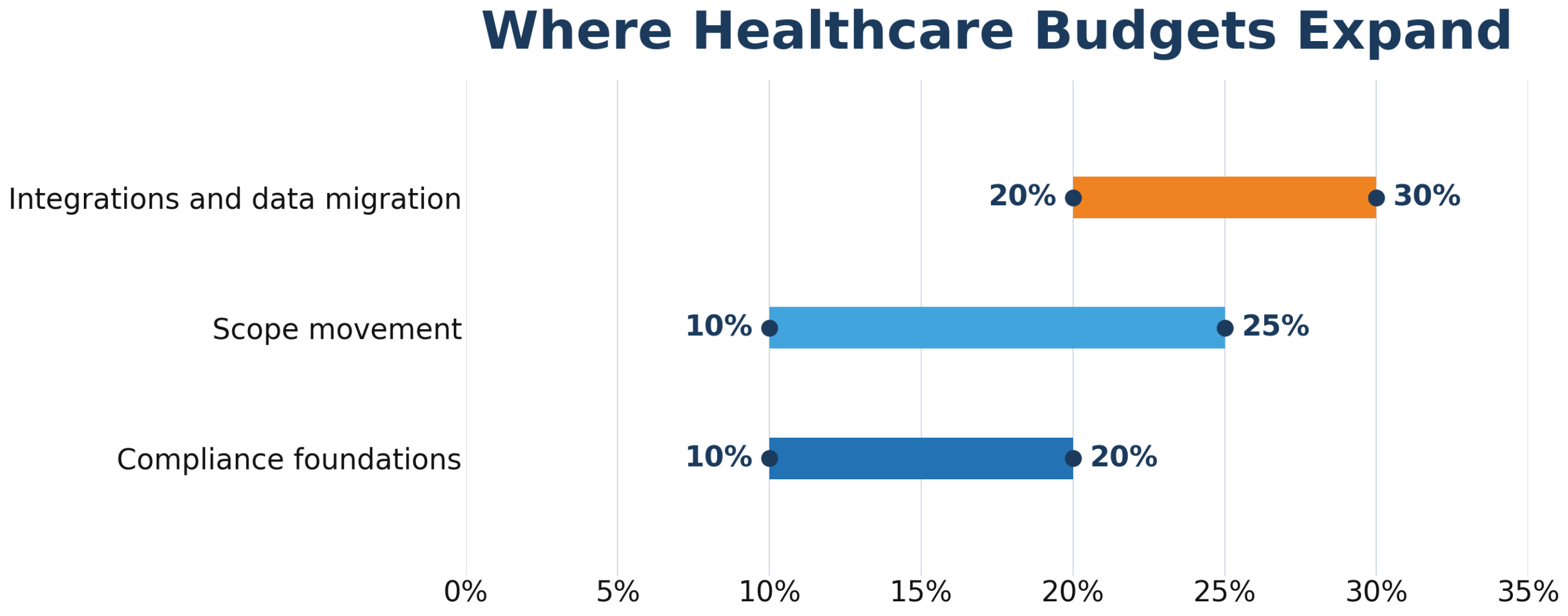
The eight breakdowns above show category-specific drivers. This section covers the factors that apply to every healthcare project, with typical shares of a total build budget.
Where the Budget Actually Goes
Cost Component | Typical Share of Build Budget | What Drives It |
Discovery, requirements, and architecture | 5% to 12% | Regulatory scope, number of stakeholders, integration discovery |
UI/UX design | 8% to 15% | Number of user roles, accessibility requirements, clinical workflow research |
Frontend development | 15% to 25% | Platform count, offline support, data density of screens |
Backend development | 20% to 35% | Business logic, integrations, scale and availability targets |
Integrations and interoperability | 10% to 30% | Number and depth of connected systems |
AI/ML development | 0% to 35% | Only applies where models are core to the product |
Security and compliance engineering | 8% to 18% | Regulatory framework, audit expectations, data sensitivity |
Testing and QA | 12% to 20% | Clinical risk level, device matrix, regression surface |
Cloud and DevOps setup | 5% to 12% | Availability targets, environment count, automation depth |
Project management | 8% to 15% | Team size, stakeholder count, delivery model |
Two planning allowances from published 2026 benchmark data are worth adding on top of any base estimate: significant integrations and data migration typically add roughly 20% to 30% to an initial build, and scope movement adds roughly another 10% to 25% on many projects. Healthcare projects sit at the upper end of both, because integration counts are high and regulatory review frequently surfaces requirements late.
Those percentages will not sum neatly to 100% for any single project, because AI work and integration depth vary so much between products. Use them to sanity-check a proposal rather than to build one.
Platform Choice
Platform Approach | Relative Cost | Notes |
Single platform (iOS or Android only) | Baseline | Suitable for pilots and closed clinical deployments |
Cross-platform (React Native or Flutter) | +15% to +35% over baseline | Best value for most patient-facing healthcare apps |
Native iOS and Android separately | +60% to +100% over baseline | Justified by heavy device, sensor, or performance requirements |
Responsive web application | Baseline to +20% | Common for clinician and administrator interfaces |
Mobile plus web plus admin portal | +80% to +150% over baseline | The realistic scope for most production healthcare platforms |
Healthcare Integrations
Integration Type | Typical Cost Range | Typical Duration |
FHIR-based read-only EHR access | $10,000 to $35,000 | 3 to 8 weeks |
FHIR-based bidirectional EHR integration | $30,000 to $120,000 | 8 to 20 weeks |
HL7 v2 interface engine work | $15,000 to $70,000 | 4 to 14 weeks |
Lab and diagnostic system integration | $12,000 to $50,000 | 4 to 10 weeks |
E-prescribing network integration | $15,000 to $60,000 | 6 to 14 weeks |
Payer eligibility and claims | $20,000 to $90,000 | 8 to 18 weeks |
Payment gateway | $5,000 to $20,000 | 2 to 5 weeks |
Wearable or consumer health platform | $8,000 to $30,000 per platform | 2 to 6 weeks |
Medical device connectivity | $15,000 to $80,000 per device class | 6 to 16 weeks |
Security, Compliance, and Assurance
Security spending in healthcare is easier to justify when you look at what a breach costs. IBM’s 2026 Cost of a Data Breach Report, released in July 2026, put the global average breach cost across all sectors at $4.99 million, the highest in the study’s history, with healthcare the most expensive industry for the thirteenth consecutive year at about $6.6 million globally. The prior year’s report put the US healthcare average at $7.42 million, with healthcare breaches taking around 279 days on average to identify and contain. Against those figures, a $25,000 security investment during development is not a cost centre.
Item | Typical Cost Range | Frequency |
HIPAA-aligned architecture and controls implementation | $15,000 to $60,000 | One-time, with ongoing upkeep |
Encryption, key management, and access control hardening | $8,000 to $35,000 | One-time |
Penetration testing | $8,000 to $30,000 | Annually or per major release |
Security risk assessment and documentation | $6,000 to $25,000 | Annually |
SOC 2 Type II readiness and audit | $25,000 to $80,000 | Initial, then annual |
Business associate agreement and vendor review process | $3,000 to $15,000 | Ongoing |
GDPR or regional privacy adaptations | $10,000 to $50,000 | Per region |
Testing, Infrastructure, and Data
Item | Typical Cost Range | Notes | Functional and regression QA |
12% to 20% of build cost | Higher for clinical risk | Test automation framework | $15,000 to $60,000 |
Pays back across releases | Device and browser compatibility testing | $5,000 to $25,000 | Scales with supported device matrix |
Accessibility conformance testing | $6,000 to $30,000 | Required for public sector and many enterprise buyers | Cloud infrastructure (production) |
$500 to $15,000 monthly | Driven by data volume, uptime targets, and AI inference | Non-production environments | $300 to $4,000 monthly |
Dev, staging, and demo | Data migration | $20,000 to $200,000 | Depends on source data quality and volume |
MVP vs Advanced Healthcare App
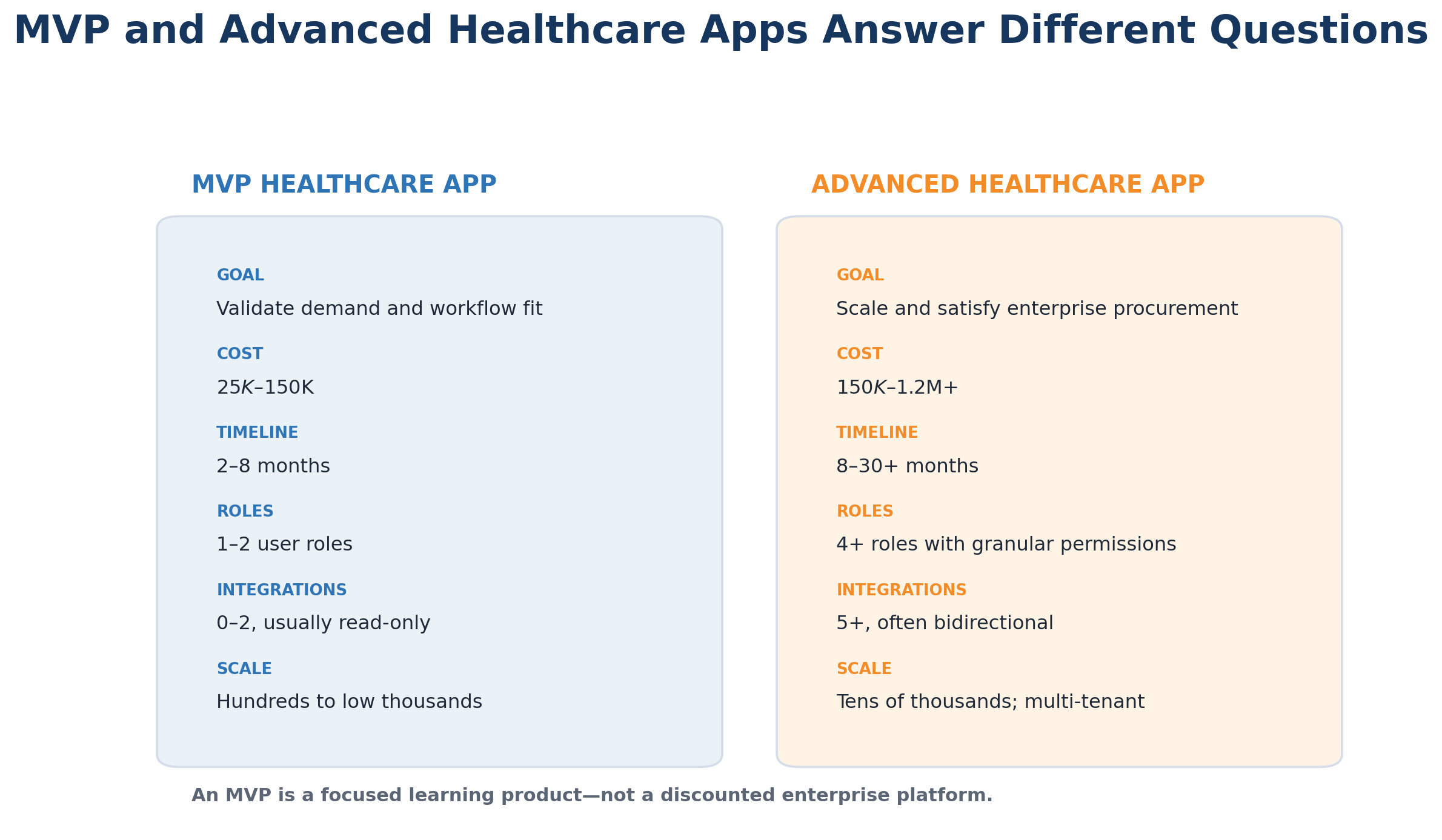
Dimension | MVP Healthcare App | Advanced Healthcare App |
Primary goal | Validate demand and workflow fit | Scale, retain, and satisfy enterprise procurement |
Feature depth | One core workflow done well | Multiple workflows, roles, and edge cases |
User roles | One or two | Four or more, with granular permissions |
Cost | $25,000 to $150,000 depending on category | $150,000 to $1,200,000+ depending on category |
Timeline | 2 to 8 months | 8 to 30+ months |
Integrations | Zero to two, usually read-only | Five or more, often bidirectional |
Compliance posture | HIPAA-aligned foundations, documented controls | Full evidence package, third-party audits, certifications |
Scalability | Hundreds to low thousands of users | Tens of thousands of users, multi-tenant, multi-region |
AI capability | Off-the-shelf models or none | Custom or fine-tuned models with monitoring |
Testing | Manual plus targeted automation | Full automation suite, load testing, security testing |
Support model | Business hours | 24/7 with defined service level agreements |
Complexity | Low to medium | High to very high |
The practical takeaway is that an MVP is not a discount version of the advanced product. It is a different product with a different question to answer. Teams that try to build a scaled-down enterprise platform generally spend MVP money and learn nothing, because the scope was too broad to ship quickly and too shallow to satisfy a real buyer.
Healthcare App Development Team Costs
Two variables set your effective rate: where the team is, and who is on it.
Hourly Rates by Region
Region | Typical Hourly Rate (2026) | Notes |
United States and Canada | $100 to $200+ | Highest rates, strongest domain and regulatory proximity |
Western Europe | $80 to $150 | Strong privacy and regulatory experience |
Eastern Europe | $45 to $85 | Common mid-cost engineering hub |
Latin America | $45 to $90 | Time zone overlap with North America |
South Asia | $25 to $55 | Largest cost advantage, depth of engineering talent |
Southeast Asia | $30 to $60 | Growing healthcare delivery capability |
Those ranges line up with published 2026 benchmark data. Accelerance’s 2026 Global Software Development Rates and Trends Guide benchmarks senior developers at roughly $64 to $76 per hour in Central and Eastern Europe and $60 to $75 in Latin America, with its senior figure for Asia lower at around $31 to $41. Industry rate guides put senior North American developers at roughly $100 to $150 or more per hour, and other 2026 research places US senior rates as high as $125 to $250. Clutch’s directory data shows most listed software development companies charging in the $24 to $49 per hour band, which reflects company-level blended averages across heavily offshore providers rather than senior onshore rates.
One useful trend: Accelerance reported that rates dipped by single-digit percentages across all major outsourcing regions during 2025, with Latin America falling 7.1% year on year, attributed to competition and AI-assisted development. Do not assume last year’s quote is this year’s price in either direction.
A blended onshore team and a blended offshore team can differ by a factor of three on the same scope. What does not change with geography is the compliance work, the integration effort, and the clinical review time, so cost savings apply to a portion of the project, not all of it. Many healthcare organizations settle on a hybrid model: onshore product, clinical, and compliance leadership with an offshore or nearshore engineering core.
Typical Team Composition and Cost Contribution
Role | Typical Allocation | Share of Team Cost | When It Is Needed |
Product manager or business analyst | 50% to 100% | 10% to 15% | Entire project |
Solution architect | 20% to 50% | 8% to 12% | Heaviest at the start |
UI/UX designer | 50% to 100% early | 8% to 14% | Front-loaded |
Frontend or mobile engineers (1 to 3) | 100% | 20% to 30% | Core build |
Backend engineers (1 to 3) | 100% | 22% to 32% | Core build |
Integration engineer | 30% to 100% | 8% to 15% | Peaks during interoperability work |
AI/ML engineer or data scientist | 0% to 100% | 0% to 25% | Only for AI-centric products |
DevOps engineer | 20% to 50% | 6% to 10% | Setup and release cycles |
QA engineers (1 to 2) | 80% to 100% | 12% to 18% | Continuous |
Compliance or security specialist | 10% to 40% | 5% to 10% | Design, pre-launch, and audits |
Clinical subject matter expert | 5% to 25% | 3% to 8% | Requirements and validation |
Post-Launch Maintenance Costs
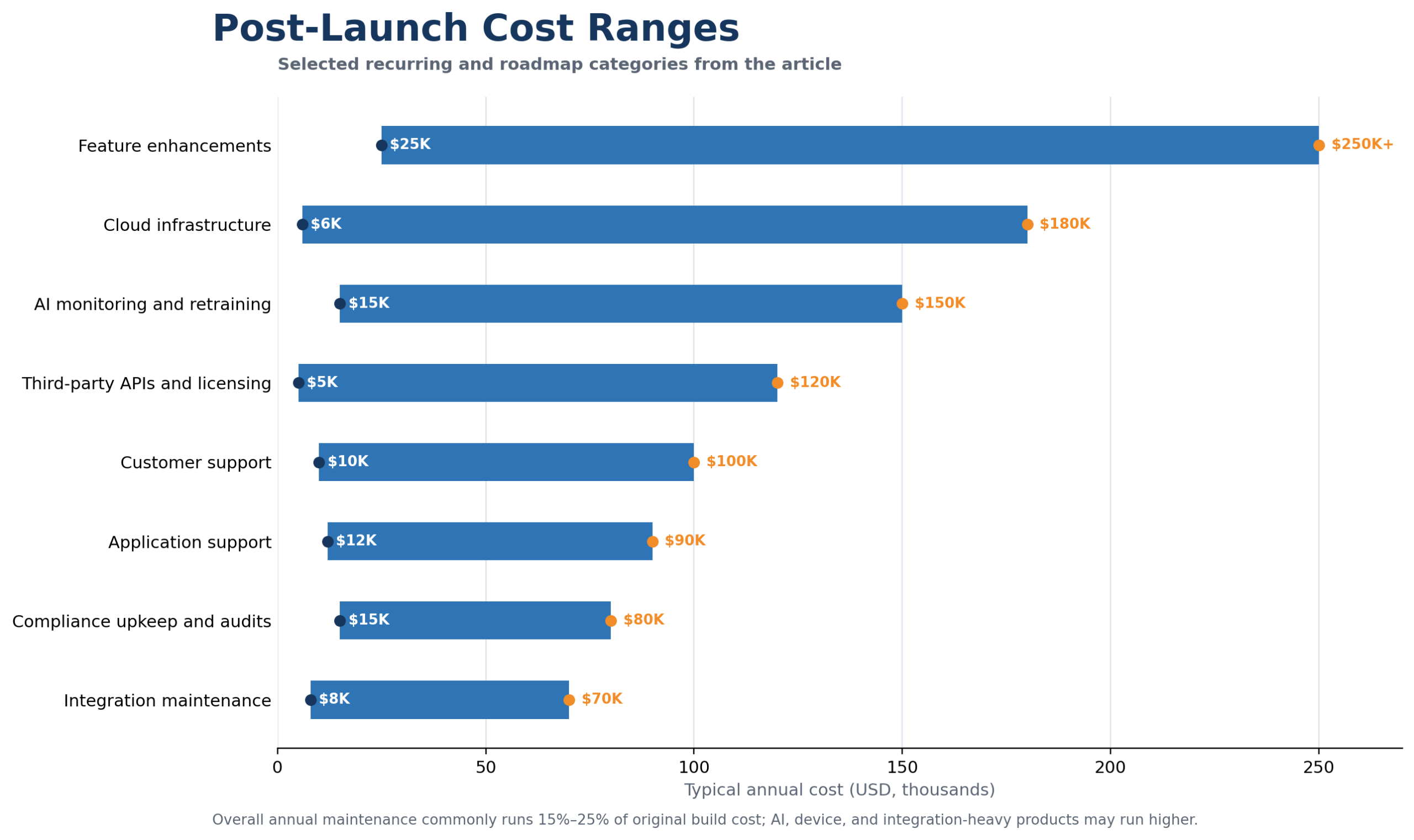
Plan on 15% to 25% of the original build cost per year for a production healthcare application. Products with AI components, heavy device connectivity, or many integrations sit at the top of that range or above it.
Maintenance Category | Typical Annual Cost | What It Covers | Cloud hosting and infrastructure |
$6,000 to $180,000 | Compute, storage, backups, networking, disaster recovery | Application support and bug fixes | $12,000 to $90,000 |
Triage, defect resolution, incident response | Security monitoring and patching | $10,000 to $60,000 | Vulnerability management, dependency updates, log monitoring |
Annual penetration testing and risk assessment | $12,000 to $50,000 | Required evidence for most enterprise buyers | Compliance upkeep and audits |
$15,000 to $80,000 | SOC 2 renewal, policy updates, vendor reviews | Third-party API and licensing fees | $5,000 to $120,000 |
Video minutes, messaging, terminology, mapping, AI inference | OS and platform compatibility updates | $8,000 to $35,000 | Annual iOS and Android release cycles |
Integration maintenance | $8,000 to $70,000 | Partner API changes, EHR upgrades, interface breakage | AI model monitoring and retraining |
$15,000 to $150,000 | Only for AI-centric products | Feature enhancements | $25,000 to $250,000+ |
Roadmap work, distinct from keep-the-lights-on maintenance | Customer support tooling and staffing | $10,000 to $100,000 | Scales with user base |
The most commonly underfunded item on that list is integration maintenance. Partner systems change on their schedule, not yours, and a broken interface in a clinical product is an operational incident rather than a backlog ticket.
Hidden Healthcare App Development Costs
These are the costs that appear after contracts are signed. Budget for them explicitly.
Hidden Cost | Typical Range | Why It Gets Missed |
Compliance documentation and evidence packages | $10,000 to $60,000 | Teams budget for controls, not for proving they exist |
Security questionnaires and vendor due diligence | $5,000 to $30,000 annually | Every enterprise customer sends their own |
EHR vendor program fees and certification | $5,000 to $50,000+ | Access to production integration environments is not always free |
Sandbox and test data setup | $5,000 to $25,000 | Realistic de-identified clinical test data is hard to source |
Medical device procurement for testing | $3,000 to $40,000 | You cannot test device connectivity without the devices |
Terminology and code set licensing | $3,000 to $40,000 annually | Some clinical vocabularies carry fees |
AI API consumption at scale | $2,000 to $40,000 monthly | Pilot usage costs almost nothing, production does not |
Data migration cleanup | $15,000 to $150,000 | Legacy data quality is always worse than expected |
Clinical review and advisory time | $8,000 to $75,000 | Clinicians who review your product expect to be paid |
Training, onboarding, and change management | $10,000 to $100,000 | Adoption failure is a cost, not a risk |
Accessibility remediation | $6,000 to $40,000 | Cheaper to design in than to retrofit |
App store review cycles for health claims | $2,000 to $15,000 | Health apps get extra scrutiny and rejection rework |
Cyber liability insurance | $3,000 to $50,000 annually | Frequently required by enterprise contracts |
How to Reduce Healthcare App Development Costs
There are good ways to cut healthcare app development cost and bad ones. The bad ones all involve trimming compliance, security, QA, or clinical validation, and they cost more later. Here is what actually works.
Narrow the first release aggressively
Ship one workflow for one user group. Every additional role, specialty, or edge case in version one multiplies design, development, and test effort. The discipline to say “version two” is the single largest cost lever available.
Use standards-based integration wherever the option exists
A FHIR-based integration is usually cheaper to build and dramatically cheaper to maintain than a custom interface. Push back when a partner offers a proprietary file drop as the path of least resistance.
Buy infrastructure, build differentiation
Video, messaging, payments, identity, scheduling primitives, and observability are solved problems with mature vendors. Spend your engineering budget on the clinical workflow and data model that make your product distinct.
Choose cross-platform for patient-facing apps
Unless you have hard requirements around sensors, background processing, or performance, a single cross-platform codebase covers iOS and Android at a large discount to two native builds.
Design compliance in from the first sprint
Retrofitting audit logging, access control, encryption, and data retention into a working system routinely costs several times what it would have cost as part of the original architecture.
Invest in test automation early
It looks like extra cost in month three and pays for itself by month nine, because healthcare products have long lifespans and heavy regression surfaces.
Use a hybrid delivery model
Keep product ownership, clinical input, and compliance decisions close to your market, and place the engineering core in a lower-cost region under strong process controls. This is where quality management certification matters, because the process is what makes distributed delivery reliable.
Reuse proven architectural patterns
Role-based portals, notification engines, document management, scheduling, and audit trails do not need to be reinvented for every project. A partner with existing accelerators in these areas starts you well ahead of a blank repository.
Stage integrations by value
Do not connect to five systems at launch. Connect to the one that unlocks your first paying customer and sequence the rest against actual demand.
Right-size infrastructure at launch
Architect for scale, provision for reality. Over-provisioned cloud environments quietly consume budget that belongs in feature development.
The Future of Healthcare App Development
Several forces are reshaping what these products cost and what they are expected to do. None of them create new categories so much as they change the eight that already exist.
AI and generative AI
Generative models are moving into production first in documentation, summarization, patient communication, and coding support. In practice this means telemedicine platforms gain ambient note generation, patient engagement portals gain conversational assistants, and EHR systems gain AI-assisted charting. Healthcare AI development cost is falling for API-based work and rising for anything requiring proprietary data and clinical validation.
Grand View Research projects the AI in healthcare segment growing at roughly 38.9% annually through 2033, several times the pace of the wider digital health market, and the FDA had already authorized more than 1,000 AI-enabled medical devices as of August 2025.
Predictive analytics
Healthcare analytics platforms are shifting from retrospective dashboards to forward-looking risk models, and clinical decision support systems are blending deterministic rules with predictive scoring. The cost implication is that data quality work moves earlier and matters more.
Wearables and remote patient monitoring
Consumer devices keep gaining clinically useful signals, which lowers the hardware barrier for remote patient monitoring systems and pulls wellness apps closer to monitoring programs. Passive sensing reduces patient burden and shifts engineering effort toward alert quality rather than data capture.
Interoperability and FHIR
With roughly 7 in 10 US hospitals already using standards-based APIs such as HL7 FHIR as of 2024, standards-based exchange continues to reduce the cost of connecting a patient engagement portal, telemedicine platform, or analytics platform to clinical systems. It also makes a focused specialty EHR system commercially viable in ways it was not a decade ago, because a smaller platform can still participate in the wider data ecosystem.
Personalized healthcare
Segmentation is giving way to individual-level tailoring of content, care plans, and outreach timing. This affects wellness apps and patient engagement portals most directly, and it raises the value of the behavioral data those products already collect.
Voice interfaces and ambient clinical intelligence
Ambient capture during clinical encounters is the most immediate change to clinician-facing products. It reduces documentation burden in telemedicine platforms and EHR systems, and it creates a new structured data source that clinical decision support systems and analytics platforms can consume.
The pattern across all six trends is the same: the interface gets simpler, the data layer gets heavier, and more of the budget moves from screens toward data engineering, evaluation, and monitoring.
How App Maisters Helps You Plan and Build Healthcare Applications
App Maisters Inc. is a Houston-based AI-First digital transformation company specializing in custom software and application serving businesses of all sizes across commercial and public sector markets. The company operates two divisions: a commercial practice and App Maisters Government, which serves public sector clients including health-related agencies.
For healthcare projects, the relevant capabilities are:
- Mobile app development across native and cross-platform mobile, responsive web, and multi-role enterprise platforms with configurable workflows, granular permissions, and audit logging.
- AI and data engineering, spanning generative AI applications, model integration, predictive scoring, data pipelines, and analytics dashboards built on major cloud platforms.
- Digital health research and development experience in remote monitoring patterns, guided mobile image capture, structured patient-reported assessment, explainable longitudinal risk scoring with deterministic safety overrides, and clinician-facing dashboards showing history, trends, and contributing factors.
- Documented quality and security processes. App Maisters holds ISO 9001 and ISO 27001 certifications, which support the development process and information security controls that healthcare buyers evaluate during vendor due diligence.
- Public sector procurement readiness. App Maisters holds SBA 8(a) and MBE certifications, relevant to health organizations purchasing through federal, state, or local channels.
- Portal and self-service platform patterns proven across resident and constituent portal work, covering secure identity, document access, request workflows, notifications, and staff administration dashboards that map directly onto patient engagement requirements.
A typical engagement starts with a scoping exercise that turns a product idea into a costed feature set, an integration inventory, a compliance plan, and a phased delivery roadmap. That artifact is what turns a wide cost range into a real budget.
Final Words
Healthcare app development pricing is a function of four things: how many workflows you support, how many systems you connect to, how much regulatory evidence you need to produce, and how much of your product depends on models rather than rules. Everything else is detail.
Use the ranges in this guide to build a defensible planning budget, then replace them with a real number through a proper scoping exercise. The organizations that stay on budget in healthcare software are the ones that scoped the integrations and the compliance work before they wrote the first line of code.
FAQs
How much does it cost to develop a healthcare app?
A focused MVP generally runs between $25,000 and $150,000 depending on the category, while production platforms range from roughly $100,000 to well over $1,000,000. Wellness apps sit at the low end and EHR systems, clinical decision support systems, and AI-centric products at the high end.
How long does healthcare app development take?
Two to eight months for an MVP and eight to thirty months or more for an enterprise platform. Integration discovery and compliance work are the most common causes of schedule slip.
Does HIPAA compliance increase development cost?
Yes. Expect HIPAA-aligned architecture, controls, and documentation to add roughly 10% to 20% to a build, plus recurring annual costs for testing, monitoring, and audits. Building without it and retrofitting later is considerably more expensive.
What drives telemedicine app development cost most?
Real-time video infrastructure choices, e-prescribing, and payer eligibility and claims integration. Teams commonly budget the video and omit the revenue cycle.
How much should I budget for maintenance?
Plan on 15% to 25% of the build cost annually, weighted toward the upper end for products with AI models, connected devices, or many integrations.
Is it cheaper to build a custom EHR or license one?
Licensing is almost always cheaper unless your specialty or care model is poorly served by existing products, or you intend to license your platform to peer organizations. Custom EHR development cost starts around $100,000 for a narrow single-specialty system and scales quickly from there.
Can offshore development reduce healthcare app costs safely?
Yes, when the partner has documented quality and security processes, and when compliance and clinical decisions stay close to your market. Rate savings apply to engineering hours, not to compliance, integration, or clinical validation effort.