


Enterprise AI Adoption Framework for Large Organizations
Most large organizations have stopped asking whether to use artificial intelligence. The harder questions are why promising pilots never reach production, why three departments have quietly purchased the same capability, and who is accountable when a model influences a decision that affects a customer.
That gap between experimentation and operational impact is rarely a technology problem. It is a structure problem. Enterprise AI adoption works when strategy, data, infrastructure, governance, and people advance on the same roadmap instead of separate ones.
This guide sets out a practical enterprise AI adoption framework built for the realities of large, multi-system environments, along with the challenges, team models, ROI measures, and mistakes that decide whether AI becomes infrastructure or stays a science project.
What Enterprise AI Adoption Actually Means
Enterprise AI adoption is the disciplined process of embedding AI into core operations, decision workflows, and customer experiences at organizational scale, supported by governed data, secure infrastructure, and clear ownership.
The distinction matters because activity is often mistaken for adoption. Experimentation lives inside one team, runs on extracted spreadsheet copies, depends on an individual champion, and ends when the demo finishes. Adoption redesigns a process, runs on governed pipelines, has a named business owner and an accountable data steward, and continues through monitoring, retraining, versioning, and user support.
Put simply, a pilot proves a model can work. Adoption proves the organization can run it.
Why Enterprise AI Adoption Matters Now
Four pressures are converging for large organizations:
- Margin and cycle time: Competitors who compress approval, resolution, and fulfillment cycles reset customer expectations for everyone in the category.
- Institutional knowledge: Retirements and turnover drain expertise that lives in documents, tickets, and long-serving specialists. Well-designed AI systems capture and operationalize that knowledge.
- Regulatory movement: Obligations under frameworks such as the EU AI Act, along with sector rules in finance and healthcare, are phasing in. Retrofitting governance costs far more than designing it in.
- Shadow AI: When there is no sanctioned path, employees use consumer tools with corporate data. An adoption framework is as much about containment as capability.
For organizations already running a broader digital transformation program, AI is most effective when it plugs into that roadmap rather than running beside it as a separate initiative.
Why Enterprise AI Adoption Matters Now
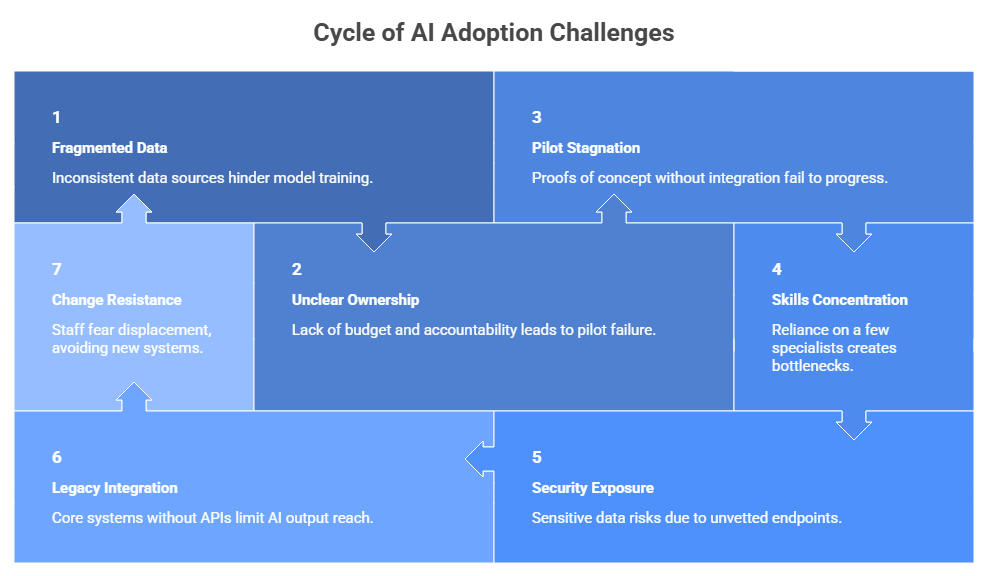
- Fragmented, undocumented data: Decades of acquisitions, custom systems, and inconsistent field definitions produce models trained on data nobody trusts.
- Unclear ownership: When AI is treated as an IT initiative rather than a business capability, pilots end up with no budget owner and no route to production.
- Pilot stagnation: Proofs of concept built without integration, security review, or a support model create sunk cost and internal skepticism.
- Skills concentration: A handful of specialists carry every initiative, creating delivery bottlenecks and single points of failure.
- Security and IP exposure: Sensitive data sent to unvetted third-party endpoints creates contractual, regulatory, and reputational risk.
- Legacy integration: Core systems without APIs or real-time access produce AI outputs that never reach the workflows that need them.
- Change resistance: Staff who assume displacement rather than augmentation quietly avoid systems that work perfectly well.
The Enterprise AI Adoption Framework
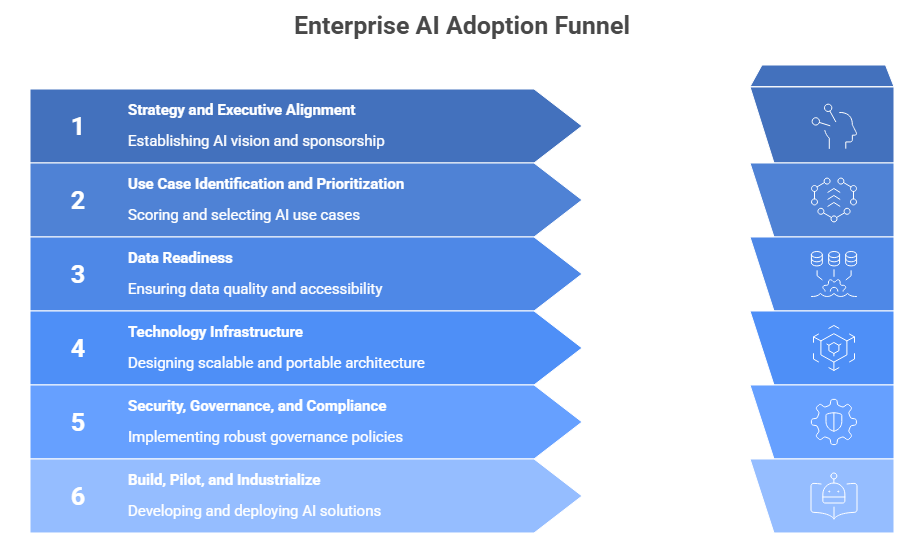
Stage 1: Strategy and Executive Alignment
Start with business objectives, not model selection. Define three to five outcomes AI must serve over the next 18 months, such as reducing manual handling in claims, improving forecast accuracy, or shortening service resolution times.
Deliverables here are an AI vision tied to corporate strategy, a named executive sponsor, an initial funding envelope, and a decision on operating model. Many organizations bring in external AI consulting and development support at this stage to pressure-test the roadmap before committing budget.
Stage 2: Use Case Identification and Prioritization
Run structured discovery across functions, then score candidates instead of debating them.
| Use case profile | Value | Feasibility | Recommended action |
|---|---|---|---|
| High value, high feasibility | High | High | Fund first and treat as the flagship |
| High value, low feasibility | High | Low | Sequence behind data and platform work |
| Low value, high feasibility | Low | High | Use for capability building and team learning |
| Low value, low feasibility | Low | Low | Decline and document the reason |
Score feasibility on data availability, integration complexity, regulatory sensitivity, and process stability. Score value on cost
Stage 3: Data Readiness
Data work is where most enterprise AI programs are won or lost. An AI readiness assessment should cover:
- Availability: where data lives, who owns it, and how it is accessed
- Quality: completeness, accuracy, duplication, and consistency of definitions
- Lineage: where each field originates and how it has been transformed
- Rights: contractual and consent constraints on using data for training
- Architecture: whether pipelines support production workloads rather than one-off extracts
Treat curated datasets as reusable data products with owners and service levels. This is what turns the second and third use case from a rebuild into a configuration.
Stage 4: Technology Infrastructure
Design for portability. Model and vendor landscapes shift quickly, so architecture should let you replace components without rewriting applications.
Core layers to define: a data platform with feature management, a model access layer that abstracts across providers, orchestration and retrieval services, evaluation and observability tooling, and integration middleware into ERP, CRM, and line-of-business systems. Where AI needs a purpose-built interface rather than an embedded panel, that becomes a custom app development workstream in its own right.
Make deployment decisions deliberately. Sensitive workloads may justify private or on-premises inference, while lower-risk workloads run cost-effectively on managed services.
Stage 5: Security, Governance, and Compliance
Governance is what makes scale possible, not what slows it down. A workable AI governance model includes a model inventory recording purpose, owner, data sources, and risk classification; a risk tiering scheme with proportionate review requirements; human oversight for consequential decisions; access controls, data residency rules, logging, and retention policies; documented bias, robustness, and accuracy testing; and an incident and rollback procedure for model failures.
App Maisters operates under ISO 9001 and ISO 27001 certified processes, which shape how client data, access control, and documentation are handled across AI engagements.
Stage 6: Build, Pilot, and Industrialize
Deliver in short cycles against a measured baseline. Capture current-state performance before the pilot begins, or ROI claims will be unprovable later.
Industrialization is a separate, deliberate step covering hardening, monitoring, retraining triggers, documentation, support ownership, and user training. Budget for it from the start rather than discovering it after a successful pilot.
Stage 7: Adoption and Change Enablement
Usage is the real deliverable. Involve frontline teams in design, communicate honestly about how roles change, publish clear acceptable use guidance, and appoint champions inside each function. Track adoption rates as a first-class metric alongside model performance.
Building and Scaling AI Teams
Three operating models dominate in large organizations. A centralized model puts a single center of excellence in charge of delivery, which suits early programs that need standards. A federated model lets each business unit build independently, which works only where engineering depth is already strong. A hub and spoke model combines a central platform, standards, and governance function with embedded delivery teams, and fits most large enterprises scaling beyond their first few use cases.
Roles to staff, in rough order of need: AI product owner, data engineer, machine learning or AI and ML engineering talent, MLOps engineer, data governance lead, security architect, and change lead. Domain experts belong on the delivery team, not on a review committee at the end.
Few organizations hire all of this at once. Most blend internal hiring with an experienced delivery partner or IT staff augmentation to reach production faster while internal capability matures.
Measuring AI ROI and Business Impact
Report across four layers so technical success and business value are never confused.
| Layer | Example measures | Owner |
|---|---|---|
| Model | Accuracy, precision and recall, latency, hallucination rate | AI engineering |
| Process | Cycle time, touchless rate, rework, throughput | Process owner |
| Financial | Cost per transaction, revenue influenced, cost avoided | Finance partner |
| Risk and adoption | Active usage, override rate, incidents, audit findings | Governance lead |
One discipline matters more than the rest: agree the baseline and the attribution method with finance before build, not after launch.
Common AI Adoption Mistakes and How to Avoid Them
- Choosing technology before defining the problem: Anchor every initiative to a business outcome with a measured baseline.
- Treating AI as an IT program: Assign business ownership, with IT as delivery partner rather than sponsor.
- Starting with a transformational first use case: Sequence one flagship alongside two lower-risk wins.
- Deferring governance until scale: Stand up the model inventory and risk tiering at the first pilot.
- Ignoring integration and support costs: Include industrialization in the original business case.
- Measuring only model metrics: Report process, financial, and adoption measures together.
- Underinvesting in change management: Fund training and communication as a delivery workstream, not an afterthought.
Real-World Enterprise Use Cases
- Financial services: transaction monitoring and fraud detection, credit document processing, regulatory reporting support, and client onboarding checks
- Manufacturing and energy: predictive maintenance from sensor data, computer vision quality inspection, demand and supply forecasting, and technician-facing knowledge assistants
- Healthcare and life sciences: clinical documentation support, prior authorization processing, capacity and scheduling optimization, and patient communication triage, an area covered by our healthcare technology work
- Retail and logistics: assortment planning, dynamic routing, returns triage, and service automation across channels
- Professional and legal services: contract review and clause extraction, research acceleration, and proposal drafting support
Future Trends in Enterprise AI Adoption
- Agentic workflows: Systems that execute multi-step processes across applications, which raises the stakes on permissioning, logging, and human checkpoints. Our agentic AI development practice is built around exactly those controls.
- Smaller specialized models: Task-specific models tuned on proprietary data, often cheaper and more controllable than general-purpose alternatives.
- Governance as a standing function: Dedicated AI risk roles, internal audit coverage, and independent model validation.
- Evaluation engineering: Continuous automated testing of AI outputs becoming as routine as software regression testing.
- Data products as the unit of investment: Funding curated, governed datasets rather than isolated model projects.
- Deployment sovereignty: Rising demand for private and regional inference driven by residency and confidentiality requirements, including for generative AI solutions handling sensitive content.
Conclusion and Recommended Next Steps
Enterprise AI adoption is an operating discipline, not a purchase. The organizations pulling ahead are not necessarily using better models. They have clearer ownership, cleaner data, proportionate governance, and a repeatable path from idea to production.
Practical actions for the next 90 days:
- Appoint an executive sponsor and confirm three to five business outcomes AI must serve.
- Run structured use case discovery and score candidates on value and feasibility.
- Complete an AI readiness assessment covering data, integration, and security.
- Stand up a model inventory and risk tiering scheme before the first production deployment.
- Select one flagship use case and two lower-risk wins, each with a documented baseline.
- Publish acceptable use guidance to reduce shadow AI exposure.
- Decide your operating model and the balance between internal hiring and partner delivery.
Work With an Experienced Enterprise AI Partner
App Maisters has been building enterprise software and AI systems since 2014 from our Houston headquarters, serving businesses of all sizes across financial services, healthcare, manufacturing, energy, retail, and professional services. Our teams work across AI strategy, data engineering, secure platform architecture, governance design, and production delivery, supported by ISO 9001 and ISO 27001 certified processes.
If you are ready to move from AI experimentation to measurable business impact, talk to our enterprise AI team about a readiness assessment and a prioritized adoption roadmap.
FAQs
What is an enterprise AI adoption framework?
It is a structured sequence covering AI strategy, use case prioritization, data readiness, infrastructure, governance, delivery, and change management. App Maisters uses this framework so large organizations move from isolated pilots to production systems with clear ownership at every stage.
How long does enterprise AI adoption take?
A focused first use case typically reaches production in months rather than weeks, while enterprise-wide scaling runs across multiple planning cycles. App Maisters shortens the early stages by sequencing one flagship use case alongside lower-risk wins instead of attempting broad transformation first.
Why do enterprise AI projects fail?
Most fail for structural reasons: unclear business ownership, poor data quality discovered late, no integration path into core systems, and governance added after the fact. App Maisters addresses these in discovery, before build, where they are far cheaper to fix.
What is an AI readiness assessment?
It evaluates whether your data, architecture, security posture, and teams can support production AI. App Maisters assesses data availability, quality, lineage, usage rights, integration complexity, and governance maturity, then maps findings to a prioritized roadmap with effort estimates.
How do you measure AI ROI in a large organization?
Measure model performance, process improvement, financial outcomes, and adoption together, always against a baseline captured before launch. App Maisters defines baselines and attribution methods with your finance stakeholders at the start so value is provable later.
Do we need an in-house AI team or an external AI development partner?
Most large organizations use both. App Maisters commonly delivers the first production deployments while client teams build internal capability, transferring documentation, platform standards, and operational ownership as internal maturity grows.
What is shadow AI and why should enterprises worry about it?
Shadow AI is unsanctioned use of consumer AI tools with company data, creating security, IP, and compliance exposure. App Maisters helps organizations reduce it by publishing acceptable use guidance and providing governed internal alternatives employees actually prefer.