


How to Build Secure Mobile Banking Apps
That Scale
Most mobile banking programs do not fail at launch. They fail where growth exposes the assumptions made in the first eight weeks. The app that felt fast at fifty thousand users buckles at five hundred thousand. Fraud rules that caught last year’s attacks miss today’s synthetic identities. A compliance posture that satisfied an auditor in 2023 no longer maps to what an assessor expects in 2026.
Security and scalability are not features added late in a roadmap. They are properties of the architecture, decided early.
Why This Is a Board-Level Question
FDIC survey data puts mobile banking as the primary account access method for roughly 48 percent of US banked households. For many customers the app is the bank, and risk has followed the volume.
IBM’s Cost of a Data Breach Report 2025 places financial services second among 17 sectors at an average of $5.56 million per incident. The same research shows breaches contained within 200 days cost around $1.14 million less than those running longer, which makes detection speed worth more than most individual controls.
The exposure sits in the apps themselves. A 2025 Ostorlab analysis of more than 500 leading mobile banking apps found hardcoded secrets such as API keys or tokens in over half of them, outdated third-party libraries in 46 percent, and cleartext HTTP traffic in 20 percent.
Security Practices That Change Outcomes
Assume the device is hostile. It runs on hardware you do not control, in an OS state you cannot verify, potentially rooted, hooked, or screen-mirrored to an attacker.
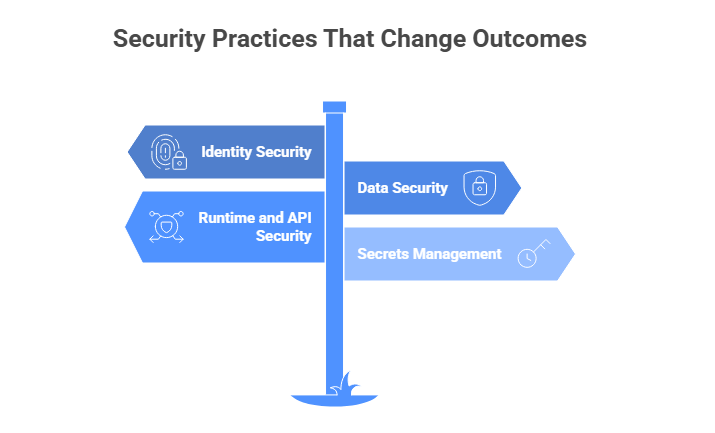
- Identity: Move to passkeys and FIDO2 with hardware-backed key storage in the Secure Enclave or Android StrongBox. Treat biometrics as a local unlock gate, never a network assertion: the device confirms the user, a cryptographic signature confirms the device. Bind payment authorization to the specific amount and payee through dynamic linking, and step up based on transaction risk rather than a fixed rule table.
- Data: Store the minimum on-device, encrypted and wiped on logout or detected tampering. Enforce TLS 1.3 with certificate pinning that includes a backup pin and a remote kill switch. Tokenize card data so the primary account number never reaches your datastore, which is also the most effective way to shrink PCI DSS scope.
- Runtime and API. Add anti-tampering, root and hook detection, and overlay abuse detection, reporting telemetry to the backend rather than acting only on-device. On the API layer, enforce authorization at the object level on every request, use non-enumerable identifiers, and rate limit per user and per endpoint. Most real losses happen here, because this is where money moves, so application security testing should validate these controls before launch.
- Secrets: Nothing sensitive ships in the binary. Issue short-lived, scoped tokens at runtime after device attestation via Play Integrity or App Attest, and fail the build on any secret detected in CI.
Architecture That Scales
Scale in banking is about correctness under concurrency, not raw request volume.
Resist premature microservices. A modular monolith with clean domain boundaries will serve a bank’s first few hundred thousand customers. Extract a service only when a domain has a different scaling profile, compliance boundary, or release cadence. Payments, fraud, identity, and ledger are usually the first four.
Make the core event-driven for durable buffering, replay, and fan-out to fraud and analytics without adding customer-path latency. Two disciplines make that safe: an idempotency key on every state-changing operation, so a retry after a timeout cannot double-post a payment, and the outbox pattern, so a database commit and an event publication cannot diverge. Keep the ledger strongly consistent and append-only, serving balance and history reads from separate projections. Getting the cloud architecture and regional strategy right early avoids migrations that later cost quarters.
Compliance as an Architectural Input
Framework | Mobile implication | Status |
PCI DSS v4.0.1 | Tokenization, payment page script inventory, tamper detection | All 51 future-dated requirements mandatory since March 2025 |
GDPR | Consent per purpose, minimization, erasure, residency | In force |
PSD2 | Strong customer authentication, dynamic linking, open banking APIs | In force, being replaced |
PSD3 and PSR | Tighter fraud liability, API performance, licensing | Texts agreed April 2026, applies around 2028 |
Instant Payments Regulation | Verification of Payee inside the payment flow | Applies to euro-area PSPs since October 2025 |
KYC and AML | Identity proofing, screening, defensible audit trail | In force |
Two points are easy to miss. The PCI DSS transition window has closed, so client-side script controls are live audit exposure, not a future project. And Verification of Payee already binds euro-area PSPs, so payment UX needs name matching today.
Technology Stack
Native Swift and Kotlin give the deepest access to hardware-backed key storage and attestation, which is why most tier-one banking apps use them. Flutter and React Native work when one team must ship both platforms, provided security-critical paths sit in native modules. On the backend, Java or Kotlin with Spring Boot suits enterprise integration and Go suits latency-sensitive authorization and fraud scoring, over a PostgreSQL ledger with Redis and Elasticsearch read projections.
Prefer boring, well-understood technology in the transaction path, and weight the talent market: a stack you cannot staff is a stack you cannot maintain. Where capacity is the constraint, dedicated engineering teams beat a hiring cycle.
DevSecOps and AI-Driven Fraud Defense
IBM’s 2025 research associates DevSecOps with measurably lower breach costs, not because a pipeline stops attackers but because it makes good practice the default. Gate it: secret scanning pre-commit, SAST and composition analysis on pull request, signed artifacts and an SBOM at build, and mobile testing against the OWASP MASVS before release, with independent quality assurance and security testing after every significant change.
Fraud has changed character. The FBI’s Internet Crime Complaint Center recorded $20.9 billion in cybercrime losses for 2025, up 26 percent, and introduced an AI-related crime descriptor for the first time, covering roughly $893 million in attributed losses that most analysts treat as an undercount.
Rules engines alone cannot keep pace. The durable signals are behavioral: typing cadence, swipe arc, device hold angle, navigation rhythm, scored continuously rather than only at login. A valid login followed by an accessibility service activating and coached navigation should trigger a hold even though the credentials checked out. At onboarding, passive liveness plus injection attack detection is now the minimum against deepfake-assisted identity fraud. AI and machine learning models catch what rules cannot anticipate; rules enforce what you cannot negotiate. Both need governance covering bias testing, explainability, and drift monitoring.
Common Mistakes
- Trusting the client: Validation that exists only in the app will be bypassed. Enforce server-side.
- Shipping secrets in the binary: Preventable, and still present in most banking apps tested.
- Premature microservices: Distributed complexity before the load requires it slows delivery.
- Missing idempotency: A correctness bug that surfaces at scale, the worst time to find it.
- Late compliance discovery: Residency, audit logging, and authentication shape the architecture.
- Over-securing onboarding: Risk-based authentication exists so you can spend friction where it buys something.
What to Prepare For
Passkeys are becoming the default rather than the alternative. Agentic finance will need delegated, scoped, revocable permissions for non-human actors, so design the authorization layer to extend rather than be rebuilt. Real-time payments remove the window in which fraud is traditionally caught, making pre-transaction scoring the only meaningful control point.
Build With a Partner Who Has Done This Before
Secure, scalable mobile banking is a discipline, not a project. It takes people who can tell a control that improves your risk posture from one that only improves your documentation.
App Maisters has delivered enterprise digital solutions from Houston since 2014 for businesses of all sizes across financial services and banking, healthcare, government, and energy. Our banking work includes the ShareOne mobile banking platform, a customizable app supporting bill payments, transfers, and account management. We operate as an ISO 9001 and ISO 27001 certified organization and hold SBA 8(a) and MBE certifications.
Engagements cover threat modeling and compliance mapping, secure architecture across mobile, API and cloud layers, iOS and Android development with mobile hardening, PCI DSS scope reduction, KYC and AML integration, DevSecOps, and AI fraud detection.
FAQs
How long does it take to build a secure mobile banking app?
Eight to twelve months from discovery to launch for core account, payment, and onboarding functionality. The main variables are the number of regulatory jurisdictions in scope, the maturity of the core banking APIs being integrated, and whether identity and fraud tooling is built or procured. App Maisters scopes timelines against those three factors during discovery rather than against feature count.
How much does it cost to build a mobile banking app?
Commonly cited 2026 industry ranges run from roughly $40,000 to $90,000 for a basic MVP up to $400,000 and beyond for an enterprise-grade digital banking platform, with post-launch maintenance usually budgeted at 15 to 20 percent of build cost annually. Scope, jurisdictions, and core banking integration drive the figure far more than screen count. App Maisters issues a milestone-based estimate with compliance scope priced in after a short discovery phase.
Can App Maisters integrate a mobile app with our existing core banking system?
Yes. App Maisters builds integration layers against core banking providers including Fiserv, Jack Henry, FIS, and Temenos, as well as open banking and Banking-as-a-Service APIs. The usual pattern is an anti-corruption layer between the core and your mobile services, so that core rate limits or batch windows do not end up dictating your app architecture.
Is Flutter secure enough for a banking app?
Flutter can meet banking security requirements when hardened properly, with certificate pinning, code obfuscation, secure storage through platform channels, and runtime integrity checks. App Maisters generally implements the security-critical paths, meaning key storage, device attestation, and biometric gating, in native Swift and Kotlin modules while Flutter handles the interface layer.
Should a banking app be native or cross-platform?
Native Swift and Kotlin give the deepest access to hardware-backed key storage and attestation, which is why most tier-one retail banking apps use them. Flutter and React Native are viable when one team must ship both platforms. App Maisters recommends the choice based on your security depth requirements, in-house skills, and release cadence rather than a fixed preference.
How do you scale a mobile banking app to millions of users?
Through an event-driven core, a strongly consistent ledger with separate read projections, idempotent write paths, and cell-based isolation so one failure does not reach the whole customer base. App Maisters designs for the next order of magnitude rather than current load, because sharding and partitioning decisions become expensive to reverse after launch.
What compliance standards apply to a mobile banking app?
Typically PCI DSS v4.0.1 where card data is handled, GDPR or the local privacy regime, PSD2 in the EU and UK with PSD3 arriving toward 2028, and KYC and AML obligations under the relevant national framework. US institutions add GLBA and state privacy laws; EU entities also fall under DORA. App Maisters maps the applicable set to your licence and target markets before architecture begins.