


A Strategic Approach to Proof-of-Concept Software Development
Every ambitious software initiative begins with a question that keeps executives up at night: Will this actually work?
Enterprises invest millions in digital products every year, yet industry research consistently shows that a significant share of software projects fail to deliver expected value not because the teams lacked talent, but because the underlying idea was never validated before full-scale development began. Proof-of-concept software development exists to close that gap. It is the discipline of proving technical feasibility, business viability, and stakeholder alignment before committing serious capital to full-scale custom software development.
In this guide, we break down what PoC software development is, why it has become a strategic imperative for enterprise leaders, and how to run a PoC process that produces decisions not just demos.
What Is Proof-of-Concept Software Development?
A proof of concept (PoC) is a small-scale, time-boxed software exercise designed to answer one question: can this idea be built, and is it worth building? Unlike a prototype or a minimum viable product, a PoC is not concerned with polish, user experience, or market launch. Its sole job is validation.
A well-scoped PoC typically:
- Tests whether a specific technology, integration, or architecture can support the intended solution
- Validates critical assumptions with real data rather than opinions
- Surfaces hidden technical constraints, compliance issues, or cost drivers early
- Gives decision-makers hard evidence to approve, redirect, or cancel an initiative
Think of a PoC as an insurance policy on innovation. For a fraction of the cost of a full build, it tells you whether the road ahead is paved or a dead end.
PoC vs. Prototype vs. MVP: What’s the Difference?
These three terms are often used interchangeably in boardrooms and that confusion leads to misaligned expectations and wasted budgets. Here’s how they actually differ:
| Dimension | Proof of Concept (PoC) | Prototype | Minimum Viable Product (MVP) |
|---|---|---|---|
| Primary goal | Prove technical feasibility | Visualize design and user flow | Test market demand with real users |
| Audience | Internal stakeholders, technical leaders | Investors, design teams, early stakeholders | Actual end users and early adopters |
| Fidelity | Low functional core only | Medium clickable, visual | High production-quality core features |
| Timeline | 2–6 weeks | 2–8 weeks | 2–6 months |
| Investment | Minimal | Low to moderate | Significant |
| Output | Go/no-go decision with evidence | Validated design direction | Revenue-ready product foundation |
| Question answered | “Can we build it?” | “How should it look and feel?” | “Will people use and pay for it?” |
The strategic sequence for most enterprise initiatives is PoC → prototype → MVP. Skipping the PoC stage is where most costly failures originate and when you’re ready to move beyond validation, an experienced app development partner can carry the concept through to a production-grade build.
Why PoC Development Matters for Enterprises
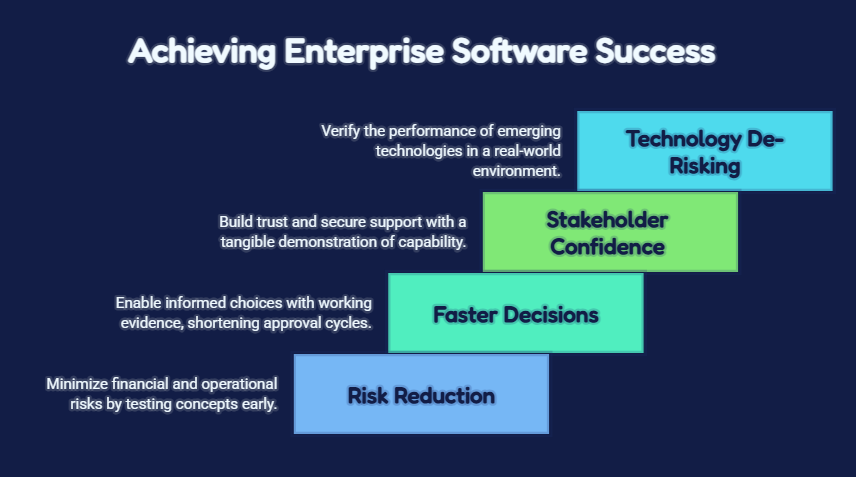
Risk Reduction Before Capital Commitment
Enterprise software initiatives routinely carry six- and seven-figure budgets. A PoC converts unknowns into knowns for a small percentage of that spend. If the concept fails, it fails cheaply and a fast, inexpensive failure is one of the most valuable outcomes a technology organization can produce.
Faster, Evidence-Based Decision-Making
Steering committees make better decisions with working evidence in front of them. A PoC replaces speculative slide decks with a functioning demonstration, shortening approval cycles and reducing internal debate.
Stakeholder and Investor Confidence
Whether you’re securing internal budget or external funding, a working PoC demonstrates execution capability. It shifts the conversation from “trust us” to “see for yourself.”
Technology De-Risking
Modern enterprise builds often depend on emerging technologies AI and machine learning models, IoT integrations, legacy system modernization, or blockchain infrastructure. A PoC verifies that these components perform under your real-world constraints, with your data, inside your environment.
The Strategic PoC Development Process
A PoC only creates value when it’s run with the same rigor as any other business investment. Here is the framework we apply at App Maisters:
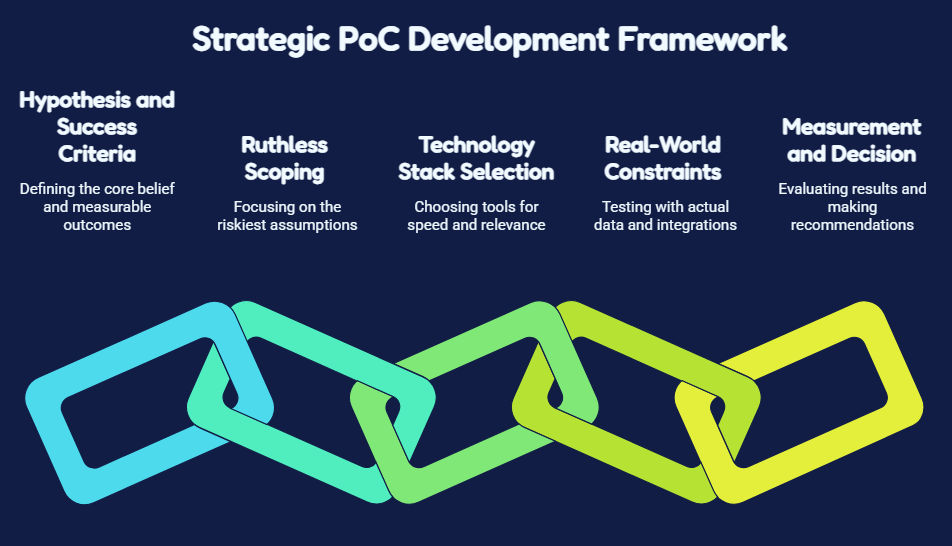
1. Define the Hypothesis and Success Criteria
Every PoC should begin with a written hypothesis: “We believe X technology can achieve Y outcome under Z conditions.” Alongside it, define measurable success criteria response times, accuracy thresholds, integration benchmarks, or cost ceilings. Without predefined criteria, a PoC devolves into an open-ended experiment with no decision at the end.
2. Scope Ruthlessly
The most common PoC failure mode is scope creep. Identify the one or two riskiest assumptions and test only those. Everything else UI polish, secondary features, edge cases is deliberately excluded.
3. Select the Right Technology Stack
Choose tools that reflect the eventual production environment closely enough for results to be meaningful, but favor speed of implementation. Whether the target environment is on-premise or a cloud platform like AWS or Azure, the goal is learning velocity, not architectural perfection.
4. Build with Real Constraints
Wherever possible, test against real data, real system integrations and APIs, and realistic volumes. A PoC that works on sanitized sample data but collapses against production data has proven nothing.
5. Measure, Document, and Decide
Conclude with a structured evaluation against the original success criteria, a documented findings report, and a clear recommendation: proceed to prototype/MVP, pivot the approach, or stop. The deliverable of a PoC is a decision, not code.
Key Benefits of a Well-Executed PoC
- Lower total cost of failure: Problems discovered in a 4-week PoC cost a fraction of what they cost in month eight of development.
- Accelerated time-to-market: Validated assumptions eliminate rework, letting downstream MVP development move faster with fewer surprises.
- Sharper budgeting and estimation: PoC findings produce realistic effort estimates grounded in evidence, not guesswork.
- Early architecture insight: Teams learn how systems will behave at scale before those decisions become expensive to reverse.
- Organizational alignment: A tangible demonstration unites business and technical stakeholders around a shared, concrete understanding of the solution.
Common Challenges and How to Avoid Them
Even experienced teams stumble in predictable ways:
- Vague objectives. A PoC without defined success criteria produces ambiguous results. Fix: write the hypothesis and metrics before writing a line of code.
- Scope inflation. Stakeholders naturally want “just one more feature.” Fix: appoint a single decision-owner empowered to protect scope.
- Treating the PoC as version 1.0. PoC code is intentionally quick and disposable; promoting it directly to production creates long-term technical debt. Fix: plan a proper rebuild for the MVP phase.
- Testing in artificial conditions. Clean demo environments hide real-world friction. Fix: incorporate production-representative data and integrations from day one.
- No decision framework. Some PoCs end without anyone acting on the results. Fix: schedule the go/no-go review before the PoC even starts.
Enterprise Use Cases for PoC Development
Proof-of-concept development delivers outsized value in scenarios where uncertainty is high and the cost of being wrong is higher:
- AI and machine learning initiatives: Validating that a model can reach required accuracy with your actual data for example, an AI chatbot handling citizen service requests or an intelligent document-processing pipeline.
- Mobile-first product concepts: Confirming that a core mobile experience offline sync, real-time tracking, device hardware integration is technically achievable before committing to full mobile application development.
- Legacy modernization: Proving that a critical mainframe or on-premise system can be safely integrated with, or migrated to, modern cloud architecture.
- IoT and connected devices: Confirming that hardware, firmware, and cloud platforms communicate reliably at expected scale from smart-building sensors to connected medical devices.
- Government and public-sector solutions: Demonstrating compliance-ready functionality (accessibility, security frameworks, data residency) before procurement commitments a core focus of our government app development
- Fintech and regulated industries: Testing transaction throughput, encryption approaches, and audit-trail requirements under realistic load.
Measuring PoC Success: The Metrics That Matter
A PoC should be judged against the criteria set at kickoff. The most useful measures typically include:
- Technical feasibility score: Did the solution meet performance, accuracy, and integration thresholds?
- Effort-to-outcome ratio: What did we learn per dollar and per week invested?
- Risk retirement: How many critical unknowns were converted into knowns?
- Estimation confidence: How much tighter are the full-build cost and timeline projections post-PoC?
- Decision velocity: Did the PoC produce a clear, timely go/no-go outcome?
If your PoC ends and leadership still can’t make a confident decision, the PoC not the idea failed.
Best Practices at a Glance
- Time-box aggressively (2–6 weeks is the sweet spot for most enterprise PoCs).
- Assign a small, senior team PoCs reward experience over headcount.
- Involve business stakeholders throughout, not just at the final demo.
- Document everything: findings, failures, and architectural implications all inform the next phase.
- Treat every PoC outcome including “no-go” as a win. Avoided losses are returns, too.
Conclusion: Validate Before You Invest
In an environment where technology budgets face intense scrutiny and the pace of innovation keeps accelerating, proof-of-concept software development is no longer optional it’s how disciplined organizations separate promising ideas from expensive mistakes. A strategically executed PoC de-risks investment, aligns stakeholders, and gives leadership the evidence needed to move forward with conviction.
Ready to validate your next big idea? App Maisters brings ISO 9001 and ISO 27001 certified engineering discipline to proof-of-concept development for enterprises, startups, and government organizations alike. Our teams have delivered PoCs across AI, mobile, IoT, cloud, and legacy modernization turning uncertainty into actionable, evidence-backed roadmaps in weeks, not months.
Schedule a free PoC consultation with App Maisters today and take the first strategic step from concept to confident execution.
FAQs
What is a proof of concept (PoC) in software development?
A proof of concept is a small, time-boxed software exercise that tests whether an idea is technically feasible before full development begins. At App Maisters, every PoC is built around a clear hypothesis and measurable success criteria, so it ends with a confident go/no-go decision.
What is the difference between a PoC and an MVP?
A PoC proves an idea can be built; an MVP proves people will actually use it. App Maisters typically recommends the sequence PoC → prototype → MVP, using PoC findings to de-risk and accurately estimate the MVP build.
How long does proof-of-concept software development take?
Most enterprise PoCs take 2–6 weeks. App Maisters keeps PoCs deliberately time-boxed and narrowly scoped testing only the riskiest assumptions so clients get validated answers quickly without runaway costs.
How much does a proof of concept cost?
A PoC usually costs a small fraction of a full build, since it focuses on one or two critical assumptions rather than a complete product. App Maisters provides fixed, milestone-based PoC pricing after a short discovery session, so budgets are predictable from day one.
Why do proof-of-concept projects fail?
The most common causes are vague objectives, scope creep, and testing with unrealistic data. App Maisters avoids these pitfalls by defining success metrics upfront, protecting scope with a single decision-owner, and validating against production-representative data and integrations.
Can a PoC be used for AI and machine learning projects?
Yes, AI initiatives are among the strongest PoC candidates, since model accuracy with your real data is unknowable until tested. App Maisters regularly delivers AI PoCs for chatbots, document processing, and predictive analytics across commercial and government clients.
What happens after a successful proof of concept?
A successful PoC produces documented findings, a validated architecture direction, and evidence-based cost estimates for the next phase. App Maisters then transitions clients into prototype or MVP development, rebuilding on production-grade foundations rather than promoting disposable PoC code.