


Designing AI Applications for Industry-Specific Use Cases
Artificial intelligence has crossed the line from experiment to expectation. According to McKinsey’s 2025 State of AI research, 88 percent of organizations now use AI in at least one business function. Yet a widely cited MIT analysis tells the other half of the story: despite an estimated $30 to $40 billion in enterprise generative AI investment, roughly 95 percent of organizations report no measurable financial return.
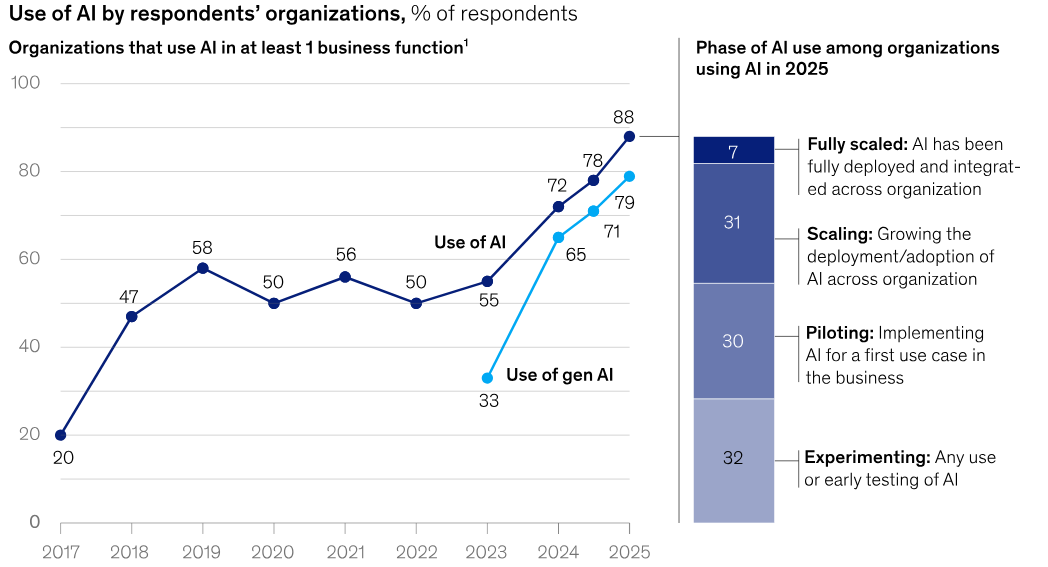
That gap is not a technology problem. Today’s models are cheaper, faster, and more capable than anything available two years ago. The gap exists because most companies deploy AI that was never built for their industry, their data, or their regulatory reality. A hospital, a hedge fund, and a factory floor do not share the same risks, vocabulary, or definition of “correct.” When the software treats them as if they do, results stall at the pilot stage.
This is exactly why demand for industry-specific AI applications is accelerating. Decision-makers are no longer asking whether to adopt AI. They are asking how to build enterprise AI solutions that actually understand the domain they operate in. This article breaks down how to design AI for real industry use cases, the technologies that make it work, and why purpose-built systems consistently outperform generic tools.
Why Generic AI Applications Fall Short
Off-the-shelf AI is optimized for broad applicability, which means it is optimized for no one in particular. It follows a vendor’s roadmap built for market averages, not the specific logic and competitive priorities that define your business. Research summarized across the industry suggests as many as 70 percent of businesses that invest in generic AI express dissatisfaction because the tools cannot meet specialized needs.
The failure points are consistent:
- Context blindness: A general-purpose model answers from its training data, which does not include your pricing, your protocols, or your compliance rules.
- Integration friction: Connecting third-party tools to legacy ERP, EHR, or core banking systems often requires brittle workarounds.
- Compliance exposure: Regulated sectors frequently cannot send sensitive data to shared SaaS platforms without violating HIPAA, SOC 2, or data-residency obligations.
- Generic output: Because the same tool serves every industry, it produces no competitive differentiation.
Custom AI flips the relationship. The technology adapts to the business rather than forcing the business to adapt to the technology.
Key Principles for Designing Industry-Specific AI
Strong domain AI is not simply a general model with a new logo. Several principles separate systems that reach production from those that stall.
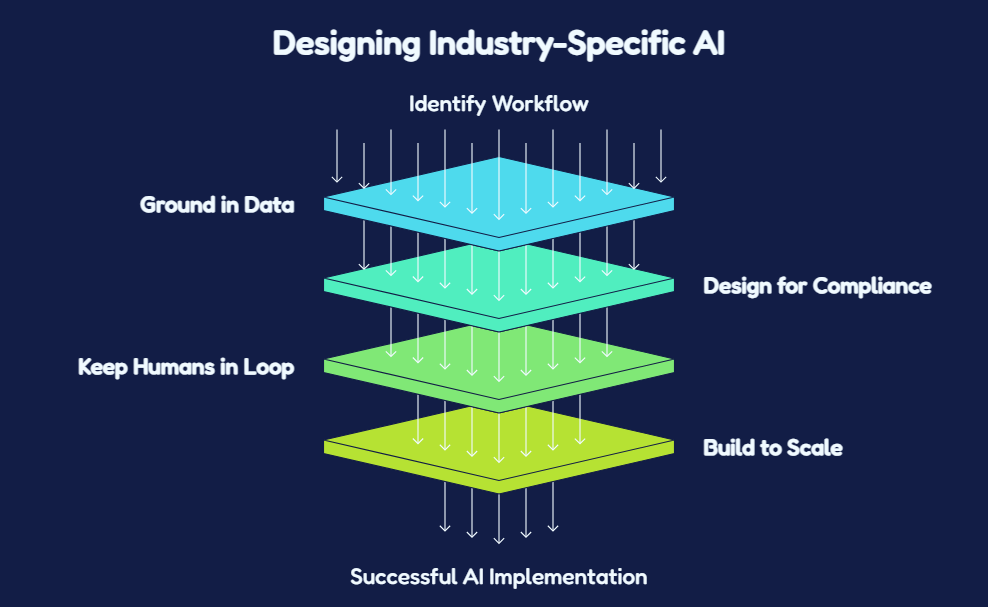
- Start with the workflow, not the model: The 2026 benchmark question is not “are we using AI,” it is “have we redesigned a workflow around AI, and can we prove it.” Map the decision or task before choosing a technology.
- Ground the AI in proprietary data: Your competitive edge lives in your historical records, specialized inventory, and domain documents. A system trained or retrieval-anchored on that data will outperform any generic alternative.
- Design for compliance from day one: In regulated industries, auditability, explainability, and data control are not features you add later. They are architectural decisions.
- Keep humans in the loop where stakes are high: The most durable AI implementation pairs automation with human oversight on consequential decisions.
- Build to scale: Custom systems should absorb growing data and transaction volume without hitting architectural ceilings.
Industry Use Cases That Prove the Point
The value of AI becomes concrete only when it meets a specific operational problem. Here is how AI for business translates across eight sectors.
Healthcare
Adoption is already deep, with reporting suggesting a majority of physicians and most hospitals use AI in at least one function. Practical use cases include clinical documentation from ambient voice, prior-authorization automation, diagnostic imaging support through computer vision, and patient-triage assistants grounded in verified medical guidelines rather than open-ended generation.
Finance
Financial services leads production deployment of AI agents. High-value applications include real-time fraud detection, credit-risk modeling, automated regulatory reporting, and document-grounded analyst copilots that cite the source behind every number.
Manufacturing
Custom computer vision trained on your own products and defect types powers quality inspection at speeds no human line can match. Predictive maintenance models forecast equipment failure before it happens, and industry data points to equipment downtime reductions in the range of 20 to 40 percent for well-scoped programs.
Retail
Beyond generic recommendations, retailers use AI for demand forecasting, dynamic pricing, inventory optimization, and personalized shopping experiences that reflect real purchase history rather than broad segments.
Logistics
Route optimization, warehouse robotics, shipment-delay prediction, and autonomous inventory tracking cut cost and improve reliability across the supply chain.
Real Estate
AI supports automated property valuation, lease and contract analysis, tenant-facing virtual assistants, and predictive models that flag maintenance needs before they escalate.
Education
Adaptive learning platforms tailor content to each student, while AI assists with grading, curriculum design, and administrative workflows so educators can focus on teaching.
Energy
Utilities apply AI to grid-load forecasting, predictive maintenance on turbines and transformers, consumption optimization, and emissions monitoring, often at the edge where real-time response matters.
Core Technologies Behind Industry AI
Purpose-built systems rarely rely on a single technique. They combine several, matched to the problem.
- Large Language Models (LLMs) power reasoning, summarization, and natural conversation.
- Machine Learning drives forecasting, classification, and pattern detection on structured data.
- Computer Vision enables defect detection, medical imaging, and visual inspection.
- Natural Language Processing extracts meaning from contracts, claims, and clinical notes.
- Predictive Analytics anticipates churn, demand, fraud, and equipment failure.
- Retrieval-Augmented Generation (RAG) anchors every answer in your verified documents. This is the difference-maker for accuracy: production RAG deployments show 60 to 80 percent reductions in domain-specific hallucination compared with generic prompting, and every answer can be audited against its source.
- AI Agents plan and execute multi-step tasks, turning AI automation into end-to-end workflows.
- Edge AI processes data locally for real-time, privacy-sensitive use cases in manufacturing, energy, and healthcare.
The best generative AI solutions blend these components rather than betting on one.
From Discovery to Deployment: The Development Process
Effective AI application development follows a disciplined path.
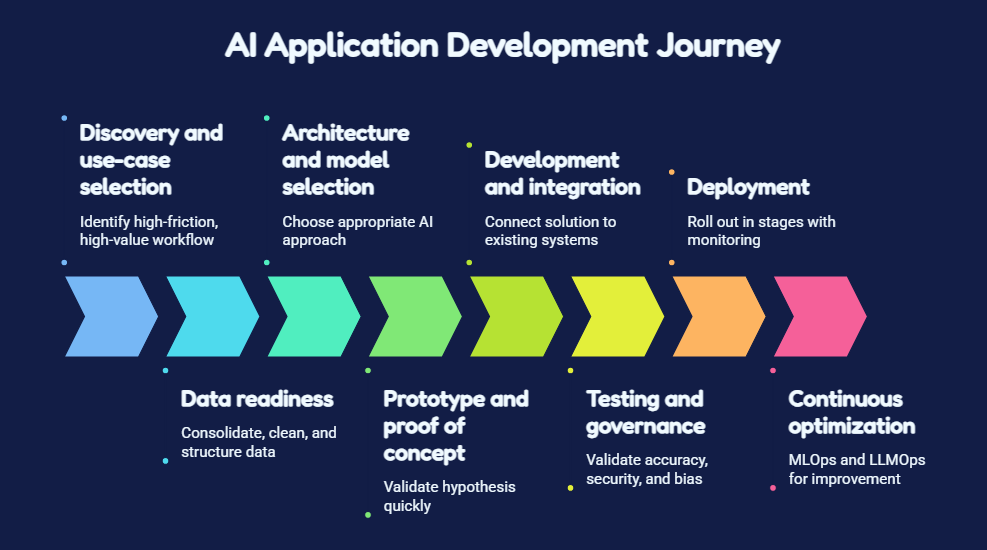
- Discovery and use-case selection: Identify one high-friction, high-value workflow. Broad, vague scope is a leading cause of failed projects.
- Data readiness: Data quality is the single most cited barrier to AI, named by more than half of businesses. Consolidate, clean, and structure the data the system will depend on.
- Architecture and model selection: Decide between fine-tuning, RAG, agents, or a hybrid, based on accuracy, cost, and compliance needs.
- Prototype and proof of concept: Validate the hypothesis quickly, often in a few weeks, before committing to full build.
- Development and integration: Connect the solution to existing CRM, ERP, and core systems through secure APIs.
- Testing and governance: Validate accuracy, security, bias, and explainability.
- Deployment. Roll out in stages with monitoring in place.
- Continuous optimization: MLOps and LLMOps keep the system improving as new data arrives, protecting ROI over time.
Common Challenges and Best Practices
The obstacles are predictable, and so are the countermeasures.
- Data quality: treat data engineering as a first-class workstream, not an afterthought.
- Integration with legacy systems: roughly 42 percent of teams report difficulty here, so plan integration early.
- Skills gap: Deloitte’s 2026 research names the AI skills gap the top barrier to integration. A specialized partner closes it fast.
- Governance and risk: Gartner projects that more than 40 percent of agentic AI projects may be cancelled by 2027, largely due to unclear ROI and weak controls. Define metrics and guardrails before you build.
- Change management: redesign the workflow and bring users along, or adoption stalls no matter how good the model is.
Why Custom AI Delivers Better ROI Than Off-the-Shelf Tools
Off-the-shelf tools look cheaper on a year-one spreadsheet. Extend the horizon and the picture changes. Subscription fees compound as usage scales, often rising 20 to 30 percent at renewal, and enterprise deployments frequently cost several times their advertised price once integration is included.
Custom AI, by contrast, delivers compounding advantages: ownership of your data and IP, precise fit to your workflows, stronger security, and differentiation competitors cannot copy. Industry analysis attributes meaningfully higher productivity gains to purpose-built systems over generic ones, and studies of generative AI report an average return in the range of roughly $3.70 for every dollar invested when deployments are well scoped. For organizations with unique data, complex workflows, or strict compliance requirements, custom AI development is not the expensive option. It is the one that actually pays back.
How App Maisters Builds Industry-Specific AI
App Maisters is a Houston-based digital transformation and software development firm that designs secure, scalable, custom AI solutions for both commercial and government markets. As an AI software development company certified to ISO 9001 and ISO 27001, and holding SBA 8(a) and MBE credentials, App Maisters brings the engineering discipline and security posture that regulated industries require.
Our teams work across the full lifecycle, from discovery and data readiness through model development, secure integration, deployment, and continuous optimization. We build RAG-grounded assistants, predictive models, computer vision systems, and AI agents tailored to healthcare, finance, manufacturing, retail, logistics, real estate, education, and energy. For public-sector clients, App Maisters Government delivers the same rigor with an added focus on compliance and mission requirements.
The result is AI that speaks your industry’s language, respects your data, and scales with your business.
Final Thoughts: Build AI That Understands Your Industry
The companies pulling ahead in 2026 are not the ones spending the most on AI. They are the ones building AI that fits how their business actually works. Generic tools will keep producing generic results. Purpose-built systems, grounded in your data and designed for your domain, are where measurable ROI lives.
If you are ready to move from experimentation to real business value, App Maisters can help you design and deploy secure, scalable, industry-specific AI applications built around your goals.
Contact App Maisters today to start your AI application development project and turn industry-specific challenges into a lasting competitive advantage.
FAQs
What are industry-specific AI applications?
Industry-specific AI applications are custom AI solutions built around a single sector’s data, workflows, and compliance rules rather than general use. App Maisters designs these purpose-built systems for healthcare, finance, manufacturing, retail, and more so the technology fits how your business actually operates.
How is custom AI development different from off-the-shelf AI?
Off-the-shelf tools are trained on generic data and cap out when your workflows become unique, while custom AI is built on your proprietary data and business logic. App Maisters delivers custom AI development that integrates with your existing systems and creates a competitive advantage generic tools cannot match.
Which industries benefit most from AI application development?
Healthcare, finance, manufacturing, retail, logistics, real estate, education, and energy all see strong returns from AI for business, especially where data is proprietary or regulation is strict. App Maisters builds enterprise AI solutions tailored to the specific challenges of each of these sectors.
Why do generic AI applications fail for businesses?
Generic AI often fails because it lacks industry context, struggles to integrate with legacy systems, and raises compliance concerns in regulated sectors. App Maisters solves this by grounding every AI implementation in your own data, workflows, and security requirements.
What technologies are used to build enterprise AI solutions?
Modern enterprise AI combines LLMs, machine learning, computer vision, NLP, predictive analytics, RAG, AI agents, and edge AI, matched to the use case. App Maisters selects and blends these technologies to build accurate, scalable generative AI solutions for your industry.
How much does custom AI development cost and how long does it take?
Cost and timeline depend on scope, data readiness, and integration needs, with most projects moving from a proof of concept to a production system in stages. App Maisters scopes each engagement around your highest-value use case first, protecting budget and speeding time to ROI.
Why does custom AI deliver better ROI than off-the-shelf AI?
Custom AI avoids compounding subscription fees, gives you full ownership of your data and IP, and aligns precisely with revenue-driving workflows for stronger long-term returns. App Maisters builds secure, scalable custom AI solutions engineered to pay back over time, not just launch quickly.