


Why Most Hospitals Fail at Cloud Migration
Healthcare is finally moving to the cloud at scale and a surprising number of hospitals are stumbling on the way there. The global healthcare cloud computing market is projected to reach roughly $74.02 billion in 2026 and $169.34 billion by 2031, a 17.7% compound annual growth rate (MarketsandMarkets, May 2026). Other analysts peg the 2026 figure between $75 billion and $97 billion, but the direction is unanimous: healthcare cloud adoption is accelerating fast.
Yet adoption and success are not the same thing. Gartner has long been cited for the finding that as many as 83% of data migration projects fail or overrun their budget and schedule, and Accenture has reported that nearly 45% of cloud migrations never deliver their expected outcomes. In a sector where a botched cutover can delay care, expose protected health information (PHI), and trigger regulatory penalties, those odds are not acceptable.
The stakes: A healthcare data breach now costs an average of $7.42 million the highest of any industry for 14 consecutive years (IBM Cost of a Data Breach Report, 2025). In 2025 alone, 772 large healthcare breaches exposed the records of roughly 139.7 million people (HIPAA Journal / HHS OCR).
So why do so many hospital cloud migrations go sideways? After more than a decade modernizing systems for healthcare and government clients, we see the same root causes again and again. Here is the honest diagnosis and what to do instead.
Legacy EHR Dependencies Nobody Mapped
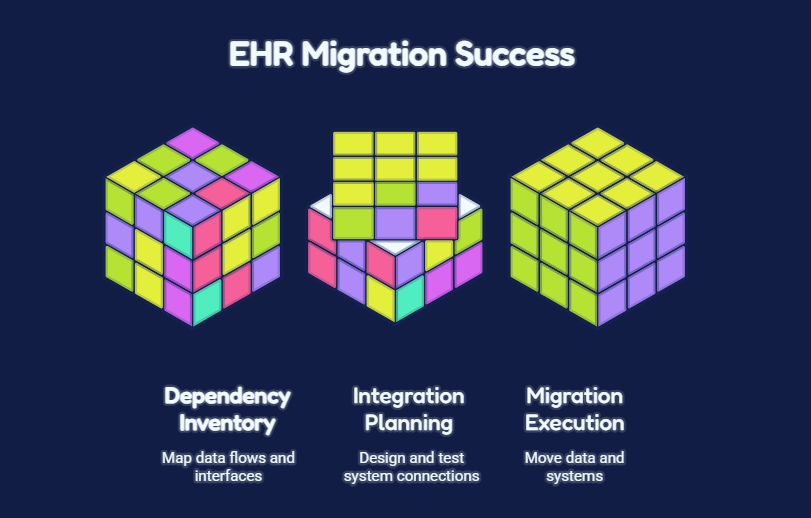
Most hospitals don’t run an EHR. They run a sprawling ecosystem of clinical, billing, lab, imaging, pharmacy, and scheduling systems stitched together over 15–20 years, often with undocumented custom interfaces.
When teams attempt a “lift-and-shift” without mapping these dependencies, the migration breaks in ways no one anticipated: an interface engine stops feeding results to the EHR, a nightly batch job silently fails, or a downstream report goes dark.
Upgrading from a legacy EHR environment can cost $2 million to $4 million once integration, migration, and retraining are included (industry estimates, 2026). The hidden interfaces not the servers are usually where projects derail.
The fix: A full dependency and interface inventory before anything moves. If you can’t draw the data flows on a whiteboard, you’re not ready to migrate them. (This is exactly the discovery phase App Maisters runs at the start of every EHR migration and healthcare modernization engagement.)
HIPAA and Compliance Gaps Treated as an Afterthought
Too many hospitals architect for performance first and bolt on compliance later. In a HIPAA-regulated environment, that order is backwards and expensive.
The HHS Office for Civil Rights launched its Risk Analysis Initiative precisely because inadequate risk analysis is implicated in roughly 90% of Security Rule enforcement actions. Moving PHI into a public cloud without encryption, identity controls, audit logging, and a signed Business Associate Agreement (BAA) isn’t a HIPAA-compliant cloud it’s a liability waiting for an auditor.
Healthcare’s mean time to identify and contain a breach is 279 days, versus 241 days globally (IBM, 2025). That’s roughly five extra weeks of exposure for every incident.
The fix: Compliance gets designed in, not patched on. Encryption in transit and at rest, least-privilege IAM, immutable audit trails, and BAAs with every cloud vendor are the baseline for any secure cloud migration mapped against HIPAA, CMS, NIST, and ISO 27001 from day one.
Poor Data Governance Going In
Garbage in, garbage in the cloud. Hospitals frequently migrate decades of duplicate records, inconsistent naming conventions, orphaned patient identifiers, and fields that were never designed to move between systems.
Without governance, you simply relocate the mess to a more expensive address and undermine the interoperability and analytics that justified the migration in the first place.
The fix: Data classification, de-duplication, master patient index cleanup, and clear ownership rules before migration. Governance is the difference between a data lake and a data swamp.
Underestimated Downtime and Cutover Risk
In a 24/7 hospital, there is no convenient maintenance window. Yet many migration plans assume a clean weekend cutover and have no rollback strategy when reality intervenes.
About 44% of organizations now report hourly downtime costs exceeding $1 million (Uptime Institute, 2025), and IT downtime is widely estimated to run into the thousands of dollars per minute. In healthcare, the cost isn’t only financial it’s clinical.
The fix: Phased, parallel-run migrations with tested rollback, real-time data synchronization, and zero-downtime cutover patterns so live clinical operations are never interrupted.
Weak Change Management
Technology rarely fails alone adoption does. Clinicians who weren’t consulted, weren’t trained, or weren’t given a fallback will route around a new system, and a migration that the staff resents is a migration that fails on go-live day.
The fix: Treat change management as a first-class workstream. Clinical champions, role-based training, phased rollouts, and feedback loops turn a forced rollout into an embraced upgrade.
No Migration Roadmap
The common thread behind every failure above is the absence of a sequenced plan. Organizations that conduct a formal readiness assessment before migrating report meaningfully higher success rates, yet hospitals routinely jump straight to procurement and provisioning.
A migration without a roadmap is a series of expensive surprises. With one, it’s a managed program.
How to Do Hospital Cloud Migration the Right Way
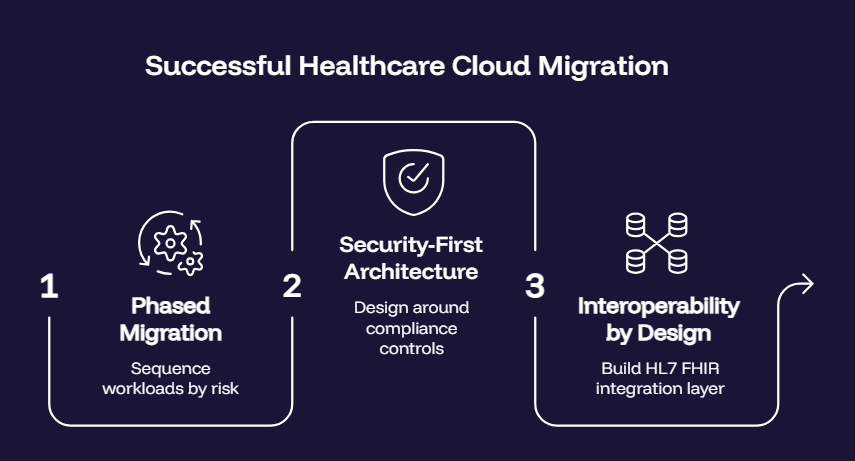
Successful healthcare cloud adoption isn’t luck it’s method. Three principles separate the migrations that work from the ones that make headlines.
Phased Migration Over Big-Bang Cutovers
Sequence workloads by risk and dependency. Start with lower-risk, loosely coupled systems to prove the pattern, run old and new in parallel during cutover, and keep a tested rollback at every stage. Each phase de-risks the next.
Security-First, Compliance-Native Architecture
Design the target environment around HIPAA, CMS, NIST, and ISO 27001 controls before the first workload moves. Encryption, identity and access management, network segmentation, continuous compliance monitoring, and signed BAAs are part of the blueprint not a remediation phase.
Interoperability and HL7/FHIR by Design
Modern care depends on data flowing cleanly between EHRs, labs, pharmacy, imaging, and patient apps. Building an HL7 FHIR-compliant integration layer during migration rather than after future-proofs the environment against tightening federal interoperability mandates and unlocks AI strategy and consulting downstream.
Healthcare organizations adopting FHIR-based interoperability report returns on the order of 3.2x on their investment through reduced duplication and faster care coordination (vendor analyses, 2025–2026).
How App Maisters Helps Hospitals Migrate to the Cloud
App Maisters is a Houston-based Cloud Consulting Company and digital transformation partner with a 14-year track record and 400+ delivered projects across healthcare and government. We don’t sell technology projects we deliver outcomes.
Our healthcare cloud migration practice covers the full journey:
- Discovery & readiness assessment: full dependency, interface, and data-governance mapping before anything moves.
- Cloud migration & modernization: phased, zero-downtime transitions of legacy systems to AWS, Azure, Google Cloud, and hybrid environments.
- Secure data exchange & interoperability: HL7/FHIR integration layers connecting EHR/EMR, lab, pharmacy, and billing systems.
- Security, risk & compliance: architectures aligned to HIPAA, CMS, NIST, FedRAMP, TX-RAMP, ISO 27001, and ISO 9001.
- High-availability & disaster recovery: built-in resilience for mission-critical clinical systems.
- Managed services & ongoing optimization: continuous monitoring, QA of data pipelines, and cost optimization after go-live.
Crucially, we’re ISO 9001 (Quality) and ISO 27001 (Information Security) certified, and an SBA 8(a) and MBE-certified firm so security, compliance, and process discipline are built into how we work, not promised after the fact. Our certified cloud architects use a well-architected framework to reduce migration risk and modernize legacy infrastructure without disrupting care.
It’s the same outcome-driven method we bring to every digital transformation engagement from first assessment through post-migration support.
Ready to Migrate Without the Risk?
Most hospital cloud migrations fail for reasons that are entirely preventable with the right partner and the right plan. Book a consultation with App Maisters to get a HIPAA-ready cloud migration roadmap tailored to your systems, your compliance obligations, and your patients.
FAQs
Why do most hospital cloud migrations fail?
Most hospital cloud migrations fail because of unmapped legacy EHR dependencies, compliance gaps, poor data governance, underestimated downtime, and weak change management. App Maisters addresses each with a phased, readiness-first migration roadmap.
How does App Maisters keep EHR migration HIPAA-compliant?
App Maisters designs a HIPAA-compliant cloud from day one encryption, identity and access management, audit logging, and signed BAAs mapped against HIPAA, CMS, NIST, and ISO 27001 rather than added after go-live.
How long does a hospital cloud migration take?
It depends on system complexity, but a phased EHR migration typically runs across several months in sequenced stages. App Maisters begins with a readiness assessment so timelines and milestones are realistic from the start.
Can hospitals migrate to the cloud without downtime?
Yes. App Maisters uses parallel-run, phased cutovers with real-time data synchronization and tested rollback, so live clinical operations continue uninterrupted during migration.
What is HL7/FHIR and why does it matter for healthcare cloud adoption?
HL7 FHIR is the modern standard for exchanging health data between systems. App Maisters builds FHIR-compliant interoperability layers during migration so EHRs, labs, and apps share data cleanly and meet federal mandates.
Is the cloud secure enough for protected health information?
A properly architected, HIPAA-compliant cloud is more secure than most aging on-premise systems. As an ISO 27001-certified Cloud Consulting Company, App Maisters builds encryption, monitoring, and compliance controls into every environment.
Why choose App Maisters as a healthcare Cloud Consulting Company?
App Maisters combines a 14-year track record, 400+ projects, certified cloud architects, and ISO 9001, ISO 27001, SBA 8(a), and MBE certifications to deliver secure, compliant hospital cloud migration with measurable outcomes.