


How Healthcare Industries Benefit From Custom App Development
A thought-leadership perspective from App Maisters on digital transformation, patient care, and enterprise health technology
Healthcare is no longer just a clinical discipline; it is, increasingly, a software discipline. Every diagnosis, referral, claim, and follow-up now leaves a digital trace, and the organizations that control that trace control the patient experience. Hospitals that once competed on bed count and specialist rosters are now being judged on how quickly a patient can book an appointment, how clearly a discharge summary is communicated, and how seamlessly a wearable device talks to an electronic health record. This is the quiet, irreversible shift defining the next decade of care delivery.
Generic software cannot keep pace with this shift. Off-the-shelf platforms are built for the average use case, not for the specific clinical workflows, regulatory obligations, and patient populations that define a given health system. Custom app development closes that gap. It allows providers, payers, and health-tech innovators to build digital infrastructure shaped around their actual operations rather than forcing their operations to bend around someone else’s product roadmap. For enterprise leaders evaluating where to invest next, this is no longer a question of “if” but “how fast.”
The Healthcare Industry’s Defining Challenges
Before exploring what custom development makes possible, it is worth being precise about what it is solving for. Three structural pressures dominate boardroom conversations across the sector today.
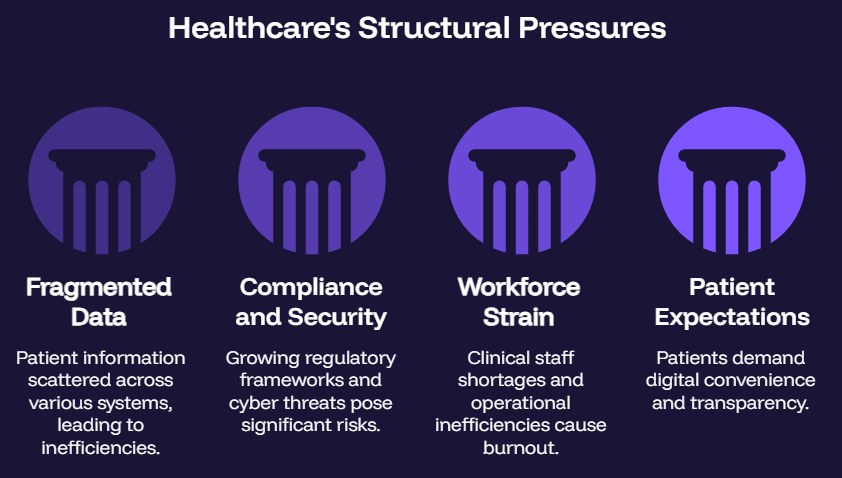
Fragmented, Siloed Data
Patient information is frequently scattered across electronic health record (EHR) systems, lab portals, billing software, and legacy point solutions that were never designed to communicate with one another. The result is duplicated tests, delayed diagnoses, and clinicians spending valuable hours reconciling records instead of treating patients.
Rising Compliance and Security Exposure
Healthcare remains one of the most heavily targeted sectors for cyberattacks, and regulatory frameworks such as HIPAA in the United States, GDPR in Europe, and equivalent regional data-protection statutes are only growing stricter. A breach is no longer just a technical incident; it is a reputational and financial event that can take years to recover from.
Workforce Strain and Operational Inefficiency
Clinical staff shortages, administrative overload, and rising patient volumes have pushed hospital operations to their limits. Manual scheduling, paper-based intake, and disconnected billing workflows compound the burden rather than relieving it, contributing directly to clinician burnout and slower patient throughput.
Rising Patient Expectations
Patients now expect the same convenience from their healthcare provider that they get from their bank or food delivery app: instant booking, transparent pricing, real-time updates, and digital-first communication. Providers that cannot deliver this experience risk losing patients to competitors who can.
How Custom App Development Solves These Challenges
Off-the-shelf software solves generic problems generically. Custom healthcare app development takes the opposite approach: it starts with the specific clinical workflow, regulatory environment, and patient population of an organization, and engineers the technology around them. This precision is what allows custom platforms to outperform packaged solutions on the metrics that matter most to healthcare enterprises: interoperability, security, and operational fit.
A purpose-built application can be architected from day one for HL7 and FHIR interoperability standards, ensuring it speaks fluently with existing EHR and laboratory systems rather than requiring expensive, brittle middleware. Security and compliance can be designed into the foundation of the system, with role-based access controls, audit trails, and encryption mapped to the specific regulatory frameworks a provider must satisfy, rather than retrofitted after the fact. And because the application is built around real clinical and administrative workflows, automation can be applied exactly where it relieves staff burden, from intake forms to insurance verification to discharge documentation, generating measurable time savings rather than superficial digitization.
Core Benefits of Custom Healthcare Applications
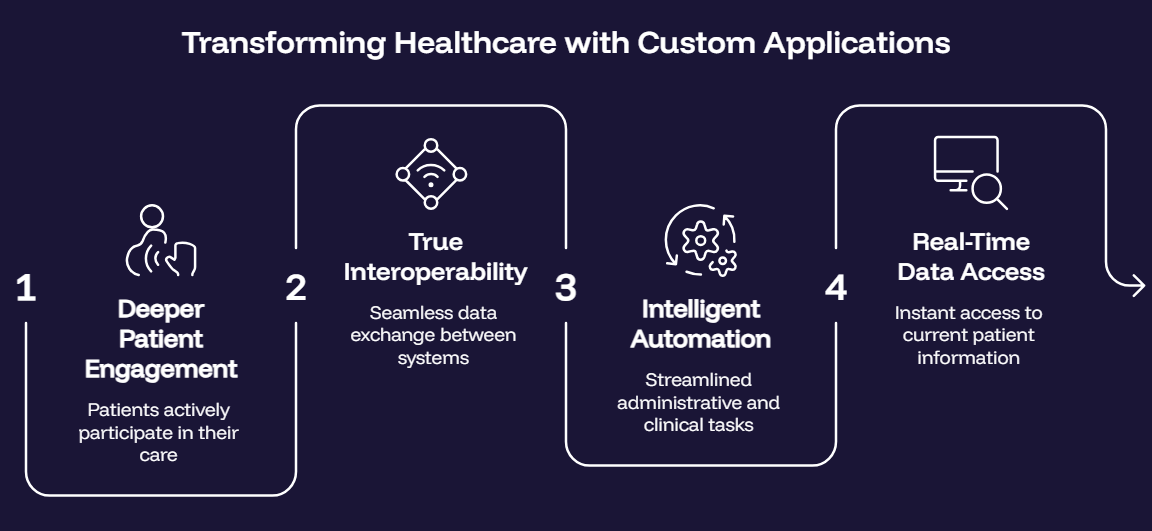
Deeper Patient Engagement
Custom patient portals and mobile applications give individuals direct visibility into their own care: appointment scheduling, lab results, medication reminders, and secure messaging with their care team. Engaged patients are demonstrably more likely to adhere to treatment plans, attend follow-up visits, and report higher satisfaction scores, all of which feed directly into value-based care reimbursement models.
True Interoperability
Custom builds can be designed around FHIR-based APIs from the outset, allowing disparate systems, EHRs, pharmacy platforms, imaging systems, and billing software, to exchange data securely and in real time. This eliminates the manual re-entry and data silos that slow down clinical decision-making.
Intelligent Automation
Appointment scheduling, insurance eligibility checks, claims processing, and inventory management can all be automated within a custom platform, reducing administrative load on clinical staff and minimizing costly human error in billing and coding.
Real-Time Data Access
Clinicians making decisions at the point of care need current information, not data that is hours or days old. Custom applications built on modern cloud architecture can surface lab results, vitals, and medication histories the moment they are recorded, directly to the device a clinician is already using.
Remote Monitoring and Telemedicine
Custom-built telehealth modules and remote patient monitoring tools extend care beyond the four walls of a facility, allowing chronic disease management, post-surgical follow-up, and elderly care to happen safely from a patient’s home while clinicians retain full visibility into their condition.
Enterprise-Grade Data Security
Because custom applications are not shared across thousands of unrelated organizations, their attack surface can be tightly controlled. Encryption, granular access permissions, and continuous compliance monitoring can be tailored precisely to an organization’s risk profile and regulatory obligations, rather than relying on the lowest common denominator of a multi-tenant commercial product. For healthcare leaders, this distinction carries real weight: a custom-built security architecture can be audited, adjusted, and certified against the exact standards a given jurisdiction requires, whether that means HIPAA in the United States, GDPR across the European Union, or comparable regional data-protection frameworks elsewhere, instead of accepting whatever baseline a vendor has decided is sufficient for its broadest customer base.
Use Cases Across the Healthcare Ecosystem
Hospitals and Health Systems
Large hospital networks use custom applications to unify scheduling, bed management, and clinical documentation across multiple facilities, giving administrators a single operational view instead of dozens of disconnected dashboards.
Clinics and Specialty Practices
Smaller practices benefit from lightweight custom tools built specifically around their specialty, whether that is a dermatology practice needing integrated image capture or a physical therapy clinic needing exercise-adherence tracking, without paying for the bloated feature sets of generic practice-management software.
Telehealth Platforms
Purpose-built telehealth applications support secure video consultations, e-prescribing, and integrated payment processing in a single workflow, designed around the specific regulatory and reimbursement requirements of the regions a provider serves.
Wearable and IoT Integration
Custom applications can ingest data directly from wearable devices and connected medical equipment, glucose monitors, cardiac sensors, smart inhalers, turning continuous biometric streams into actionable clinical alerts rather than disconnected data points sitting in a separate app.
EHR and Clinical Systems
Custom EHR extensions and middleware allow organizations to modernize legacy systems incrementally, adding modern interfaces, mobile access, and analytics capabilities without the cost and disruption of a full system replacement.
Emerging Trends Shaping the Next Generation of Healthcare Apps
Artificial Intelligence in Clinical Workflows
AI-powered features, from clinical decision support to ambient documentation that listens to a consultation and drafts the note automatically, are moving from pilot projects to standard expectation. Custom applications give organizations the flexibility to pursue AI development validated for their specific patient population, rather than relying on generic, one-size-fits-all algorithms.
IoT and Connected Care
The expansion of connected medical devices is turning hospital rooms, ambulances, and even patients’ homes into continuous data-generating environments. Custom platforms that can securely ingest and act on this data in real time will define the competitive edge of forward-looking health systems.
Predictive Analytics and Population Health
Predictive models built on an organization’s own historical data can flag patients at risk of readmission, deterioration, or missed appointments before those events occur, shifting care from reactive to proactive. This level of population-health insight is only possible when the underlying data architecture is custom-built to the organization’s own clinical reality.
The App Maisters Advantage
Healthcare organizations do not need more software. They need the right software, built to their workflows, their compliance obligations, and their patients. That is the distinction custom application development makes, and it is the distinction that separates healthcare enterprises that lead their markets from those still managing around the limitations of generic tools.
At App Maisters, we partner with hospitals, clinics, and health-tech innovators to design and engineer custom applications that meet the realities of modern care delivery, from HIPAA-aligned data architecture and FHIR-based interoperability to AI-enabled clinical tools and remote patient monitoring platforms. Our teams bring together healthcare domain expertise and enterprise app development discipline to build systems that clinicians trust, patients find easy to use, and compliance teams can stand behind. We approach every engagement as a long-term technology partnership rather than a one-time build, working alongside internal IT and clinical leadership to ensure each application evolves as regulations shift, patient expectations rise, and new capabilities such as AI-assisted diagnostics and predictive analytics become standard expectations rather than differentiators.
If your organization is ready to move beyond the constraints of off-the-shelf software and build a healthcare technology foundation designed for what comes next, App Maisters is ready to be that partner.
FAQs
What is custom healthcare app development?
Custom healthcare app development is the building of software shaped around a provider’s specific clinical workflows, compliance obligations, and patient population rather than a generic template. App Maisters engineers these platforms for interoperability, security, and real operational fit.
How much does it cost to build a custom healthcare app?
Cost depends on complexity, integrations, and compliance scope, so there is no flat figure. App Maisters provides a tailored estimate after scoping your workflows, features, and EHR or device integration needs.
Are App Maisters healthcare apps HIPAA compliant?
Yes. As an ISO 27001 certified firm, App Maisters builds HIPAA-aligned applications with encryption, role-based access controls, audit logging, and secure authentication designed into the architecture from day one.
Can App Maisters integrate a custom app with our existing EHR/EMR system?
Yes. App Maisters builds FHIR- and HL7-based interoperability so custom platforms exchange data securely with major EHR, lab, pharmacy, and billing systems without brittle middleware.
What is the difference between custom and off-the-shelf healthcare software?
Off-the-shelf software solves average use cases generically, while custom software is engineered around your actual operations. App Maisters builds to your workflows and risk profile rather than the lowest common denominator of a multi-tenant product.
How can AI improve healthcare apps?
AI supports clinical decision support, ambient documentation, predictive risk modeling, and population-health insight. App Maisters integrates AI models validated for your specific patient population instead of one-size-fits-all algorithms.
Does App Maisters build telemedicine and remote patient monitoring apps?
Yes. App Maisters develops secure telehealth modules and remote monitoring tools that support video consultations, e-prescribing, and chronic disease management while keeping clinicians in full view of patient data.