


Why Enterprises Need AI Strategy Consulting in the USA
Artificial intelligence has moved past the experimentation phase. Across the United States, it now sits inside core business operations informing decisions, automating workflows, and reshaping how companies compete. Yet for all the investment pouring into AI, a strange pattern keeps showing up in boardrooms: budgets are bigger than ever, and confidence in returns is shrinking.
This isn’t an AI capability problem. It’s a strategy problem. And it’s exactly why AI strategy consulting has become one of the most consequential decisions an enterprise can make in 2026.
The AI Adoption Curve Has Reached an Inflection Point
The scale of enterprise AI adoption in the US is no longer in question. The average enterprise now runs 4.2 AI models in production, more than double the 1.9 it ran in 2023, and 65% of enterprises increased their AI budgets in 2026 alone, with a median increase of 22% year-over-year. Enterprise spending on AI software, hardware, and services has reached $184 billion in 2026, and AI adoption is expected to unlock up to $2.9 trillion in productivity gains globally by 2030.
But scale doesn’t equal success. A 2026 survey of 2,400 global leaders found that 79% of organizations face significant challenges in adopting AI a double-digit increase from 2025 and 54% of C-suite executives admit AI adoption is straining their organization, despite 59% of companies investing over $1 million annually in AI.
The agentic AI numbers tell a similar story. McKinsey’s 2026 research shows that while nearly two-thirds of enterprises have experimented with AI agents, fewer than 10% have scaled them to deliver tangible value, and only about 23% have managed to scale agentic AI in any function at all. Perhaps most striking: only 12% of CEOs report achieving both revenue gains and cost reductions from their AI investments.
This is the central paradox of enterprise AI in the US today universal belief in AI’s potential, paired with a widening execution gap. And it’s a gap that strategy, not technology, is responsible for closing.
Why Enterprises Struggle Without a Clear AI Strategy
Most enterprises don’t fail at AI because the technology doesn’t work. They fail because they treat AI as a series of disconnected tools rather than a coordinated capability. A handful of patterns explain why:
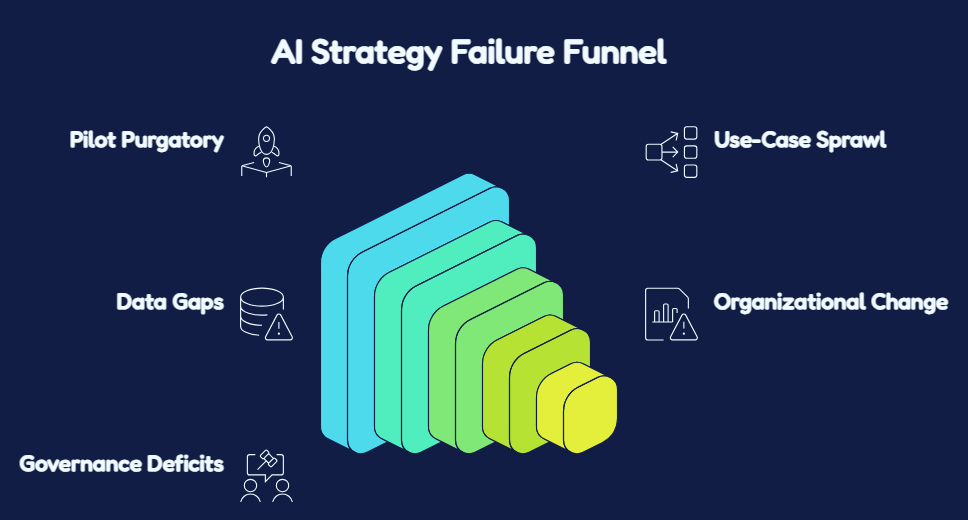
- Pilot purgatory: Promising proofs of concept never reach production because there’s no architecture, governance model, or budget pathway designed to scale them.
- Use-case sprawl without prioritization: Departments pursue AI projects based on local pain points rather than enterprise-wide value, duplicating effort and diluting ROI.
- Data and infrastructure gaps: AI models are only as good as the data feeding them, and without unified, well-governed pipelines tied to a sound cloud migration strategy, even well-designed initiatives underperform.
- Underestimated organizational change: AI adoption changes workflows, roles, and decision rights, and most change management plans don’t account for how much team structures and reporting lines need to shift alongside the technology.
- Governance and trust deficits: In regulated industries especially, the absence of explainability, audit trails, and compliance frameworks stalls deployment before it begins.
A single missing strategic layer a clear, sequenced, enterprise-wide AI roadmap usually connects all five failure points. This is precisely where AI strategy consulting earns its place at the table.
The Role of AI Strategy Consulting: Reducing Risk, Maximizing ROI
AI strategy consulting exists to close the gap between ambition and execution. Rather than chasing every emerging tool or model, the right consulting partner builds a disciplined framework around three things: where AI creates the most value, how fast it can be deployed responsibly, and how it scales without breaking under its own complexity.
The ROI case is compelling when this is done well. Organizations following structured AI deployment approaches have reported an average 5.8x return on AI investment within 14 months of production deployment and that 14-month figure is itself telling: the median time to ROI across enterprises has compressed from 24 months in 2024 as implementation patterns mature. That compression isn’t accidental. It’s the direct result of enterprises learning, often the hard way, that strategy has to precede deployment, not follow it.
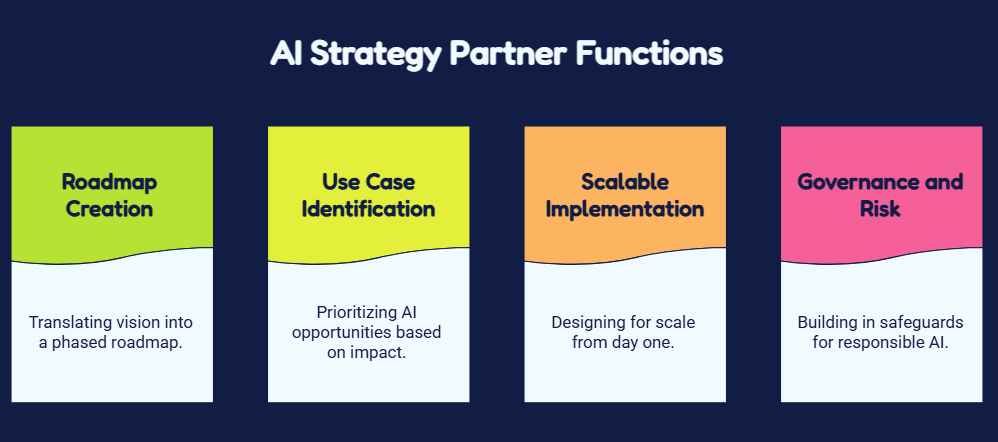
A capable AI strategy partner typically focuses on four core functions:
- Roadmap creation: Strategy consultants translate executive vision into a phased, milestone-driven roadmap sequencing initiatives by feasibility, dependency, and expected value rather than by which department asks loudest.
- Use case identification and prioritization: Not every AI opportunity deserves equal investment. Consultants apply structured scoring models weighing business impact, data readiness, technical complexity, and regulatory risk to separate use cases with compounding returns from those that simply look impressive in a slide deck.
- Scalable implementation design: The difference between a pilot and a production system is architecture. Strategy consultants design for scale from day one: model governance, MLOps pipelines, integration with legacy systems, and cost controls that prevent AI spend from spiraling as usage grows.
- Governance, risk, and change management: Especially in the US regulatory environment, consultants build in explain ability, bias testing, data privacy safeguards, and workforce transition plans ensuring AI scales without creating legal, reputational, or operational exposure.
Industry-Specific Value: Where AI Strategy Pays Off Fastest
While the principles of AI strategy are universal, the application is highly industry-specific. Adoption is most advanced in technology and financial services, with manufacturing not far behind but each sector faces distinct strategic priorities.
Financial services
Banks and insurers face some of the highest regulatory scrutiny of any US industry. Priorities center on fraud detection, algorithmic credit risk modeling, and AI-driven compliance monitoring all demanding rigorous explainability and audit-readiness built in from day one, not retrofitted later.
Healthcare
Healthcare AI strategy must balance innovation with patient safety and HIPAA compliance. The highest-value use cases include clinical decision support, administrative automation that reduces documentation burden, and predictive analytics for patient outcomes each requiring a governance-first approach.
Logistics and supply chain
AI strategy here typically centers on demand forecasting, route optimization, and predictive maintenance. ROI tends to materialize fastest because the data is structured and efficiency gains translate directly into cost savings.
Retail and manufacturing
Personalization engines, predictive analytics, and AI-driven quality control are reshaping competitive dynamics and strategy consulting helps convert that operational upside from theoretical to delivered.
Across every vertical, the pattern holds: industries with the clearest strategic frameworks for AI governance and deployment convert investment into impact fastest.
Key Challenges Enterprises Face in the US AI Market
Even well-resourced enterprises run into a consistent set of obstacles when scaling AI without expert strategic guidance:
- Talent and expertise shortages: Specialized AI talent people who understand both the technology and the business context remains scarce and expensive to hire directly.
- Data quality and fragmentation: Legacy systems, siloed departments, and inconsistent data standards continue to undermine AI model performance.
- Regulatory complexity: US enterprises navigate a patchwork of federal guidance, state-level AI laws, and sector-specific rules (HIPAA, SOX, GLBA), with no single unified national framework.
- Legacy infrastructure: Many enterprises run on decades-old core systems, including aging blockchain in enterprise systems, never designed for real-time AI integration.
- Workforce trust and adoption: Technology alone doesn’t drive transformation employee buy-in does. Without structured change management, even technically sound systems see poor adoption.
- Measuring true ROI: Isolating which AI initiatives actually drove business value, versus which simply added cost, requires measurement frameworks most internal teams haven’t built.
These challenges aren’t reasons to slow down. They’re precisely why enterprises need an experienced strategic partner who has navigated this terrain before.
Why Partner With App Maisters
This is the environment App Maisters was built to operate in. As an enterprise AI consulting Company, App Maisters works alongside CTOs, CIOs, and digital transformation leaders to convert AI ambition into measurable enterprise value grounded in each organization’s data maturity, regulatory context, and competitive position, not a generic playbook.
Three differentiators matter most here. Strategic depth over tool obsession: App Maisters starts with business outcomes revenue growth, cost reduction, risk mitigation and works backward to the right AI capabilities, rather than starting with a trending model and searching for a use case to justify it. Implementation discipline: a roadmap means little without the engineering rigor to execute it, and App Maisters bridges the gap between strategic vision and production-grade deployment so initiatives don’t stall in pilot purgatory. Governance built in, not bolted on: given the regulatory complexity of the US market, App Maisters embeds compliance, explainability, and risk management into every stage of the roadmap, protecting enterprises from the exposure that comes with rushed deployment.
For enterprises competing in a market where adoption challenges are the norm rather than the exception, that combination strategic clarity, execution discipline, and governance maturity is what separates AI leaders from AI laggards.
Ending: AI Strategy Consulting Is No Longer Optional
The numbers leave little room for ambiguity. AI investment in the US has never been higher, adoption has never been broader, and the gap between companies extracting real value and those struggling to justify their spend has never been more visible. The enterprises pulling ahead aren’t necessarily the ones with the most advanced technology they’re the ones with the clearest strategy for deploying it.
For CTOs, CIOs, and digital transformation leaders, the strategic question for 2026 and beyond isn’t whether to adopt AI. That decision has already been made by the market. The real question is whether your organization has a deliberate, well-governed roadmap for turning AI investment into durable competitive advantage or whether it’s accumulating tools and pilots without a coherent path to scale.
AI strategy consulting exists to answer that question with confidence. And for enterprises serious about long-term growth in an increasingly AI-driven economy, partnering with a firm like App Maisters isn’t an added expense it’s the strategic foundation that determines whether AI becomes a genuine competitive advantage or another underperforming line item on the technology budget.
The enterprises that get this right now will define their industries for the next decade. The ones that wait will spend that decade trying to catch up.
FAQs
What is AI strategy consulting?
It’s the process of building a clear, business-aligned roadmap for adopting AI rather than chasing isolated tools or pilots. App Maisters helps enterprises identify high-value use cases and scale them into production with the right governance in place.
How much does AI consulting cost for a US enterprise?
Cost depends on scope and existing data maturity. App Maisters typically phases engagements starting with an assessment and use-case prioritization so investment scales as value is proven.
How do I choose the right AI consulting firm?
Look for a partner that starts with business outcomes, understands your industry’s regulations, and has a track record of moving AI from pilot to production. This is the core of App Maisters approach.
Why do most enterprise AI projects fail to scale?
Most stall in “pilot purgatory” due to missing roadmaps, weak data infrastructure, or no governance. App Maisters designs for scale from day one to avoid this.
What industries benefit most from AI strategy consulting?
Finance, healthcare, logistics, and manufacturing typically see the fastest returns. App Maisters tailors its approach to each industry’s compliance needs and operational priorities.
How long does it take to see ROI from AI consulting?
It varies, but a clear roadmap gets results faster than uncoordinated pilots. App Maisters sequences quick wins alongside long-term initiatives to deliver early value.