


Why Education Mobile Apps Get Downloaded and Never Opened Again
A parent hears about a new education mobile app that promises to make math fun for their eight-year-old. They hit download, hand over the tablet and three weeks later, the app is uninstalled to free up storage. This scenario plays out millions of times a year.
The global education app market is booming, yet average user retention sits at a dismal 25% after just 30 days. Downloads are up. Engagement is down. In this post, we explore why education mobile apps lose users so quickly, how 2026 technologies are changing the game, and what mobile app development company teams can do right now to turn downloads into daily habits.
Why Users Abandon Education Mobile Apps
The honeymoon period for most education mobile apps lasts about four minutes. Users arrive with motivation and leave with frustration. So what goes wrong?
Core Components of a Modern BI System
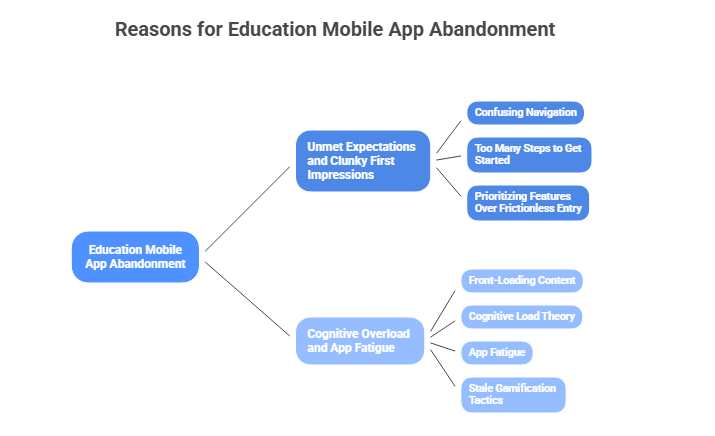
Unmet Expectations and Clunky First Impressions
The onboarding flow is frequently an app’s biggest failure point. A 2026 survey by Mobile Learning Insights found that 61% of users who uninstall education mobile apps do so within the first week, with nearly half citing “confusing navigation” or “too many steps to get started.” Users arrive expecting simplicity and find themselves navigating something closer to an enrollment form. When app development company prioritizes features over frictionless entry, users walk away before seeing the value.
Cognitive Overload and App Fatigue
Many education mobile apps front-load content, presenting hundreds of courses and categories on the very first screen. For a new user still figuring out the interface, this is overwhelming rather than exciting. Cognitive load theory tells us that working memory has limits dump too much on a screen and the brain disengages.
“When everything is a priority, nothing is.” Education mobile apps that fail to create a clear guided path leave users paralyzed by choice and paralyzed users close apps.
Compounding this is app fatigue. The average smartphone user has 35 to 40 apps but actively uses fewer than ten. Meanwhile, the gamification tactics that once drew users in points, badges, leaderboards have grown stale. A EdTech Retention Report found that gamification alone boosts initial engagement by 22% but has negligible effect on retention beyond the second week.
2026 Technology Shifts That Can Help
The same technological momentum reshaping healthcare and finance is now arriving in custom app development company solutions for education with real solutions to the engagement problem.
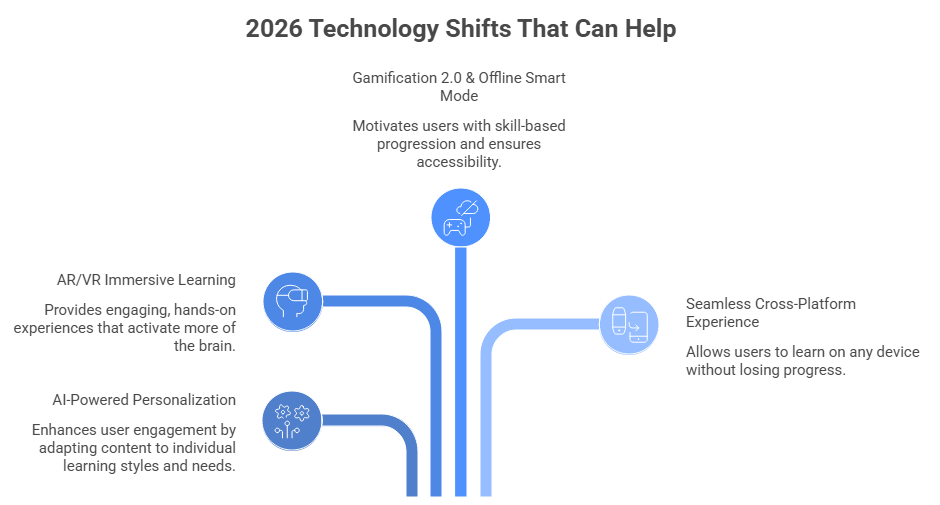
AI-Powered Personalization
The most significant shift in app development company services for EdTech is the move to adaptive learning systems. AI-driven algorithms analyze how users interact with content pacing, error patterns, session length and dynamically adjust what they see next. An app that identifies a visual learner after three sessions and prioritizes diagram-heavy content creates an experience no static library can match.
AR/VR Immersive Learning
Augmented and virtual reality have graduated from novelty to genuine pedagogical tools. Language education mobile apps now use AR to label real-world objects through a phone camera. Science apps let students conduct virtual dissections. Immersive, embodied experiences activate more of the brain than passive reading and they are far harder to scroll away from.
Gamification 2.0 and Offline Smart Mode
Next-generation gamification moves beyond surface rewards toward progression systems tied to actual skill development think narrative branches that respond to demonstrated knowledge rather than a simple badge for completing a lesson. Alongside this, AI prediction models in app development company workflows now allow apps to preload likely content during connected periods, making education mobile apps resilient to spotty connectivity. A student who studies vocabulary every evening can have tomorrow’s lesson ready before they even open the app.
Seamless Cross-Platform Experience
The modern learner is not stationary. They start a lesson on their phone at lunch, continue on a tablet at home, and check a smartwatch reminder before a meeting. Education mobile apps that sync progress seamlessly across devices including emerging AR glasses remove the friction that kills engagement between sessions.
Solving the Engagement Problem
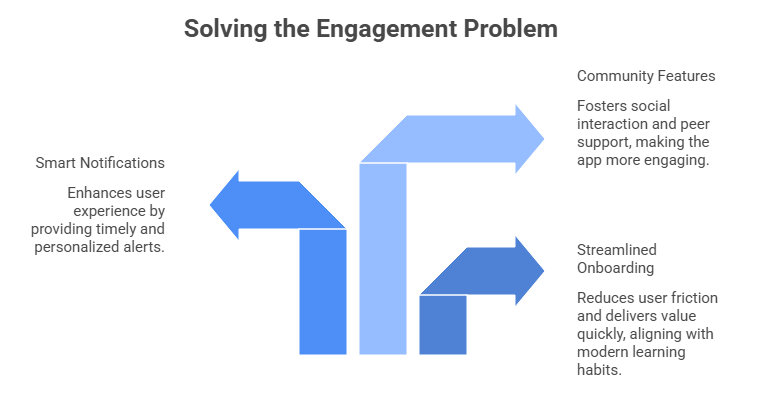
Streamlined Onboarding and Micro-Learning
Every additional onboarding step costs users. Strong app development company practice delivers value within 90 seconds of first launch progressive profiling collects user information gradually rather than all upfront. DuoLingo’s model is instructive: get users into their first lesson before asking for an account. Pair this with micro-learning modules of three to seven minutes each, and you align with how modern learners actually consume content, not how educators wish they did.
Smart Notifications and Community Features
AI-driven notifications analyze behavior to identify optimal send times and message framing for each individual user transforming push alerts from interruptions into genuine invitations. Equally powerful are social features: peer discussion forums, study groups, and real-time challenges make the education mobile app part of a learner’s social fabric. When a user has a friend waiting for them in a vocabulary battle, the app becomes much harder to abandon.
Future Outlook
Looking ahead, predictive analytics will allow education mobile apps to identify at-risk users before they churn and intervene proactively. AI tutors powered by conversational language models are beginning to replicate the most valuable aspect of one-on-one instruction: asking questions, identifying misconceptions, and adapting in real time. They don’t get impatient, don’t repeat what a learner already knows, and are available at 2 AM.
The app development company teams that integrate these capabilities thoughtfully with real user research and iterative design are positioned to define what EdTech looks like in the next decade. Better retention drives better learning outcomes, and better outcomes drive sustainable revenue.
If you want your education mobile app to be not just downloaded but loved, App Maisters can help bring 2026-ready app development company technology to your fingertips. From adaptive AI systems to AR-powered experiences, we build products users actually return to.
Final Thoughts
Here’s the truth people actually want to learn. They download your app with real intention. But if the experience fights them at every turn, they’ll close it and never come back. Clunky onboarding, information overload, and a cookie-cutter app development company thinking kills that motivation fast often before users even see what your app can really do.
The good news? The tools to fix this already exist. Adaptive AI, AR/VR, smarter notifications, seamless cross-device sync these aren’t futuristic ideas anymore, they’re available right now. The EdTech apps that win in 2026 and beyond will be the ones that treat learners like real people meeting them where they are, removing every bit of unnecessary friction, and making every session feel worth showing up for. The download is just the beginning. What happens next is everything.
And that’s exactly what App Maisters helps you build.
FAQs
Why do education apps have low retention rates?
Most education apps lose users within the first week due to poor onboarding, cognitive overload, and one-size-fits-all content. App Maisters builds adaptive EdTech solutions designed to turn first-time downloads into long-term daily habits.
How can AI improve learning app engagement?
AI-powered personalization tailors content to each learner’s pace, style, and progress dramatically improving session frequency and completion rates. App Maisters integrates adaptive AI engines that make every user feel like the app was built just for them.
What makes a good education mobile app in 2026?
A great education app in 2026 combines frictionless onboarding, micro-learning modules, smart push notifications, and cross-platform sync. App Maisters delivers all of these through cutting-edge app development company expertise built for modern learners.
How do AR and VR improve student learning outcomes?
Immersive AR/VR experiences engage more cognitive pathways than passive reading, leading to better knowledge retention and higher app return rates. App Maisters develops AR/VR-powered education apps that transform abstract concepts into unforgettable, interactive experiences.
What is the best onboarding strategy for EdTech apps?
The best EdTech onboarding delivers value within 90 seconds using progressive profiling instead of lengthy sign-up forms. App Maisters applies proven app development company best practices to ensure users reach their first meaningful moment before ever creating an account.
How does gamification affect education app retention?
Traditional badges and leaderboards boost early engagement but fade fast next-gen gamification ties rewards directly to demonstrated skill progression. App Maisters designs Gamification 2.0 systems that keep learners motivated well beyond the second week.
How do I choose the right app development company for an EdTech project?
The right partner combines deep EdTech domain knowledge with expertise in AI, AR/VR, and behavioral UX design. App Maisters is a trusted app development company that specializes in building education mobile apps users actually return to from concept to launch and beyond.