


How Can We Reduce the Risk of Data Issues During a Cloud Migration
Cloud migration is no longer a future goal, it’s a business-critical move for organizations aiming to stay competitive in an increasingly digital world. Companies are shifting to the cloud to unlock greater agility, optimize costs, and scale faster than ever before. However, as cloud adoption accelerates, so do the risks tied to one of an organization’s most valuable assets: its data. From unexpected data loss and corruption to security breaches and compliance failures, poorly managed cloud migrations can quickly turn opportunity into liability.
The good news? These risks are not unavoidable. With the right strategy, tools, and expert guidance, organizations can migrate with confidence while safeguarding their data at every stage of the journey. This guide well breaks down practical, research-backed approaches to minimizing data risks during cloud migration, explore modern best practices shaping today’s cloud landscape, and highlight how cloud consulting services play a crucial role in ensuring a secure, seamless transition.
The Rising Importance of Cloud Migration and Data Safety
Cloud migration has become a top priority for organizations worldwide as businesses accelerate digital transformation and modernize their IT ecosystems. An increasing number of enterprises are shifting workloads to the cloud to gain scalability, flexibility, and operational efficiency. However, this rapid adoption also introduces significant data-related challenges. Studies show that nearly nine out of ten organizations are impacted by data migration activities, and close to a quarter face data loss when migrations are poorly planned or executed.
At the same time, data security remains a critical concern. Cloud environments continue to attract cybercriminals, and configuration errors are among the most common causes of cloud-based data breaches. Without strong governance, visibility, and security controls, sensitive data can easily be exposed during the transition process.
These realities make it clear that minimizing data risks during cloud migration is not merely an IT responsibility it is a core business priority that directly affects operational resilience, customer trust, and regulatory compliance.
Common Data Risks in Cloud Migration and What Causes Them
Before diving into specific solutions, it’s essential to understand the most frequent causes of data issues during cloud migration:
1. Misclassification and Poor Data Governance
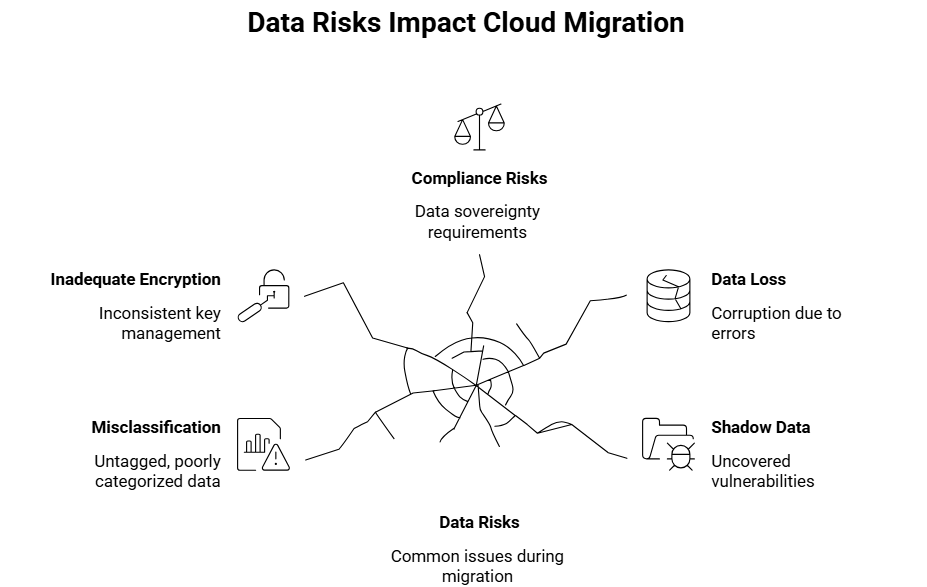
Legacy systems often contain untagged or poorly categorized data, making it difficult to apply the right security and sensitivity controls. Gartner warns that improperly classified data accounts for a significant portion of unintentional exposures during migrations.
2. Inadequate Encryption and Key Management
While encryption is standard practice, inconsistent key management increases risk when data is transferred between environments. A notable percentage of enterprises still rely on fragmented systems for key storage.
3. Regulatory Compliance Risks
With data sovereignty requirements tightening globally, especially across industries like healthcare and finance, concern over cross-border compliance is now more complex than ever.
4. Data Loss and Integrity Issues
Large-scale migrations introduce the potential for data corruption due to compatibility issues or transfer errors. Studies show that synchronization problems or incomplete transfers can leave gaps in critical datasets.
5. Shadow Data and Hidden Assets
Shadow IT—including unmanaged backups, test environments, and neglected data stores—can introduce uncovered vulnerabilities that create significant risk post-migration.
Best Practices to Reduce Data Risks in Cloud Migration
Mitigating data issues is about strategy, tools, process, and people. Here are actionable best practices to ensure a safer, smoother cloud migration.
1. Comprehensive Pre-Migration Assessment
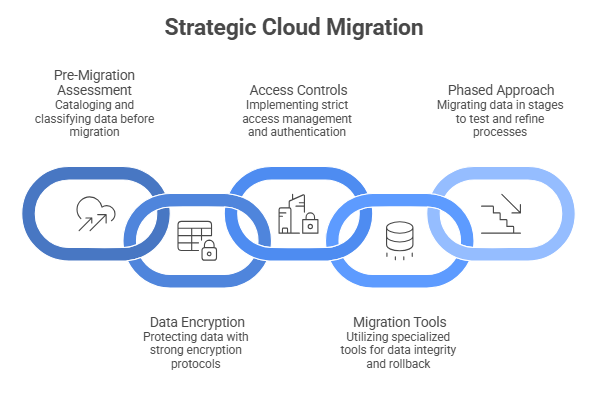
Start by cataloging existing data and classifying it based on sensitivity, compliance requirements, and business value. Knowing what you have helps you decide what to move, how, and in what order.
Key actions:
- Perform data discovery and mapping.
- Identify dependencies between applications and data stores.
- Establish a data governance framework for the migration.
2. Encrypt Data In Transit and At Rest
Strong encryption is a cornerstone of data protection. Encrypting data both during transfer and after it lands in the cloud shields it from unauthorized access.
Modern protocols such as TLS 1.3 and end-to-end encryption dramatically reduce the likelihood of interception or exposure.
3. Implement Robust Access Controls and IAM
Identity and Access Management (IAM) must be tightly controlled. Least-privilege access, role-based permissions, and multi-factor authentication (MFA) reduce the attack surface.
Best practices include reviewing access roles before migration, immediately revoking unnecessary privileges, and tracking access logs during and after the migration.
4. Use Secure and Auditable Migration Tools
Specialized cloud migration tools (e.g., AWS Migration Hub, Azure Migrate, or Google Cloud Transfer) help ensure data integrity by providing detailed transfer logs, error handling, and consistency checks.
These tools also support rollback mechanisms—allowing you to revert if something goes wrong greatly reducing the fear of unintended data loss.
5. Adopt a Phased, Tested Approach
Migrating all data at once increases risk. Instead, adopt a phased strategy:
Phased migration benefits:
- Test early with non-critical data.
- Validate integrity before moving mission-critical systems.
- Learn from early phases to refine processes.
Testing in simulated environments ensures that potential issues are discovered early and fixed before they impact business operations.
Cloud Platforms Are Driving AI Innovation
Today’s cloud platforms aren’t just storage and compute providers, they’re engines for AI transformation. Cloud environments provide the scalable infrastructure necessary for training large AI models, harnessing real-time analytics, and supporting AI-driven automation in security, monitoring, and optimization.
By leveraging cloud-native AI tools for anomaly detection, threat prediction, and automated compliance checks, organizations can proactively prevent and resolve data issues during and after migration.
Integrating AI tools into your cloud strategy can significantly enhance visibility into data flows and speed up incident response, reducing both risk exposure and operational overhead.
Automation and Continuous Monitoring: Your Safety Net
Cloud environments are dynamic. Once data is in the cloud, configurations, policies, and access rights can drift over time leading to compliance gaps and vulnerabilities.
Key strategies:
- Implement automated monitoring and alerting.
- Use Cloud Security Posture Management (CSPM) tools for ongoing oversight.
- Employ real-time dashboards to track data integrity and transfer error rates.
Automation lowers human error and ensures that your cloud estate remains secure long after the migration is complete.
The Role of Cloud Consulting Services
Cloud consulting services are vital for reducing data risks during migration. Experienced consultants bring:
- Deep technical expertise across cloud platforms.
- Risk mitigation frameworks tailored to your organization.
- Governance and compliance strategies aligned with industry needs.
- Seamless integration with existing processes and tools.
Partnering with a trusted cloud consulting partner ensures that your migration isn’t just a technical undertaking it’s a strategic business transformation.
Secure the Future with Confidence
Reducing the risk of data issues during cloud migration demands careful planning, robust security practices, and strategic execution. From encryption and identity management to phased migration and AI-enabled monitoring, each step contributes to a secure, efficient transition.
With the stakes higher than ever especially as cloud platforms fuel innovations in AI and digital services organizations need expert support more than ever. Cloud consulting services are not just helpful; they are essential to navigating complexities, safeguarding data, and maximizing the value of cloud investments.
App Maisters, with its deep expertise in cloud consulting services, stands ready to help your organization migrate securely and confidently turning cloud challenges into competitive advantage. Whether your focus is risk reduction, performance optimization, or future-proof digital transformation, App Maisters delivers the insights and execution your business needs.
FAQs
What are the biggest data risks during cloud migration?
The most common risks include data loss, security breaches, compliance violations, and misconfigurations. App Maisters helps organizations identify and mitigate these risks through structured cloud migration planning.
How can data loss be prevented during cloud migration?
Data loss can be prevented by using secure migration tools, phased transfers, and continuous validation. App Maisters ensures data integrity with proven cloud consulting services and best practices.
Why is data security important in cloud migration?
Data security protects sensitive information from breaches and unauthorized access during migration. App Maisters implements strong encryption, access controls, and monitoring to keep data secure.
How does cloud consulting help reduce migration risks?
Cloud consulting services provide expertise, governance, and risk management strategies. App Maisters guides businesses through secure cloud migrations tailored to their compliance and security needs.
What role does compliance play in cloud data migration?
Compliance ensures data meets regulatory and industry standards throughout migration. App Maisters helps organizations maintain compliance while transitioning data safely to the cloud.
Can AI and automation reduce cloud migration data issues?
Yes, AI-driven monitoring and automation can detect anomalies and configuration errors early. App Maisters leverages modern cloud platforms to enhance visibility and reduce migration risks.
Why choose App Maisters for cloud migration services?
App Maisters combines technical expertise, security-first strategies, and scalable cloud consulting services to deliver secure, reliable, and future-ready cloud migrations.