


Vibe Coding reveals how AI is transforming Application development in 2026
Have you ever had a powerful app idea but delayed building it because you lacked the time, budget, or a full development team?
With Vibe Coding, you can build applications simply by describing what you want in plain English and AI generates the code for you. Instead of writing thousands of lines of syntax or managing complex frameworks, you focus on outcomes, features, and user experience while AI handles the technical implementation.
As businesses face increasing pressure to innovate faster and release products quicker, AI-powered development tools are seeing rapid adoption. Vibe Coding enables rapid prototyping, shorter feedback cycles, and smarter experimentation without heavy upfront investment.
It’s not about replacing developers; it’s about empowering them. In this human-in-the-loop model, AI drafts the code, and developers refine, validate, and optimize it unlocking a faster, more agile future for application development.
What Is Vibe Coding?
In the rapidly evolving world of application development, Vibe Coding has emerged as a groundbreaking concept. It allows developers to create apps by describing their desired outcomes in plain English. AI-powered tools then translate these descriptions into executable code. Gone are the days when developers had to write code line by line. With Vibe Coding, you can now focus on what you want to build, while AI handles the heavy lifting of writing the code.
Vibe Coding essentially turns the app development process into a conversational interaction. This eliminates the need for deep technical knowledge, empowering non-technical people such as business owners, designers, and marketers to contribute to app creation.
Where Did Vibe Coding Come From?
Vibe Coding was introduced in February 2025 by computer scientist Andrej Karpathy, who made a tweet about it that gained massive traction in the tech community. The concept is grounded in Natural Language Processing (NLP), which enables AI systems to understand human instructions and generate relevant code.
The rise of Large Language Models (LLMs), such as GPT-4, laid the foundation for Vibe Coding to thrive, providing the technology necessary for such AI-driven code generation. As AI models continued to advance, Vibe Coding gained momentum, and its applications in app development began to take shape.
How Is Vibe Coding Different From Traditional Software Development?
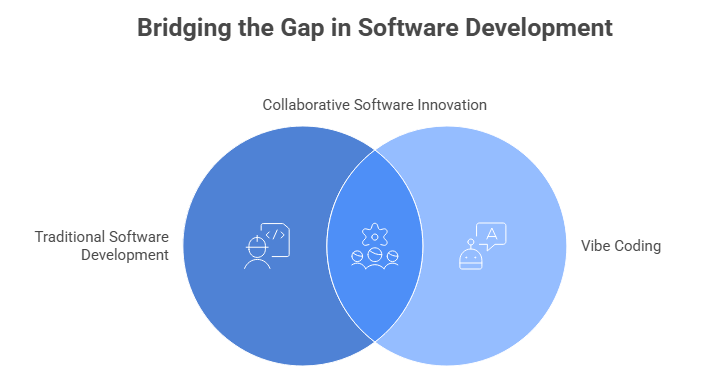
Traditional software development relies heavily on manual coding, where developers must write precise lines of code, define functions, and ensure technical architecture is sound. It’s a meticulous process that demands deep technical knowledge, including expertise in programming languages, frameworks, and algorithms.
Vibe Coding, however, flips the traditional approach. Instead of focusing on the “how” (writing code), it focuses on the “what” describing the desired behavior of the app. AI takes care of generating the code, while developers can guide, review, and refine the AI’s output.
Aspect | Traditional Development | Vibe Coding |
Development Approach | Structured, process-driven, and manual | Intent-driven, conversational, rapid iteration |
Technical Requirements | Deep knowledge of programming languages and frameworks | Knowledge of user expectations and prompt writing |
Code Generation | Written manually by developers | Generated by AI from plain language descriptions |
Focus Area | Focus on structural correctness and long-term scalability | Speed, experimentation, and rapid validation of ideas |
Scalability | Suitable for complex, long-term projects | Ideal for prototyping and MVPs |
Vibe Coding offers speed and agility, making it perfect for rapidly testing new ideas and prototyping apps. It reduces the friction between business teams and developers, enabling faster, more efficient collaboration.
Why Vibe Coding Matters Now
The demand for faster app development has never been higher. In today’s fast-paced tech landscape, companies need to rapidly develop, test, and release apps to stay ahead of the competition. Vibe Coding addresses this demand in several key ways:
- Shorter Development Cycles: Traditional app development can take months, but with Vibe Coding, developers can generate a basic version of an app within days.
- Increased Innovation: With less time spent writing code, teams can focus more on experimenting with new features and improving user experiences.
- Democratizing App Development: Vibe Coding enables non-technical founders, marketers, and other business stakeholders to create functional prototypes without relying on developers, lowering the barrier to entry.
By 2026, Vibe Coding will be a critical tool for businesses that want to stay agile, reduce development costs, and create apps that respond quickly to shifting market demands.
How to Implement Vibe Coding
If you’re interested in implementing Vibe Coding, here’s a step-by-step guide to get started:
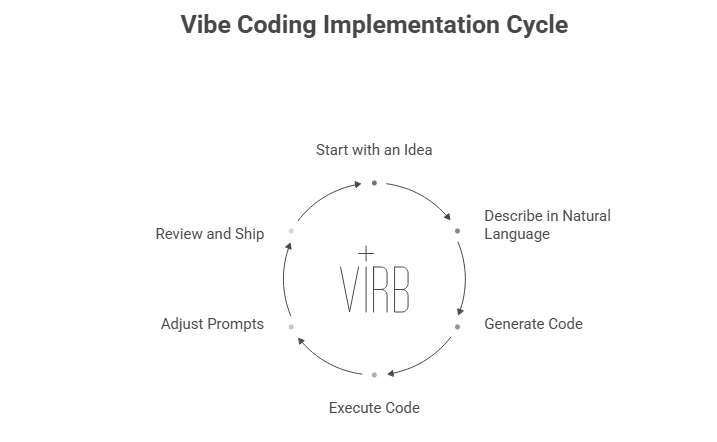
Start with an Idea
The foundation of any app is a clear understanding of the problem you’re solving. Before jumping into the development process, define what you want the app to achieve. For example, you may want to build an app that helps users track their fitness progress or a dashboard that displays real-time sales data.
Describe What You Want to Build in Natural Language
Once you have a clear idea, describe the app in simple, human-friendly language. The more specific your instructions, the better. For instance, instead of saying, “I want a fitness app,” say something like, “I want a fitness app that allows users to track their workouts, view progress over time, and set fitness goals.”
Let AI Generate the First Draft of Code
AI tools will use the natural language description to generate the first draft of your app. Think of this as a rough prototype it won’t be perfect, but it will provide a solid foundation to build on.
Execute the Code
Run the code in a real-world environment to see how it performs. During this phase, you’ll identify bugs, usability issues, and other improvements that need to be made.
Adjust and Refine Your Prompts
As you test the app, continue to interact with the AI by refining your prompts. This iterative process will help you adjust the features, improve functionality, and fix bugs.
Review and Ship
Before launching your app, conduct thorough reviews, perform security checks, and test its scalability. Once the app is polished and ready, deploy it to your users.
What Are the Challenges of Vibe Coding and How to Address Them?
While Vibe Coding brings immense benefits, there are challenges that need to be addressed to ensure long-term success:
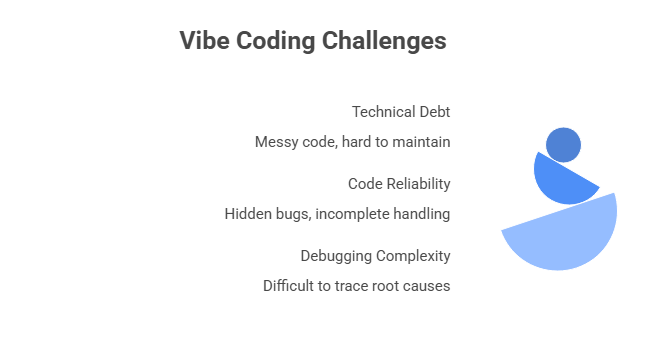
1. Technical Debt
Because Vibe Coding accelerates development by generating quick prototypes, the code can sometimes be messy, leading to technical debt. Inconsistent architecture, incomplete documentation, and fragile code can make it harder to maintain the app as it grows.
2. Maintaining Code Reliability
AI-generated code may include hidden bugs or incomplete edge case handling. Frequent changes to the app can break previously working features.
3. Debugging Complexity
With AI generating the code, developers may find it difficult to trace the root causes of bugs, especially when the code is large and complex.
Why Vibe Coding Needs Strong QA
Quality assurance (QA) plays a crucial role in the Vibe Coding ecosystem. Since Vibe Coding emphasizes speed, the generated apps may prioritize basic functionality over robustness and edge case handling. This makes QA even more critical to ensure that apps perform as expected under various conditions.
With AI-powered testing tools like CoTester, you can ensure that Vibe-coded apps are thoroughly tested before launch. These tools help detect bugs, validate user flows, and simulate real-world scenarios.
How AI-Powered Testing Can Help Validate Vibe Code
AI-powered testing platforms can continuously monitor code quality, adapt to changes, and ensure that your app performs optimally. Automated testing tools can run functional tests, regression tests, and exploratory tests to identify any issues early on.
By implementing shift-left testing and continuous integration, businesses can catch bugs before they affect users, maintaining high-quality standards in Vibe-coded apps.
Wrapping Up
Vibe Coding is reshaping how applications are built by enabling faster, more intuitive development processes. As AI continues to evolve, Vibe Coding will only become more powerful, offering exciting opportunities for businesses, startups, and non-technical professionals to create innovative apps quickly. With the right tools, like App Maisters, and a strong emphasis on testing and quality assurance, the future of app development is incredibly bright.
Embrace the future of app development with Vibe Coding and let App Maisters guide you on this exciting journey!
FAQs
What is Vibe Coding in 2026?
Vibe Coding is an AI-driven development approach where you describe app features in plain English, and AI generates the code. App Maisters helps businesses implement Vibe Coding with structured development and testing support.
How does AI help in application development?
AI automates code generation, debugging, and testing, reducing development time and effort. App Maisters leverages AI-powered tools and agentic testing to ensure faster and more reliable app delivery.
Is Vibe Coding replacing traditional developers?
No, Vibe Coding enhances developers’ productivity rather than replacing them. At App Maisters, AI works alongside expert developers to refine, optimize, and scale applications effectively.
Can non-technical founders build apps using Vibe Coding?
Yes, non-technical founders can create prototypes using AI prompts. App Maisters supports founders by turning vibe-coded ideas into secure, scalable, production-ready applications.
What are the challenges of Vibe Coding?
Common challenges include technical debt, debugging complexity, and reliability issues. App Maisters addresses these through continuous integration, structured code reviews, and advanced QA practices.
Is Vibe Coding suitable for enterprise applications?
Vibe Coding is ideal for rapid prototyping and MVPs. App Maisters ensures enterprise-grade scalability, security, and performance when transitioning vibe-coded apps into full-scale solutions.
How can I test a vibe-coded app effectively?
Testing requires automated regression, functional validation, and real-world simulations. App Maisters implements AI-powered agentic testing to validate performance, security, and user experience before launch.