


Mobile App Development Explained: The Ultimate Step by Step Guide
The world of mobile apps has completely transformed the way we connect, work, and entertain ourselves. What started as simple games like Temple Run has now evolved into a booming industry that powers everything from social media platforms to business solutions. Whether you’re planning to create an app for your business or want to launch your own product, understanding the mobile app development process is crucial.
In this app development guide, we’ll break down the entire mobile app creation journey into digestible steps, from brainstorming your idea to launching your app on iOS or Android. You’ll also get to know about the 4 main approaches to mobile app development and industry trends to keep in mind.
Let’s dive into the app development steps, key stats, and practical insights that will help you build a winning mobile app.
Key Mobile App Development Statistics You Should Know
Before we explore the mobile app development process, let’s take a look at some powerful stats to highlight the app market’s scale:
- Mobile app revenue will exceed $935 billion, making the app industry one of the most lucrative markets.
- 1.96 million apps are available for download on the Apple App Store.
- 2.87 million apps are available on Google Play Store.
- On average, smartphone owners use 10 apps daily and up to 30 apps monthly.
- Around 49% of people open an app at least 11 times a day.
These statistics emphasize the importance of creating an app that is not only useful but also engaging enough to capture user attention in a saturated market.
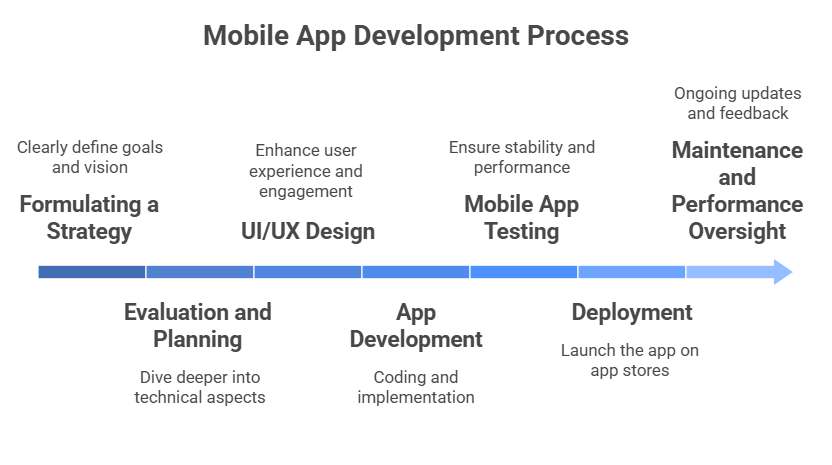
Step 1: Formulating a Strategy
The first step in any successful app development project is formulating a strategy. At this stage, you should clearly define the goals and vision for your app. Consider these essential questions:
- What problem does your app solve?
- Who are your target users?
- What features will your app offer to meet their needs?
By answering these questions, you’ll begin to sketch a roadmap that aligns with your app’s objectives. Creating an MVP (Minimum Viable Product) can help you stay focused on core functionalities while testing your concept before investing in full-scale development.
Competitor Analysis
Before proceeding, it’s also important to understand the competitive landscape. Are there other apps that address similar needs? How well are they performing? Competitor research helps you identify opportunities to innovate and differentiate your app from existing solutions.
Choose the Right Platform
Deciding whether to develop a native app for Android or iOS, or go with a cross-platform solution, is a crucial choice. Native apps tend to provide superior performance, but cross-platform apps can be more cost-effective and time-efficient.
Monetization Strategy
For consumer-focused apps, determining how you will monetize your app is a key decision. Common monetization strategies include:
- In-app purchases
- Subscription models
- In-app advertisements
Your choice of monetization will depend on your app’s purpose. For instance, a social networking app may rely on ads and subscriptions, while a game might generate revenue through in-app purchases.
Step 2: Evaluation and Planning
Once you have a strategy in place, the next step is evaluation and planning. This is when you dive deeper into the app’s technical aspects.
Define Functional and Non-Functional Requirements
Functional requirements are the features and actions that your app will perform (e.g., user authentication, search functionality). Non-functional requirements, on the other hand, are related to the app’s performance, such as its speed, security, and reliability.
Set the Project Path
Create a clear development plan with milestones and timelines. A Minimum Viable Product (MVP) should be prioritized to ensure the key features are implemented first, helping you launch faster and test your app in real-world conditions.
Select the Technology Stack
Choosing the right technology stack is crucial. Whether you need an iOS developer, a cross-platform framework like React Native, or a more complex solution like Flutter or Xamarin, the tech stack impacts the performance and scalability of your app.
Step 3: UI/UX Design
The design phase is one of the most important steps in the app development process. A well-designed app can elevate user experience (UX) and enhance engagement.
Structure Information and Processes
Begin by outlining the information architecture how users will interact with your app and navigate through its features. You can use tools like flowcharts to visualize user journeys.
Wireframes and Mockups
Wireframes are blueprints of your app, showing its layout and flow. After that, mockups will bring the visual design to life, including elements like buttons, fonts, and color schemes.
Prototypes
Prototypes are interactive models that give you a feel of the final app’s user experience. This is your chance to identify any design flaws before moving into development.
Step 4: App Development
Once the design is approved, it’s time to start coding. The development process consists of two main parts: Frontend (UI) and Backend (Server-side) development.
Frontend Development
Frontend development focuses on the parts of the app that users interact with. Depending on the platform, you’ll either create:
- Native Apps: Developed specifically for iOS or Android.
- Cross-Platform Apps: Use a single codebase for both platforms (e.g., React Native).
- Hybrid Apps: Combine web-based elements and native code to run on multiple platforms.
Backend Development
The backend consists of databases, servers, and APIs that support the app’s functionalities. This part handles tasks like data storage, authentication, and interactions between the user interface and the database.
Step 5: Mobile App Testing
Testing ensures that your app is stable, secure, and performs well across devices. Testing can be categorized into:
- Functional Testing: Ensures that the app’s features work as intended.
- Security Testing: Safeguards against security vulnerabilities.
- Performance Testing: Measures the app’s responsiveness and load speed.
- Compatibility Testing: Ensures the app functions well on different devices and operating systems.
Remember, testing is critical for a positive user experience and app performance.
Step 6: Deployment
When your app is ready for the market, it’s time for deployment. For iOS apps, you’ll submit your app to the Apple App Store, and for Android, you’ll use Google Play Store. Keep in mind that each platform has specific guidelines and approval processes that your app needs to meet.
Step 7: Maintenance and Performance Oversight
Once the app is live, ongoing maintenance is crucial for its success. This includes regular updates, fixing bugs, and responding to user feedback. Key performance indicators (KPIs) like user retention, active users, and customer lifetime value should be monitored to evaluate your app’s success.
The 4 Main Approaches to Mobile App Development
There are four primary methods of building mobile apps:
- Native App Development: Best for high-performance apps with complex features, as it offers the best speed and integration with the device.
- Hybrid App Development: Combines native and web technologies, providing a balance between cost and performance.
- Cross-Platform App Development: Allows developers to write one codebase for both Android and iOS, reducing time and cost.
- Progressive Web Apps (PWAs): Web-based apps that provide a native app-like experience without requiring installation.
Why Choose App Maisters for Your App Development Journey?
Bringing your app idea to life isn’t just about coding it’s about creating an experience that resonates with your users. At App Maisters, we understand that every app is unique, and we’re here to help you navigate the entire mobile app development process with ease and confidence.
From the initial brainstorming session to the final deployment and post-launch maintenance, we treat your vision as our own. Our team of experienced designers, developers, and project managers will work closely with you to ensure your app not only meets but exceeds your goals. Whether you’re aiming for a high-performance native app, a cross-platform solution, or an innovative progressive web app, we’ve got you covered.
With our expertise in custom mobile app development, advance security, and the latest trends, we deliver apps that stand out in the competitive app marketplace. And we don’t stop there App Maisters continues to support you long after launch, ensuring your app remains relevant, secure, and optimized for performance.
So, if you’re ready to transform your idea into a successful app, there’s no better time to get started than now. Let’s make your app vision a reality! Reach out to App Maisters today and see how we can help you navigate the exciting world of mobile app development with confidence.
FAQs
What is the mobile app development process?
The app development process includes strategy, design, development, testing, and deployment. At App Maisters, we guide you through each stage to build a successful app.
How long does it take to develop a mobile app?
App development time varies by complexity. A basic app can take 3-6 months, while complex apps may take longer. App Maisters helps streamline the process for faster delivery.
What types of mobile apps can App Maisters build?
App Maisters develops Native, Cross-Platform, Hybrid, and Progressive Web Apps (PWAs) based on your needs and budget.
How do I choose the right platform for my app?
App Maisters helps you decide between Native or Cross-Platform development based on your goals, performance needs, and budget.
What is an MVP (Minimum Viable Product)?
An MVP is a basic version of your app with essential features. App Maisters helps you create and test an MVP to gather feedback before full development.
How do I monetize my mobile app?
App Maisters offers various monetization strategies, including in-app purchases, subscriptions, and ads, depending on your app’s goals.
Why choose App Maisters for mobile app development?
App Maisters provides expert guidance through the entire app development process, from idea to launch, ensuring your app stands out in the market.