


AI Predictive Analytics: An Executive Guide to Driving Proactive Growth
The business world has fundamentally changed. We’ve moved from reacting to what happened yesterday to predicting what will happen tomorrow. If you’re not leveraging AI predictive analytics yet, your competitors likely are and they’re gaining a substantial advantage.
We have spent the last decade helping organizations transform their decision-making processes through intelligent data strategies. What we have learned is this: the most successful companies aren’t faster at responding to problems. They’re better at seeing them coming.
That’s where AI predictive analytics comes in.
Understanding AI Predictive Analytics
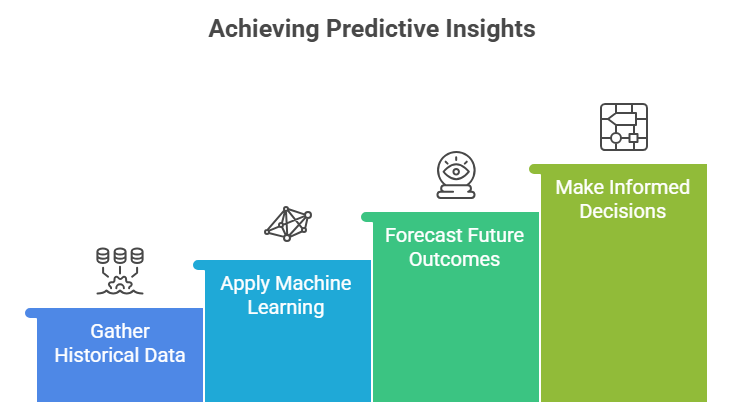
Let me be direct: AI predictive analytics isn’t some mysterious black box reserved for tech companies. At its core, it’s about using historical data and machine learning algorithms to forecast future outcomes with remarkable accuracy.
Think of it this way. Traditional business intelligence tells you what happened and why. Predictive analytics tells you what’s about to happen and what actions you should take now.
Here’s a practical example: A retail company can use historical sales data, seasonality patterns, customer behavior, and market trends to predict which products will fly off shelves next quarter—and adjust inventory accordingly. Rather than guessing or waiting for stock-outs, they’re making informed decisions months in advance.
Machine learning powers this transformation by identifying complex patterns in your data that humans would miss. The algorithms improve over time, becoming smarter with each new data point.
Key Business Benefits That Matter
When we implement predictive AI solutions for our clients, the results speak for themselves. Here are the business outcomes that consistently drive ROI:
- Revenue Acceleration: Predictive models help identify high-value customers before they become major revenue drivers. You can allocate resources to the opportunities with the highest conversion probability, not just the loudest ones.
- Risk Mitigation: Churn prediction, fraud detection, and supply chain disruptions don’t catch you off guard. Instead, you have weeks or months to intervene with retention strategies, security measures, or alternative sourcing.
- Operational Efficiency: From optimizing maintenance schedules to right-sizing workforce planning, AI business intelligence eliminates the waste of over-provisioning and the pain of under-resourcing. One manufacturing client reduced downtime by 30% in their first year.
- Customer Experience Improvements: Predictive personalization means your customers see what they actually want when they want it. This isn’t creepy; it’s helpful. And it drives loyalty.
- Cost Reduction: Whether it’s reducing customer acquisition costs, minimizing waste, or optimizing logistics, the savings compounds. Most organizations see measurable cost reductions within 6-12 months of implementation.
Real-World Applications Across Industries
Let me share some scenarios I’ve witnessed firsthand that show the practical power of these approaches:
Financial Services
A mid-sized credit union used AI Transformation to revolutionize their lending process. By analyzing thousands of historical loan applications and outcomes, they built predictive models that identify creditworthy customers that traditional scoring systems overlook. The result? Better loan performance, happier customers, and expanded market reach.
Healthcare
Hospitals are using predictive analytics to forecast patient no-shows and readmission risks. One health system predicted which patients would likely miss appointments with 78% accuracy, allowing them to send targeted reminders and reduce costly no-show rates by 22%.
E-Commerce
Demand forecasting has always been crucial for online retailers. Now, companies combine historical sales, website traffic, social sentiment, and seasonal factors into sophisticated models. This prevents both overstocking and stockouts two problems that destroy margins.
Manufacturing
Predictive maintenance is transformative here. Instead of replacing equipment on a schedule, companies predict failures based on sensor data and operating patterns. Maintenance happens when needed, not before or after. Equipment lifespan extends, and emergency repairs disappear.
Telecommunications
Churn prediction in telecom is straightforward but impactful. Identify customers likely to switch providers three months before they leave, and retention offers become surgical, not shotgun. One carrier reduced churn by 15% through targeted interventions.
The Honest Conversation About Challenges
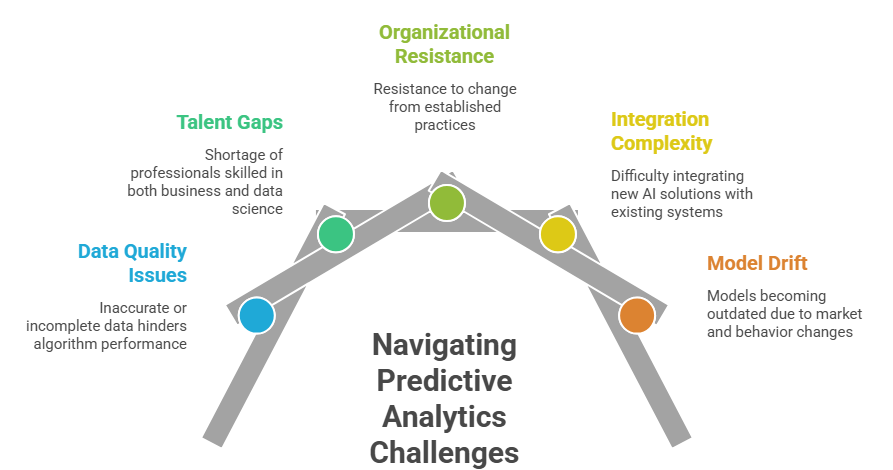
I wouldn’t be serving you well if I painted a rosy-only picture. Implementation of predictive analytics tools comes with real obstacles:
- Data Quality Issues: Your algorithms are only as good as your data. Dirty data, incomplete records, and inconsistent formats create blind spots. Most organizations spend 40-60% of project time on data preparation and it’s necessary work.
- Talent Gaps: Finding people who understand both business strategy and data science is genuinely difficult. You need translators people who can bridge the gap between technical teams and executive decision-makers.
- Organizational Resistance: “But we’ve always done it this way” is more powerful than it should be. Change management is often the limiting factor, not the technology. Executives who champion this work must actively manage cultural shifts.
- Integration Complexity: Your predictive AI solutions need to live within your existing systems. Legacy infrastructure, siloed departments, and outdated APIs create friction. Budget for integration costs they’re real.
- Model Drift: Markets change. Customer behavior evolves. Models that worked brilliantly three years ago become stale. Continuous monitoring and retraining are non-negotiable.
Implementation Best Practices That Actually Work
Here’s what separates successful deployments from expensive failures:
- Start with Business Problems, Not Technology: Identify your most painful business challenge first. Then evaluate whether predictive analytics solves it. Too many organizations fall in love with the technology and retrofit a business case afterward. That’s backwards.
- Build with Your Best Data First: Don’t boil the ocean. Choose a high-priority use case with clean, available data. Prove value, build momentum, then expand. One successful project builds organizational appetite for the next three.
- Invest in AI Consulting Early: Whether internal or external, get experienced guidance before you’re deep in implementation. A good AI consultant prevents costly mistakes and accelerates your time-to-value by months.
- Make Models Explainable: If your executives can’t understand why the model recommends a decision, they won’t trust it. Interpretability matters more than raw accuracy in business applications. Demand transparency.
- Create Feedback Loops: Once models are live, performance monitoring isn’t optional—it’s essential. Track how predictions actually play out, retrain regularly, and continuously improve.
- Foster Cross-Functional Teams: Your best implementations blend data scientists, business analysts, IT, and operational leaders. Siloed expertise fails. Collaboration wins.
Looking at Tomorrow’s Landscape
The AI Transformation journey is far from complete. Here’s what’s emerging:
Real-time predictive models are becoming standard. Rather than batch forecasts, organizations will make decisions on live, streaming data. A customer could churn in the next 24 hours and you’ll know it immediately.
Automated machine learning (AutoML) will democratize these capabilities. You won’t need a PhD in statistics to build solid models. This expands access dramatically.
Ethical AI and regulatory compliance will become competitive differentiators. Organizations that embed fairness and transparency into their AI business intelligence solutions will earn trust and avoid costly regulatory issues.
Edge AI will bring predictions closer to customers. Rather than sending data to distant servers, smart predictions will happen right where decisions matter most.
The Bottom Line
AI Predictive Analytics isn’t a “nice to have” anymore. It’s a strategic imperative for organizations serious about sustainable competitive advantage.
The companies that master these capabilities in the next 18-24 months will establish lead positions that are hard to catch. Those that delay will find themselves perpetually reactive, losing ground to smarter competitors.
The good news? The technology is mature. The tools are proven. Success stories abound across every industry. What separates winners from laggards is simply the decision to start—deliberately, thoughtfully, and with proper guidance.
If you’re ready to move beyond gut-feel decision-making into a world of data-driven confidence, the time is now.
Ready to explore how AI predictive analytics could transform your organization? Our AI consulting services help executives implement predictive solutions that drive measurable business outcomes. Let’s talk about your specific challenges.
App Maisters specializes in AI Transformation for mid-market and enterprise organizations. Our experienced consultants help you implement predictive analytics tools and machine learning solutions that accelerate growth and minimize risk. Learn more about our AI services here.
FAQs
What's the difference between predictive analytics and business intelligence?
Business intelligence shows what happened (historical trends), while predictive analytics forecasts what will happen next (future outcomes). BI answers “Why did revenue drop?” while predictive analytics answers “Which customers will churn next quarter?” App Maisters integrates both to give you complete decision-making power.
How long does predictive analytics implementation take?
Proof of concept typically takes 6-12 weeks, while full-scale AI Transformation deployment ranges from 4-9 months. App Maisters prioritizes data preparation upfront to ensure solid foundations, reducing your time-to-value and improving prediction reliability.
How accurate can predictive analytics be?
Modern machine learning models achieve 75-95% accuracy depending on use case and data quality. App Maisters focuses on ROI-driven accuracy predictions that directly improve your bottom line—rather than just optimizing statistical metrics.
Which industries benefit most from predictive analytics?
Every industry benefits financial services, retail, healthcare, manufacturing, and telecom see exceptional ROI through churn prediction, demand forecasting, fraud detection, and predictive maintenance. App Maisters specializes in deploying predictive AI solutions across sectors with proven, industry-specific playbooks.
Do I need data scientists to implement predictive analytics?
Not necessarily you have options: build in-house (expensive/slow), use AutoML tools (faster), or partner with AI consulting firms like App Maisters (fastest ROI). Most executives choose the partner approach to leverage specialized expertise without years of talent acquisition.
What's the cost of implementing predictive analytics?
POCs range from $50K-$150K, single-use deployments $150K-$500K, and enterprise programs $500K-$2M+. The real question isn’t cost but ROI most App Maisters clients recover initial investment in 12-18 months through revenue gains and cost savings.
How do I start with predictive analytics if I'm new to it?
Identify a high-impact business problem, audit your data, define success metrics, then get expert guidance from AI Transformation consultants like App Maisters. Start with a POC to prove value, then scale that’s how successful predictive analytics tools deployments work.