


AI-Enhanced AR & VR Mobile Apps Transforming User Engagement
In 2026, AI-enhanced AR and VR mobile apps are no longer just futuristic concepts — they’re a reality that’s reshaping the mobile app development landscape. Augmented Reality (AR) and Virtual Reality (VR) are being turbocharged by Artificial Intelligence (AI) to create immersive experiences that are more personalized, adaptive, and engaging than ever before.
As AI continues to improve the way we interact with mobile apps, businesses that integrate these advanced technologies can see exponential growth in user engagement. Whether it’s a retailer using AR to offer a virtual fitting room experience or a healthcare provider using VR to conduct remote surgeries, the possibilities are vast and growing rapidly.
In this article, we’ll dive into how AI in AR/VR is revolutionizing mobile apps in 2026, the benefits for both businesses and users, and why investing in AI-powered immersive technology is no longer optional but essential for future mobile app development.
The Rise of AI-Enhanced AR & VR Mobile Apps
Augmented Reality (AR) and Virtual Reality (VR) have already gained significant traction in industries like gaming, healthcare, education, and retail. However, the integration of AI into these technologies is enhancing their capabilities, enabling more intuitive, responsive, and personalized experiences for users.
What is AI in AR & VR?
AI in AR and VR refers to the use of machine learning algorithms, natural language processing (NLP), and computer vision to improve the performance and usability of AR and VR apps. These AI algorithms enable these applications to understand user behaviors, make real-time adjustments, and predict what actions the user will take, creating seamless and intelligent immersive experiences.
By infusing AR and VR apps with AI, developers can make these experiences not only more interactive but also more adaptive to the user’s preferences and behaviors. As a result, user engagement skyrockets, giving rise to new opportunities for brands and businesses to connect with their audiences in innovative ways.
Key Trends in AI-Enhanced AR & VR Mobile Apps
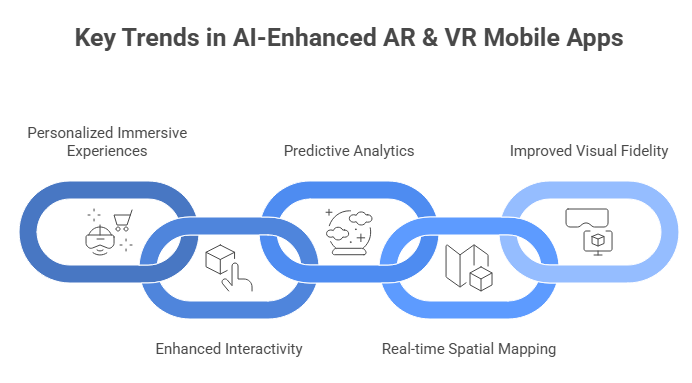
Personalized Immersive Experiences
- AI allows for real-time analysis of a user’s actions and environment, enabling apps to deliver tailored content based on individual preferences. Whether it’s virtual shopping experiences or AR-driven interior design apps, users enjoy experiences that cater to their specific needs and desires.
- According to a 2025 report by Statista, the global market for AI in AR/VR is expected to reach $50.9 billion by 2026, showing the growing significance of this innovation in mobile app development.
Enhanced Interactivity and Natural Interfaces
- With the power of computer vision and NLP, AI can enable voice and gesture control in AR/VR apps. Users no longer need physical controllers; they can interact with virtual environments just by using their hands or voice commands. This intuitive interaction boosts user engagement significantly and helps break down barriers to adoption for tech-savvy and non-tech-savvy users alike.
Predictive Analytics and Smart Recommendations
- AI algorithms analyze user behavior to predict actions and offer personalized recommendations. For instance, in a virtual store, AI can suggest products that align with the user’s preferences, making the shopping experience more engaging and customized.
Real-time Spatial Mapping
- AI helps AR apps enhance real-time spatial awareness, allowing users to experience dynamic content based on the physical world around them. In VR apps, AI can create realistic environments that respond and adapt to users’ movements, making these experiences more authentic and immersive.
Improved Visual Fidelity
- AI can enhance the visual quality of AR and VR apps by optimizing image rendering in real-time. It helps overcome challenges such as latency and lag, providing users with smoother experiences even on lower-end mobile devices.
The Role of AI in Building AR & VR Mobile Apps
For a mobile app development company, integrating AI into AR/VR apps involves more than just embedding algorithms. It requires a nuanced approach to how the apps interact with users and their surroundings. Let’s take a deeper dive into how AI is actively being utilized in the development of mobile apps.
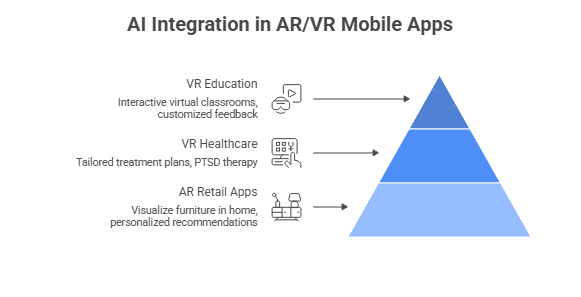
1. AI in AR-Enabled Retail Apps
AI-powered AR apps are revolutionizing the retail sector. For example, apps like IKEA Place use AR to allow users to visualize how furniture will look in their homes. The AI algorithms analyze room dimensions, adjust the furniture scale, and provide recommendations based on user preferences, offering an incredibly personalized shopping experience.
According to a survey by Deloitte, 58% of consumers said they would be more likely to purchase products from an app that used AR technology, showing that integrating AI in these apps can increase conversion rates and user engagement.
2. AI in VR for Healthcare
In healthcare, AI-driven VR applications have shown tremendous promise in medical training, patient rehabilitation, and mental health therapies. AI helps tailor treatment plans based on the patient’s progress, providing a more personalized and effective approach.
For instance, AI-based VR therapies for PTSD use real-time data to adjust scenarios in the virtual environment to help patients confront and overcome their fears. As the virtual world adapts to the patient’s responses, the healing process becomes more intuitive and less intimidating.
3. AI in VR for Education
Virtual classrooms powered by AI and VR are making education more interactive. AI-based systems analyze how students interact with content in a VR environment and offer customized feedback to enhance learning outcomes. For example, VR medical simulations use AI to track students’ progress, ensuring they are mastering the skills needed for real-world applications.
The Future of AI-Enhanced AR & VR Mobile Apps in 2026 and Beyond
Looking ahead to 2026, mobile app innovation will be dominated by AR, VR, and AI technologies. With the advent of 6G and improved edge computing, developers will have access to faster data processing, allowing AR and VR apps to become even more sophisticated and dynamic.
1. 6G and the Future of Immersive Experiences
The rollout of 6G networks will play a pivotal role in unlocking the full potential of AI-enhanced AR and VR apps. With ultra-low latency and high-speed internet, the real-time data processing required for complex AI and immersive AR/VR experiences will be seamless, giving users lifelike and uninterrupted experiences. According to Qualcomm, 6G will increase the speed of AR/VR applications by up to 100 times, making it an essential tool for future mobile app development.
2. AI in AR/VR for Remote Work and Collaboration
The future of remote work will be greatly enhanced by AI-powered AR and VR applications. Virtual meeting spaces, powered by AI, will enable more interactive and lifelike communication, breaking down geographical barriers. AI will be used to tailor virtual environments to each participant, enhancing collaboration and engagement.
3. Immersive Entertainment
The gaming and entertainment industry will continue to be a major driver of AR, VR, and AI innovation. From interactive VR games to AI-curated virtual concerts, users can expect highly immersive experiences that push the boundaries of what we consider entertainment.
Final Words
As we move into 2026, the fusion of AI with AR and VR is no longer a distant vision, but a rapidly growing trend that is transforming user engagement across industries. From personalized retail experiences to revolutionizing education and healthcare, AI-powered AR and VR apps are reshaping how users interact with technology. For businesses and developers, upgrading mobile apps with AI-enhanced AR and VR capabilities will be critical for staying competitive and delivering innovative, immersive experiences.
To leverage this powerful combination of AI, AR, and VR, businesses must partner with a forward-thinking mobile app development company like App Maisters. Their expertise in building cutting-edge, AI-driven mobile apps ensures that your app stays ahead of the curve and provides users with the immersive experiences they demand. Get ready for the next era of mobile app innovation start upgrading your app today and embrace the future of AI-enhanced AR & VR for 2026 and beyond!
FAQs
How does AI improve AR and VR apps developed by App Maisters?
App Maisters enhances AR and VR apps using AI to provide real-time analysis of user behavior, personalize content, and improve interactivity. AI also optimizes visual fidelity, predictive analytics, and adaptive environments, creating seamless user experiences.
What are some real-world applications of AI in AR and VR by App Maisters?
App Maisters uses AI in AR and VR to transform industries like retail (virtual try-ons), healthcare (VR therapies), and education (virtual classrooms) by crafting highly personalized and immersive experiences that cater to specific user needs.
What role does AI play in mobile app development at App Maisters?
At App Maisters, AI enables the creation of intuitive, responsive, and engaging AR/VR apps by leveraging machine learning, computer vision, and natural language processing to tailor apps to user actions, preferences, and behavior patterns.
How will 6G technology impact AR and VR apps by App Maisters?
With 6G technology, App Maisters will be able to develop AR and VR apps with ultra-low latency and faster data processing, delivering highly realistic, seamless, and dynamic immersive experiences to users in real time.
Can AI in AR/VR apps from App Maisters increase user engagement?
Yes! By utilizing AI algorithms, App Maisters crafts AR and VR apps that personalize experiences, predict user actions, and offer tailored content, leading to higher user satisfaction and increased engagement.
How are AI and VR used in healthcare apps by App Maisters?
App Maisters leverages AI-driven VR applications in healthcare for personalized therapy, medical training, and rehabilitation. These apps adapt to users’ needs, offering customized treatments for conditions like PTSD and enhancing the learning experience for medical students.
What does the future hold for AI-enhanced AR and VR apps developed by App Maisters?
By 2026, App Maisters will continue pushing the boundaries of AR and VR apps with AI, using advanced 6G technology to create even more lifelike virtual environments, enhance remote work experiences, and deliver immersive entertainment options for users.